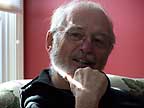
Paul Shanley hopes for a retrial (photo courtesy of Teresa Shanley)
|
 |
By
Jim D'Entremont
On November 9, 2007, a new trial motion was filed at Middlesex Superior Court in Cambridge, Massachusetts, on behalf of Paul Shanley, 77, a former Roman Catholic priest now serving
a 12- to 15-year sentence for sexual crimes he is said to have committed in the 1980s.
In one of several affidavits supporting the ex-priest's motion for a retrial, Dr. R. Christopher Barden, a Utah-based psychologist and lawyer, states that in his opinion, "the record
in Commonwealth v. Shanley documents the most egregious case of gross negligence, incompetence, and greed that I have seen in practicing law in several dozen jurisdictions over
many years."
In his own affidavit, Shanley insists, "I have vigorously maintained my absolute innocence, which is why when offered a plea bargain with no jail time by the government before
trial, I refused. I refused then to admit to something I did not do. And I refuse today."
His trial unfolded early in 2005 amid saturation media coverage and vilification from self-described sex-abuse victims, victims' advocates, and groups such as the Survivors Network
of those Abused by Priests (SNAP). Myths arose that Shanley promoted sex with children and founded the North American Man/Boy Love Association. On the basis of one
individual's uncorroborated "recovered memories," jurors steeped in pretrial publicity found Shanley guilty of child rape and indecent assault and battery. (See "The Show Trial of Paul Shanley," ,
The Guide, May 2005.)
Justice for money
Before Paul Shanley became the most reviled man in Massachusetts, he had been among the most admired. In the 1970s, Father Shanley ministered to Boston's burgeoning
population of teenagers and young adults then living on the streets. He worked closely with social workers, drug counselors, and mental health professionals who considered him an
indispensable resource. One of a legion of activist priests and nuns whose pursuit of social justice in the '60s and '70s unsettled their superiors, Shanley incurred the wrath of the Archdiocese of
Boston through his outspoken advocacy for gay rights.
In 2002, after the Boston Globe launched a sensational series about "sex predators" in Roman collars, Shanley -- the object of McCarthy- esque innuendo -- was dubbed "the worst
of the worst" by SNAP's media-smitten director, David Clohessy. The Shanley case was central to an Archdiocesan witch hunt fueled by personal injury lawyers and the press.
Some of the priestly sex-abuse cases making headlines were real; many were exaggerated. Others were bogus. All were reported luridly, with instant presumption of guilt and
scant regard for fact. Most of the accused priests never went to trial, but figured in hefty out-of-court settlements for their alleged victims. Those who did stand trial, most notably Shanley,
were convicted before their cases went to court.
But a growing number of journalists and lawyers have concluded that Shanley is innocent of his alleged crimes, concurring with
Reason magazine's web editor Tim Cavanaugh that
the ex-priest's trial was "a horrible miscarriage of justice." Shanley has admitted to having been sexually active, but no credible source has ever shown him to be sexually interested in
children. No evidence apart from chimerical "recovered memories" suggests that Shanley ever sexually abused a child.
Shanley is seeking a retrial on grounds of (1) his trial counsel's failure to challenge the admissibility of "repressed memory" evidence; (2) an erroneous statute-of-limitation in-
struction; (3) the court's failure, especially egregious in this media-saturated case, to follow mandated procedures during jury empanelment -- not providing jurors, for example, with
private opportunities to disclose personal histories concerning sexual abuse; (4) the "intentionally secretive intervention of a court officer for the express purpose of influencing the
complaining witness."
The complaining witness was Paul Busa of Newton, Massachusetts, originally one of four co-complainants, three of whom were dropped from the case during pretrial proceedings.
When Busa attempted to walk out of the trial, leaving the DA's office with no case, prosecutors permitted a court officer to give him a private pep talk resulting in his cooperation.
Such intervention is highly irregular and may be without precedent in a Massachusetts court.
Voodoo psychology
The new trial motion recounts how Busa, "stationed at a Colorado Air Force base, received notice from his girlfriend in Massachusetts that his lifelong friend was alleging
'recovered memories' of abuse at the hands of Paul Shanley."
Within 12 hours, Busa phoned his childhood friend, Greg Ford, contacted Ford's personal injury lawyer, claimed to have recovered his own memories of abuse, consulted a
military psychologist, and requested leave to return to Massachusetts in time to join a class-action suit against the Archdiocese of Boston. Busa's efforts won him an out-of-court settlement of
more than half-a-million dollars, paid before Shanley's criminal trial began.
A longtime steroid user from a troubled family, Busa was a histrionic witness who attributed his emotional turmoil to fondling, fellatio, and digital penetration by Shanley, pastor of
the Newton parish church where Busa and his friends attended Sunday school. No one, however, apart from Busa himself, remembers Shanley taking him out of class, as the priest was
alleged to have done weekly for about six years.
The affidavits appended to Shanley's new trial motion include well-documented statements from a distinguished pair of memory experts: Dr. Elizabeth Loftus of the University
of California at Irvine, and Dr. Harrison Pope, a practicing clinician and professor of psychiatry at Harvard Medical School. Pope cites a considerable body of peer-reviewed scientific
research debunking traumatic amnesia or "repressed memory," and attests that the theory fails to meet standards of admissibility in court -- a fact recognized in a widening number of
jurisdictions outside Massachusetts.
Loftus, an internationally reputable scientist, was the sole defense witness called by Shanley's trial counsel, Frank Mondano, who seemed to have no idea what to ask her. In her
affidavit, she offers testimony she was not able to provide at trial regarding the malleability of human memory, and affirms that "'repressed memory' has not been validated by scientific study."
Shanley is now being held in a secure Special Housing Unit at Old Colony Correctional Center in Bridgewater, Massachusetts. He has refused opportunities to be transferred to
the somewhat safer confines of the Massachusetts Treatment Center, a correctional facility focused on sex-offender treatment, because he would first be required to admit guilt.
As Shanley enters his fourth year of incarceration, he is optimistic about the outcome of his appeal. He has considerable confidence in his current attorney, Robert Shaw, 40,
a Cambridge-based criminal defense lawyer whose law firm crafted his new trial motion and accompanying Memorandum of Law.
"Having looked at every aspect of this case very closely over a considerable period of time," says Shaw, "I am extraordinarily concerned by what I have seen. I'm left with the firm
and unshakable belief that justice was not done."
Note: Coverage of the Shanley case appeared in these pages in March 2002
and June 2002
, February 2005 and May 2005, and May 2006. An in-depth pre- trial account of the case by
JoAnn Wypijewski appeared in the September-October 2004 issue of
Legalaffairs.org
.
You are not logged in.
No comments yet, but
click here to be the first to comment on this
News Slant!
|