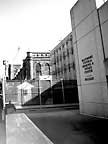
What 'getting picked up' is all about today-- the dreaded Central Booking Center
|
 |
You Can't Go Home Again
By
Frank Laterreur
Thirty-five years ago I visited Baltimore for the
first time. I fell in
love with the city, and I found my sexual self there.
Two years ago,
after retiring from a career in Boston, I returned to
Baltimore-- where
I still have many friends. I hoped to find some of the
excitement and
warmth I experienced years ago. It didn't happen. Part of that, of course, is me-- I'm now a senior
citizen. Part of it,
though, is a major change in the city's character--
especially its
sexual customs and styles, but also its basic
personality. These
changes
are symptomatic of what's happening around America,
and around the
world
wherever America is dominant.
When I first experienced "Bawlmore" charm, I was
working in Washington, DC, and living on a farm near
Hagerstown . I was just beginning to come
out, a scary experience in those pre-Stonewall days.
Washington's
chi-chi Georgetown bars were not my cup of tea, and as
an awkward
twentysomething with glasses, I didn't bowl them over
with my beauty. I had come to Baltimore for the funeral of a
colleague's mother. The
funeral was in Highlandtown. That's enough said for
any queer who ever
visited Baltimore ! Not one, but two local teenagers
waved from a bench.
That night they went back to the farm with me. That
was the beginning
of
a 20-year love affair with the city of Baltimore as a
gritty,
working-class homosexual utopia. It wasn't just the young men (though they certainly
added the spice to
the sauce). It was the variety and down-to-earthiness
of bars, clubs,
and restaurants scattered about in real neighborhoods,
not clustered in
some upscale gay ghetto. That's what made Baltimore
special. There were
bars in neighborhoods all around the city:
Highlandtown, Fells Point,
Southwest Baltimore , South Baltimore, on Bellaire
Road, in Waverly--
and
yes, downtown, but not all together and not at all
like those in
Georgetown. Some of the bars are still there-- a
watering place
downtown
called Leon's is perhaps most notable-- and the
Sportsman (the first
black bar I dared enter in my life).
Paved with gold In Baltimore of 35 years ago, the streets were where
it was happening.
They were the active site of sexual liaison, for money
or just for a
good time. The kinds of connections varied: older and
younger, men of
the same vintage looking for each other, games of
dominance and
submission, the hide-and-seek of risking sex in public
places. And so
much of it literally on the street. There was Eastern Avenue-- but also Fleet, Bond,
Baltimore , Patterson
Park Avenue (and the Park itself), Fayette , Lombard,
and a dozen more--
all on the city's east side. There was also much to
ogle and chat up in
Greek Town or further out along Dundalk Avenue. Plenty
of meat in South
Baltimore, too, especially along Light, Charles, and
Ostend all the way
across to the southwest. Also in Brooklyn, in Pig Town
and Morrell
Park,
Remington, Hampden, West Baltimore (and not just
Wilkins Avenue). Wyman
Park near Johns Hopkins University was incredible--
sex au
naturel there. Take almost any major thoroughfare
or walk in any
park and you'd find what you wanted-- east, west,
north, south.
Downtown
there was much activity to be found on Howard Street,
what used to be
the main drag. The old Greyhound bus station was just
one important
hangout. Another was a Bickford's restaurant just off
Howard-- crowded
with a wide range of queers from hustlers to
outrageous drag queens,
all
classes and races mixed. The streets around Bickford's
were often
packed
at Halloween and on New Year's with celebrating queens
in high drag.
(Several Bickford's around town were similarly
famous.) There were overlapping meatracks along Cathedral,
Monument, Park, and
Madison Streets in the somewhat tony Mount Vernon
area. These were busy
every night of the week. Men could be found most times
of day and
evening in Mount Vernon Square. Black and white men,
working-class as
well as students, plied these streets and benches. Curtis, for instance, in his late teens in the early
1970s, was a
self-described "radical street hustler" on the Mount
Vernon strolls. He
charged for sex on a sliding scale-- working-class
black men got the
lowest price, rich white queens the highest. With
older, low-income
black men who attracted him, he went for free. He left
home and got a
room downtown. His mother came to see how he was
doing-- the door was
open, so she went in. Curtis was in bed with two black
men. "I'll come
back another time," she said, softly closing the door.
Curtis often had
sex in an open basement, below a house that had been
torn down, just
below the Washington Monument . Mustn't forget the movie theaters-- from the ones
downtown to the
outlying neighborhood movies on Broadway or Eastern or
just about
anywhere. Lots going on in those dark balconies. I
don't mean sex
theaters. Those had begun to spring up about that
time, but weren't
necessary for cruising, since the ordinary
double-features featured
more
than flicks, especially on Saturdays. Westerns or
mysteries or
comedies,
it didn't matter what the bill-- they all were
accompanied by orgies in
the seats and aisles. Such theaters charged a quarter
or 50 cents in
those days, allowing everybody in from the riff-raff
to the rich, the
adolescent to the elderly. I never was much into t-rooms, but those abounded,
too-- at the
colleges
and libraries (the downtown Pratt was marvelous), but
also in parks and
at public buildings of every sort. And the "Block,"
along Baltimore
Street downtown, just bristled with sex-- in
peep-shows, bars, arcades,
sex theaters, and along the street-- as well as
cruising circuits in
adjacent areas, including the park in front of City
Hall. It was quite possible in the years between the early
1950s and the
mid-1970s to have two or three tricks an afternoon,
and come back for a
couple more in the evening-- either within one of
these venues, or by
crossing town from one to the other. Baltimore was
saturated with
homosex. Though Baltimore was racially segregated (a Southern
city actually--
still is, by the way), interracial sex abounded. In
fact, Baltimore homosexuality delighted in opposites
(not clone-to-clone as is the
modern tendency)-- black with white, drag queens with
leather, poor
with
rich, younger with older, Poles or Russians with Wasps
or Negroes. And
many of the bars were likewise diverse. The mixing
crossed the gender
gap, with diesel dykes and others of the myriad
lesbian subgroups
hobnobbing with the whole range of gay-male types--
from swish to
macho.
(There were also quite a few predominantly women's
bars in the
neighborhoods, but I can't talk much about those.)
No logo A major ingredient in sexual action for men in the
1970s in Baltimore was that sexual boundaries were
crisscrossed constantly. There was
little talk of "sexual identity," and no young man had
to consider
himself queer if he let himself get picked up by
another man. The
prominent pattern was what I call the "Baltimore
solution." Boys and
young men were easily available to older men, but also
fooled around
with each other. Virtually any young man on the street
could be
approached with the question, "Do you go out?" The
most negative
response was likely, "No, but my brother does." These
same young men
kept girlfriends on "the side," and many latter
married-- keeping up
sexual liaisons with their older and younger male
friends-- often
themselves seeking out younger partners as they aged.
The women were
the
ones "on the side," not the men. I remember often
waiting for my sex
tricks to let off their girlfriends in order to spend
the night with
me. Toward the end of the '70s, "gay liberation" got
going, with gay youth
groups and other new institutions. For a time there
was a mixing of the
old and the new models. About 1980, I met a teenager
who took the name
"Grapes" along one of the old East Baltimore cruising
streets. Gorgeous
and rather feminine, he immediately told me, "I want
to be gay-- can
you
teach me how?" I took him to a gay friend's barbecue
in the Johns
Hopkins neighborhood. My friend was a lawyer and one
of the earliest
leaders of the growing "gay community." Grapes told
his mother where he
was going, and she insisted he wear a suit and tie to
such a gathering.
Grapes became a leader of the Baltimore gay youth
group, went on to San Francisco and New York to
experience the heady post-Stonewall world of
homosexual freedom-- only later to die of AIDS. Local color The neighborhoods in those days were segregated by
class for sure, with
just a little racial mixing, but each had a
predominant culture. And
there was certainly no gay ghetto-- homo-, bi-, and
multi-sexual people
lived everywhere. Every neighborhood was a community--
real localities
with personalities and unmixed ethnic flavor. Polish,
Italian, Greek,
German, Finnish, Filipino, Lumbee (a unique blend of
American Indian,
black, and white), black-- and (as in Butcher's Hill
or on the
Baltimore
Street side of Patterson Park) West Virginia
Appalachian. Nothing fancy
or snobbish about Baltimore then (there were the
snobby neighborhoods,
like Guilford, but who went there?)-- just ordinary
people, often
living
and working in the same area, full of life and energy
and sexual
curiosity. Every neighborhood had its wonderful hangouts and
restaurants that were
unique to it-- such as Tanya's Russian sailor bar in
East Baltimore and
a host of similar places in Fells Point and along the
inner harbor.
Architecture and style of shops and dress likewise
varied by
neighborhood-- there was no mistaking where you were.
No cloned condo
developments or luxury townhouses with fancy
roof-decks in those days. As for crime and police, there were problems. From
time to time there'd
be an old-style raid on a bar-- and, yes, that often
brought serious
disgrace (and even suicide) to some gay men,
especially from
"prominent"
or "proper" families. But mostly, police looked the
other way when they
saw cruising in streets or cinemas-- at most they
chased people out,
seldom causing serious trouble. As one cop told me in
East Baltimore,
explaining why he didn't bother the boys and the men
who're looking for
fun on Eastern Avenue, "It keeps them out of other
trouble." In the old
Howard movie house I remember seeing a cop standing at
the back,
watching the film while a dozen men cruised the aisles
and johns, and a
couple of blow jobs were in progress just rows away.
Of course there
were no surveillance cameras in those days.
Villages reconceived The whole gay scene in the US has changed a lot in
these 35 years--
certainly in some ways for the better. But a lot of
the sexiness and
adventure and diversity has been lost. All this has to
be put in
historical perspective. Baltimore was one of the
northern and border-state cities which began
accepting wave after wave of immigrants after the
Civil War, and again
even more after World War I. The immigrants were fresh
out of peasant
villages in Italy ,Greece , and Eastern Europe-- flung
into the
simmering
pot of urbanization. Cast out of their Old World
villages, they created
new urban peasant villages in places such as Baltimore. They lived
packed in rowhouses built for them near the old-style
factories where
they worked (in Baltimore , especially the steel
mills). I'd argue that these particular peasant cultures
fostered same-sex
adventures-- and sexual experimentation generally--
more than, say,
Anglo and other Western European societies that made
up the elites in Baltimore (as in the rest of the US).
This earthy approach to sex got
transferred to the former peasants' new urban homes--
where the elites,
as well as their own elders, eagerly sought out the
ready street
commerce. I interviewed several grandfathers of young men I met
on Baltimore streets in the 1960s. They all (Irish,
Italian, Finnish, Polish)
reported "going out" (as sexual liaisons on the street
were then
called)
when they were boys-- often fresh off the boats that
landed in
Baltimore's Fells Point. It would seem that
heterosexual adventure
prospered similarly. The mother of one Russian boy I
knew was a hooker
in the 1960s. The family had lived near the docks in
Fells Point for at
least four generations-- with each including both male
and female
streetwalkers. So, the fantastic eroticism of the streets of
Baltimore was perhaps
highly conditional-- the '60s and '70s that I
experienced, as well as
possibly the previous hundred years, fostered sexual
opportunities and
variety precisely because of the types of immigration,
residence
patterns, and work environments of those days. By the 1980s, all this had changed. New immigrants
were mostly
non-white, non-European. New work was fragmented and
service-oriented,
not gang assembly-labor in the factories, that were
now mostly shut
down. And the new immigrants also spread around to
various
neighborhoods, sometimes replacing the old immigrants,
but often mixed
together. What was left was mile after mile of
partly-boarded up,
run-down rowhouses, a decimated economic base-- and
mostly empty
streets. After periods of abandonment, new groups
flowed in-- producing
incongruous combinations of the new-rich and near-rich
white
professionals with new arrivals from Guatemala or
Vietnam , as well as
blacks fleeing even worse ghettos in adjacent areas.
With these
changes,
the free-wheeling sexual vibrancy of the neighborhoods
and streets also
vanished. Of course much of that commerce and contact has been
replaced today by
the traffic on the internet. Instead of walking the
parks and streets,
or haunting restrooms and movie theaters, men sit for
hours at
computers
looking for sex in all its varieties. And the sex is
there-- hookups
continue, for sure, though impeded by technological
requirements,
chilled by various forms of filtering and
surveillance, and compromised
by the loss of the immediacy of bodies meeting bodies.
Perhaps the
ferment of the streets-- with their own repression and
surveillance--
has been simply replaced by that of the internet--
with more hooking-up
than ever before. But I doubt it.
Road blocked ahead For a long time-- as in other ways-- Baltimore lagged
behind these
changes, but a recent two-year stay confirms that
Baltimore is quickly
going the way of other US cities. Most of the cruising scenes I visited in my younger
days are completely
gone. No more "regular" movie-house cruising. Even
sex-cinemas--
whether
downtown on the Block, on Broadway, and in the
suburbs-- have lost
their
crowds and their energy. The Block is virtually dead
for homosexual
activity, and downtown streets are completely empty. T-rooms are only sporadically active-- and are under
constant
surveillance. Wyman Park and other similar scenes have
just vanished--
nobody there at night and only dog-walkers and joggers
by day. Most of the street cruising has also vanished-- though
a desperate and
mercenary straggler can be found now and again on
Cathedral or in Mount
Vernon Square. Wilkins Avenue cruising exists but is
sparse and
dangerous. Eastern Avenue is less dangerous but even
less active-- some
nights nary a man nor youth can be seen; on good
nights, one might see
a
couple of older, washed-out hustlers-- and on a very
good night, a
couple of younger crackheads. As for South Baltimore,
Bellaire Road, Brooklyn , Pig Town, and all the rest--
forget it. Hampden looks
promising at times, but there's little proof. Most of the old neighborhood bars are gone. In the
east, Quest is what passes for a hustler bar, not
coming close to the irreplaceable Frankie and Ronnie's
(later the
Unicorn). Still, Quest is the one place where a few
young guys cluster around the pool table. The
Drinkery and some others hold out downtown. Lots of
men older than I am (and I'm old!) hang out in these
places, and a very
occasional young man of twenty- or thirtysomething is
available, though
the prices have gone up and the selection has gone
down. Leon's is
still
packed on the weekends, but on my two visits, I was
the youngest one in
the place. The cluster of bars in the Village on
Charles Street could
be
in any US city-- there's no local quality about them.
Evidently these
are the places that all the newly married gays gather.
The strip club
that once was on the edge of Pig Town is long gone, as
is the Atlantis.
The new strip club in East Baltimore-- Spectrum-- is
titillating, but
seems more like an import from DC or New York,
though a recent visit found quite a stable of
attractive guys who might have once walked the
East Baltimore streets.
And several new Latino gay and mixed bars in the East
feature a cruising scene much like the old days -
among these are Sherrie's on Broadway, near Eastern
Avenue, and Manilla Bar on Lombard. And the neighborhoods themselves are gone forever, in
the sense of
authentic local enclaves. A new gentry dwells
ostentatiously among
boarded up houses in some areas, and cheek-by-jowl
with some of the
elderly who have not yet fled in others. And these
trendy, affluent
whites are "fixing up" everything-- elegant
door-knockers, fancy doors
and windows-- and of course the omnipresent
roof-decks. Housing prices
have skyrocketed, only this year finally leveling off,
though not
enough
to make it possible for working people to find
affordable housing
anywhere in the old neighborhoods. One thing that has not changed is Baltimore's
residential apartheid of
blacks and whites. Except for wealthy and professional
blacks and
students, segregation is the norm. Students and
tourists can still
cross
from Johns Hopkins University in the north via
downtown and the harbor,
over to Johns Hopkins Hospital in the east, and remain
virtually always
within "safe"-- that is white-- turf. When I viewed
the prize-winning
film Boys of Baraka, about some impoverished Baltimore
black kids who
went to Africa and found pride in their heritage. I
overheard a couple
of yuppies commenting, "Where is that Baltimore? I've
never seen such
slums." They need have only gone a few blocks from the
Charles Theater
where the film was playing. The black underclass is as
brutalized,
oppressed, and isolated from the mainstream as any in
the world-- yes,
in the world. Not even in Haiti , which I often visit
in my academic
work, is life in some ways as brutal, despite far
greater actual
poverty. Just as it was 35 years ago, the Baltimore gay
community is less
segregated. To their credit, Baltimore fags and dykes
have always
defied
the racial taboos. If anything, the bars are more
segregated by class
today than by race.
Crime and punishment The nature and intensity of crime and punishment has
also changed in
Baltimore- for the worse. Years ago, there was police
brutality on an
individual basis, and fags could get beaten up if they
crossed the
wrong
cop's path. Police corruption was a fact of life. But
most men, even
those who dabbled in homosex, could go through life
not coming up
against police repression. Nowadays that's difficult,
with 100,000
arrests yearly in Baltimore city-- which often entail
stays overnight
(and in some cases much longer) in the dreaded Central
Booking Center.
This huge and ancient fortress-like jail appears
somewhat like similar
institutions I've visited in Haiti . Murders within
those walls take
place fairly often-- scarcely noticed among the nearly
300 city-wide
homicides yearly. Young men of any race are fair game
for sudden police
intervention: street searches and harassment for
"quality of life"
crimes like loitering on front steps or spitting or
urinating in a
public place. Bar raids are virtually unknown, but
hundreds of people
are arrested yearly for "sex offenses." These range
from prostitution
to
public- and under-age sex. Even trivial sex offenders
face years of
public humiliation on the ever-growing sex-offender
registry-- a
veritable yellow star for perverts. No wonder this has
led recently to
suicides of gay men caught in the act in parked cars
or parks, or
because a trick turned out to be 17 (see "Down a
Slippery Slope,"
The
Guide, September 2005). And everywhere in Baltimore , police are out in force.
To an outsider it
really does look like a police state: police
helicopters, shining
floodlights on streets and alleys in the wee hours,
and blue lights
portending street-corner surveillance cameras. Some
cameras have loud
speakers hooked to monitors in police stations, from
which come booming
voices warning that those who come too close to a
wall or who loiter on
the corner face arrest for "criminal acts." These
things are so
commonplace in Baltimore that most people I've talked
to have become
numb to such massive violations of privacy and civil
liberty. This survey could not be complete without a comment
about the
ever-widening scourge of drug addiction and the
fruitless "war on
drugs," both factors driving the repression. Back
then, there were
plenty of drugs and drinking among young and old. But
the Baltimore streets, the bars, the baths, the
toilets and the parks were not
defined
by drugs and the moral and police crusades against
them. Now they are. Almost nary a trick cruising for sex in Baltimore
today is not
addicted.
Ugly thing, addiction-- crack is not pretty, but
crystal meth and
designer drugs can be even uglier and faster in their
grim toll. I came back to Baltimore , but found a different city
than I knew those
years ago. There are still spots of recognition and
some pleasures to
be
had. And Baltimore is still slightly behind the curve
of what is the
totalitarian society now taking root in the former
"land of the free."
But not enough behind the curve for me. I've moved on again-- this time outside the US
borders, to a place that
does still have some semblance of the old homosexual
flair for risk and
abandon, with male-male sex (not just LGBT political
correctness)--
believe it or not-- everywhere you look. With US power
and styles and
habits spreading fast all over the globe, sexual
variety and joie de
vivre may not last much longer in my new home, but
then I may not
either.
Chowing Down
Then & Now With a plentiful catch of Chesapeake crab to work with
and a patchwork
of ethnicities, Baltimore's always been a good place
to eat. Solace for
the loss of street sex? New upscale restaurants have largely replaced the old
Baltimore-style
crabhouses and funky eateries. A few survive-- the Sip
'n' Bite (the
delightfully sleazy and once most erotic diner in the
world) seems not
to have changed much in menu or even prices, nor has
the working-class
Eichenkranz-- though the latter is mostly empty except
for seniors, and
the Sip 'n' Bite has more hip straight couples than
hustlers or gay men
nowadays, and the sexual edge is gone. Many of the old
restaurant gems
have closed. the more upscale Hausner's at the heart
of East
Baltimore's
cruise strip closed years ago, while one of the most
recent casualties
has been the eccentric Mamie's in Hampden. Both of
these had huge menus
and varieties, where you could pay a few bucks or a
small fortune, set
amid the private art collection of the founders--
Maimie's was
low-class
kitch, Hausner's was literally museum-quality European
classic. Most of
the genuine working-class crab houses with newspaper
on the tables are
gone-- such as Bud's on Lombard in the East as well as
several in the
harbor area and Southwest Baltimore-- while the
expensive ones, such as
Obrykie's, remain. Fells Point is alive and vibrant in
the wee hours--
if you don't mind mostly tourists and rowdy college
students; and if
you
can stomach high prices and "European"-style menus
that feature all
kinds of nifty but inauthentic crab dishes. There
are to be sure, some new, authentic local restaurants
which attract all sexual persuasions. One is
Tamber's, a fantastic, friendly Indian and
Nepali staffed restaurant in Charles Village with an
eclectic Indian,
Italian and American menu, and moderate prices, as
well as a very
unique upstairs lounge which features beds where one
can drink
champaign amid pillows, while served fruits and Indian
breads--
needless to say, not for Baltimore's lower-income
queers. Another is a
Mexican eatery, Holy Frijoles on 36th-- still a cruisy
working-class strip
in Hampden. Yet another is a low-priced Italian place
called Tutti
Gusto at Linwood and Fait in the heart of the old
Canton cruising
district. There is also a proliferation of Spanish,
Mexican, El
Salvadorean, Peruvian, and other Latin restaurants--
and bars-- in East
Baltimore, with authentic, cheap, and delicious food.
You are not logged in.
|