Massachusetts: a pilot plan?
|
 |
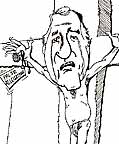
Prosecutors target gay priest with phantom evidence
By
Jim D'Entremont
With the arrest of retired Rev. Paul Shanley at his home in San Diego on May 2, moral panic swirling around allegations of child molestation by Roman Catholic priests (see
The Guide, March 2002) became surreal. As hysteria traversed the United States and spread as far afield as Taipei and Nairobi, observers who heeded the facts could see that the evidence against
Shanley and a number of other accused priests is mostly spectral.
At his May 6 arraignment in Boston, Shanley, 71, was charged with three counts of raping a Massachusetts boy named Paul Busa. The prosecution claims that in the 1980s, while
Shanley was pastor at St. John the Evangelist Church in Newton, Massachusetts, the priest repeatedly took Busa out of catechism class and subjected him to sex play and "oral and anal rape" in
a basement restroom, in the church rectory, and in a confessional. The sessions are said to have begun in 1983, when Busa was six years old, and continued until 1989. Busa, now 24, is
a military police officer stationed at Peterson Air Force Base in Colorado.
In addition to pressing criminal charges, Busa has filed a lawsuit claiming he "started to repress memories of the abuse soon after it began." If so, he went on programmatically
repressing the abuse each time it recurred over a six-year period. Busa claims that memories "came flooding back" after he read an account of Shanley's sexual predations. "In the beginning," Busa
told reporters, "I questioned myself a lot. I thought, 'Was I making this up?' The way my body was reacting, I knew it had happened."
The trigger was a February Boston Globe piece concerning his childhood friend and classmate, Greg Ford, also 24, who had just become the first to accuse Shanley of molesting
a prepubescent boy. Reportedly, Ford began remembering his abuse "in bits and pieces" after reading the
Globe's original January 31 hatchet job on Boston's once-revered street priest.
During his 17 hospitalizations and periods of residential treatment for emotional problems, Greg Ford denied ever having been sexually abused. Now his attorney, Roderick
MacLeish, attributes Ford's breakdowns and self-destructive patterns to abuse by Shanley. A third unnamed accuser lurking in the background also seems to have recovered such memories; there
may be a fourth.
The Globe's January exposé insinuated that Shanley sexually preyed upon the teenage runaways, addicts, and hustlers his Boston Ministry to Alienated Youth served from the late '60s
to the end of the '70s. A principal source was Arthur Austin, who says he entered a six-year consensual relationship with Shanley at 20.
Demon du jour
Shanley's contemporaries and former colleagues remember him as a man who may have been attracted to younger men, but not children. Many feel his reputation as a principled
caregiver to despised minorities was fully deserved. "Shanley saved lives," says Paul Shannon, a former seminarian who knew Shanley in the 1970s. "The way he's depicted is in complete
contradiction to the way he was."
If the evidence that Shanley suddenly began lusting after six-year-olds in the 1980s amounts to the parallel "recovered memories" of a few individuals, the case is almost certainly
a prosecutorial pipe dream.
"People repress memories in Hollywood movies," says Harvard psychiatry professor Harrison Pope, "but there's no acceptable methodological, scientific study you can cite to prove that
in real life, a person can repress memories of sexual abuse and recover them years later." Dr. Pope also rejects the notion of "body memory" of sexual trauma as completely lacking in
scientific support.
Mark Pendergrast, author of Victims of Memory, notes that "From 1988 to 1998, there was a virtual epidemic of false allegations based on 'memories' encouraged by misguided
therapists. I thought this fad had disappeared, but it's coming back strong."
At a recent Harvard conference on wrongful convictions, behavioral psychologist Elizabeth Loftus, an expert on memory, speculated that many of the current accusations against
priests may be unwittingly false. "Recovered memory" cases against priests are not new; during an early '90s wave of similar accusations, Cardinal Bernardin of Chicago was named by a young
man acting on therapy-induced false memories.
In the United Kingdom, "recovered memory" evidence is banned from legal proceedings. In the United States, where the Supreme Court has never ruled on its admissibility, such evidence
is unacceptable in many jurisdictions. The New Hampshire Supreme Court has barred repressed-memory evidence altogether; other states limit its use. The Massachusetts Supreme
Judicial court has never meaningfully dealt with the matter.
Old hand
Presiding over Shanley's prosecution is Martha Coakley, DA of Middlesex County, a politically strategic chunk of northeastern Massachusetts. In 1992, Coakley launched her career
by convicting an elderly couple, Ray and Shirley Souza, purely on the basis of "memories" developed in therapy by two of their grandchildren. Coakley has built her career on zealous
prosecution of child-abuse cases, both real and imaginary.
In choosing the Busa case as a means of putting Paul Shanley behind bars, Coakley may be seeking to legitimize recovered-memory evidence at a time when the release of the Souzas
from a nine-year term of house arrest is renewing spirited dismissals of "dissociative amnesia."
Lest reason prevail, Boston print and broadcast media have escalated their program of demonization, speculating, for example, about Shanley's activities during his March, 2002,
vacation in Thailand. The Boston Herald has described Shanley as "a notorious Newton priest who endorsed man-boy sex for decades yet earned glowing reviews from Boston Archdiocese
officials" and who "appeared at formative meetings of the infamous North American Man-Boy Love Association" (NAMBLA) in 1978.
Father Shanley's one appearance in a forum that focused on man-boy sex issues took place on December 2, 1978, at a gathering organized by the Boston/Boise Committee, an ad hoc
group of gay activists and others formed to deal with a 1977-'78 witch hunt focused on young male hustlers and their clients at the height of Anita Bryant's "Save Our Children"
campaign. Speakers included an array of clergymen, law enforcement officials, mental health professionals, and community leaders. Appearing on a panel, Shanley cited the case of a youth who
was traumatized not by his relationship with an older man, but by the intervention of parents and police. He did not attend the post-conference caucus that marked the inception of NAMBLA.
The record shows only that Shanley was an outspoken proponent of gay rights. His position on homosexuality and his participation in Dignity, the unauthorized organization of gay
Catholics, had by the late '70s become his central issue with the Church. Shanley's support for gay men and lesbians was and remains a heretical stance in a faith whose position, as articulated
by the Vatican, is that homosexuality is a "disordered" predisposition toward an "intrinsic moral evil." Hence Cardinal Humberto Medeiros, who considered the rising number of uncloseted
gay priests "ominous," ended Shanley's Boston street ministry in 1979 and assigned him to suburban Newton. In 1990, after Shanley clashed with the Archdiocese over a Vatican loyalty
oath, he was placed on sick leave.
Retirement disrupted
Shanley might have gone on living quietly on the West Coast if it were not for flamboyant, Catholic-baiting Boston attorney Mitchell Garabedian's over-the-top campaign on behalf
of supposed victims of Father John Geoghan, a nonviolent serial fondler who recently received a ten-year sentence for touching the backside of a ten-year-old. Although at least two
of Geoghan's accusers have been convicted of fraud, the number of accusers and accused continues to grow. Largely through out-of-court settlements, the Roman Catholic Church has
paid $40 million to alleged abuse victims in the Archdiocese of Boston alone.
As disaffected Catholics call for members of the Church hierarchy to resign, lawsuits and criminal cases alleging priestly misdeeds keep erupting in Maine, New Hampshire, Rhode Island,
New York, Michigan, California, elsewhere in the US, and abroad. Few reporters have asked how many plaintiffs and accusers have been inspired by media hype, enticed by lawyers promising
large cash settlements, or encouraged by discredited therapeutic dogmas.
Meanwhile, the possibility of Paul Shanley receiving a fair trial in Massachusetts, if it ever existed, may have been swept away.
You are not logged in.
|