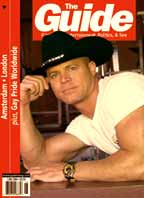
June 2004 Cover
|
 |
Books that take a contrary view
By
Michael Bronski
Why You Should Give a Damn About Gay Marriage
by Davina Kotulski
Advocate Books
How to order
With the juggernaut of same-sex marriage rolling along, we're faced with a mini-deluge of books that overwhelmingly laud this small revolution in social relations as an enormous change
for the better.
No matter what you own feelings about it, same-sex marriage is clearly the movement of the moment. And this moment has become such a publishing moment that two older
books are being born again. Beacon Press will be reissuing E.J. Graff's critically acclaimed 1999
What Is Marriage For? The Strange Social History of Our Most Intimate
Institution with a new introduction by Village
Voice editor-in-chief Richard Goldstein. While not a "same-sex marriage" book per se, Graff's cultural history of the institution has been cited in nearly every legal
brief filed in defense of gay marriage. Smart and readable as cultural history, Graff's book may not convince gay people with qualms about marriage to tie the knot, but it's informative and witty.
Andrew Sullivan's 1997 Gay Marriage: Pro and
Con is also being reissued by Random House. A compilation of essays, op-ed pieces, political opinion columns on the topic by those
against and for, the Sullivan book offers a good run-through of the basic arguments. While Sullivan is certainly pro-marriage, he presents a wide range of arguments-- including radical gay
ones against same-sex marriage.
Meanwhile, Jonathan Rauch's Gay Marriage: Why It Is Good for Gays, Good for Straights, and Good for
America has just been published. Rauch is an openly-gay, conservative
syndicated columnist noted for distancing himself from the more liberal activist establishment. His basic arguments is that marriage is a basic civil right and that gay marriage will also make
everyone behave better, be happier, and contribute to the general good. Rauch is a sunny sort of conservative who-- at least here-- is far less interested in preventing others (well, queers)
from entering mainstream social institutions than in expanding those institutions to include everyone.
Perhaps the most interesting gay marriage book to be released so far is Devina Kotulski's
Why You Should Give a Damn About Gay
Marriage. Kotulski attempts to convince a gay
and lesbian readership that traditional marriage is a vital civil-rights issue. And her book isn't bad. She has a witty, snappy style that's engaging and often amusing. The most persuasive part
of her argument is that queers get discriminated against by the current marriage laws. Issues such as benefits, taxes, and such important legal rights connected to visiting a loved one in
a hospital, being able to make important medical decisions, and co-parenting an adopted or foster child would all (with a few minor exceptions) be remedied by same-sex marriage.
But Kotulski's book begins to flounder when she touches on social or psychological issues. Referring to an unpublished study by the San Francisco Department of Health, men who
were registered domestic partners were more like to have safe sex then those who were not. Kotulski then states: "When gay men's relationships are respected by legal status, they are
more likely to respect themselves, their domestic partners, and other sexual partners."
It is leaps like this-- so common among those who argue for same-sex marriage-- that may stun the reader. Look at the adultery and divorce rates among heterosexuals-- all of
whom of have relationships "respected by legal status." Marriage and monogamy (and respect) are not synonymous, and even if they were there is a far larger discussion to be had here about
how integral sexual freedom may be to personal growth.
Later in the book Kotulski argues that one of the best effects of same-sex marriage will be to help poor queers by helping them gain government benefits such as welfare, public
housing, and access to health benefits. Well, yes. There are some benefits that poor gay couples might have access to, but it is outrageous that Kotulski doesn't mention that over the past
two decades the federal government has been actively-- and recently very energetically-- dismantling all of these programs. If you are in favor of poor people have access to health care
and housing fighting for same-sex marriage is an idiotic way of doing it.
These examples show the often hypocritical aspects of the argument for same-sex marriage. Rather than simply focus on inequality under the law, or accept the fact that many
gay people really want to enter into matrimonial bonds, advocates insist on presenting same-sex marriage as the leading edge of gay liberation and a cure for all social ills. As succinct and
smart as is some of Why You Should Give a
Damn, Kotulski can't get around the fact that marriage is essentially a conservative institution that only promotes change in the most limited and
limiting ways.
| Author Profile: Michael Bronski |

|
Michael Bronski is the author of
Culture Clash: The Making of Gay
Sensibility and The Pleasure
Principle: Sex, Backlash, and the
Struggle for Gay Freedom. He writes
frequently on sex, books, movies, and
culture, and lives in Cambridge,
Massachusetts. |
| Email: |
mabronski@aol.com |
You are not logged in.
No comments yet, but
click here to be the first to comment on this
Book Review!
|