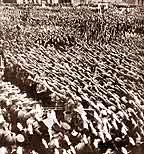
They got with the program....
|
 |
Does the Millennium March herald a brave new age for the gay movement?
The 20th century saw totalitarian regimes perfect the mass rally as a staged spectacle, its message carefully dished up in the service of a reigning elite. The 20th century also saw mass demonstrations, sometimes
spontaneous, in which "people power" steered dramatic social change and peacefully toppled dictators. It happened in India leading to independence, in the US at the 1963 March on Washington for civil rights, in the Philippines
against Ferdinand Marcos, throughout Eastern Europe at the end of communism, and in South Africa. Which will be more the model for the Millennium March on Washington (MMOW), set for April 30th in the US capital?
The march has sharply divided the US gay movement. Plans for the event were announced in 1998 by the Human Rights Campaign and the Metropolitan Community Church, the two largest American
gay groups-- the former richest in money, the latter in sheer numbers of souls. From the beginning, some activists questioned the idea of a march as ill-timed and a diversion from local organizing. An "Ad Hoc Committee for
an Open Process," formed last year, has doggedly shadowed the Millennium organizers, charging them with being antidemocratic, elitist, financially unaccountable, racist, and sectarian. San Francisco Supervisor Tom
Ammiano, playwright Harvey Fierstein, writer Barbara Smith, cartoonist Alison Bechdel, and historian Allan Bérubé are among the hundreds who have signed the Ad-Hoc Committee's call. The march has become so contentious
that some groups meeting in DC during the weekend of the event, such as the Gay and Lesbian Press Summit, have made a point of declaring they are agnostic on the event. In December, Black and White Men Together
pointedly declined to endorse the MMOW and rescheduled its Washington DC convention from the March weekend to two weeks before just to emphasize its "distaste."
But some judge the feuding petty. "If this sounds like a typical movement hissy fit, it is," wrote Richard Goldstein in the
Advocate. "What's the problem with a group of queers celebrating their
sexuality, whether they choose to do so by marching, dancing, or praying?"
A national gay and lesbian march has become so logistically complex, say others, that the task goes beyond what can be done by nonprofessionals. And if the main impact of a march on Washington comes
from a few CNN crowd shots and sound bites, does so much hang in the balance?
Opponents say the Millennium March could be a tipping point: will the US gay movement be organized from the bottom-up, characterized by community groups and involvement at the grassroots? Or will it
be more like an automobile club, run by corporate managers, with closed meetings, paid staff, carefully managed lobbying and public relations, with sponsoring car-makers and oil companies financially greasing the works?
A queer parliament
The three previous gay marches on Washington-- in 1979, 1987, and 1993-- were grassroots efforts that-- in retrospect, at least-- helped create and then ride distinct waves of community sentiment. The
first national march came after the assassination of Harvey Milk; the second, as the plagues of AIDS and Ronald Reagan were in full swing. The last march, in 1993, was spurred by the hopes raised in some quarters by
Bill Clinton's election. The marches' greatest value was not so the headlines they generated, but the work, discussion, and community mobilizing around the US that it took to organize them. They were produced mainly
by volunteers, with details and demands hashed out in dozens of open, often contentious, town-hall meetings held all over the country at which representative of organizations could vote and anyone could speak. While the
march platform that emerged from this process may have been a document little-read, the work of hashing it out had real value, an expression of the closest thing there was to a national queer parliament.
This march was different. The call for it came from HRC and MCC alone, with these groups' particular interests not far from mind. The theme they proposed was "Faith and Family." MCC said it sought
another national march in part because past ones had been so good for recruiting new members into the flock. HRC, which aspires to be a kingmaker in Democratic party politics, wants to get out the vote for Gore in the
2000 presidential election.
The Millennium March's version of the queer parliament is a web site where visitors can click on the gay issues most important to them, with the results set to influence, not a platform of demands, but
a "working vision."
"I received dozens of e-mails from MMOW organizers, urging me to vote on the greatest hits of gay liberation issues. I felt like a guest on VH1's 'The List,'" quips columnist Kirk Read. "Curiously, the right
to suck cock was not among the choices."
Millennium March organizers have been emphasizing attributes of gay and lesbian people other than their sexuality. "Marketers worldwide are increasingly recognizing the importance and spending power
of the gay community as a dynamic, fast-growing economic force in the business world today," according to a promotional pamphlet aimed at would-be corporate sponsors of the festival that will accompany the march. "As
a result of their unique lifestyles, gay men and women are by definition intensely brand loyal, and hyper acquisitive."
Much of the march's planning has taken place behind closed doors. MMOW organizers refused a request by the Ad Hoc Committte for meeting minutes. While the board has been expanded beyond the
original two groups, HRC continues to have a large say in MMOW decisions. When the Ad-Hoc Committee for an Open Process asked for a financial accounting, Millennium March co-chair Donna Red Wing refused
flat-out, declaring that "Our contractual arrangements are none of their business. Those involve legally binding information." Organizers have refusal to provide detailed financial information to
The Guide and other gay publications that have requested it-- a refusal that violates the requirements of the tax-exempt status the Millennium March is seeking to attain.
The silence has raised suspicion of sweetheart deals among organizers. In the vague figures that have been released, $700,000 is budgeted for "consulting fees" to Millennium officials. When lesbian
comedian Robin Tyler, the march's original producer, was terminated last fall, she received, according to one report, a settlement of some $35,000 after threatening to sue, a deal that was sealed with a two-year nondisclosure
agreement. The person then appointed as March co-director, Malcom Lazin, jumped to that paid post from a voluntary seat on the Millennium March board. In February, Lazin resigned-- or was pushed-- that job in a dispute with
the board over which firm should get the half-million-dollar contract to produce the event's sound, lights, and staging.
But as the march approaches, organizing appears in disarray. Articles have appeared in local gay press around the US noting that the march has generated little excitement with seemingly few planning to
attend. A Gay People's Chronicle reporter did not find a single bus reserved in the state of Ohio for the MMOW; for the 1993 march, reservations were in place months before. Illinois groups, including Equality Illinois-- the
largest statewide group-- have announced they will not be going to DC. And in the host city, some local residents have announced a boycott of the march. MMOW organizers are counting on a last-minute decisions of people
within driving distance of Washington to fill the National Mall on the April 30th.
Having failed to stop the march, opponents say they think they have at least tossed a monkey-wrench into the works. If the march flops, they hope it will send a message that national organizing that
bypasses the grassroots will fail. Yet the tendency to professionalize political work, an obsession with good PR, and the temptation to tone things down to get plum corporate tie-ins are issues that confront all levels of gay political
life, from the local on up. Groups with boards of directors and needing to raise hundreds of thousands of dollars every year have a different capacity to defend, for instance, public sex, than one comprised of volunteers
where people engage each other directly in living rooms and cafes without any overhead. The lesbian and gay movement-- from the bottom up-- has become more professionalized and bureaucratized since the last march
on Washington, making it more susceptible to a politics based in disembodied, manipulated imagery that is the defining quality of the staged totalitarian spectacular.
Kerry Lobel, head of the National Lesbian and Gay Task Force, resigned from the Millennium March board a year ago with a flourish, declaring that the march was not inclusive enough. But the NGLTF,
which plays a slightly more progressive Tweedledum to the HRC's Tweedledee, has itself dimmed its progressive creds in recent years-- embracing law-and-order measures like hate-crimes statutes and sex-offender
registries. They've taken these stands responding to the same pressures of money and PR that MMOW organizers saw as providing an opportunity to really cash in. If an endeavor like the Millennium March runs the danger of
mowing down the grass, have the conditions that potentially gave it such momentum also withered the roots?
You are not logged in.
No comments yet, but
click here to be the first to comment on this
News Slant!
|