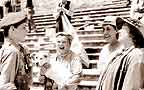
Dog's cute... uniform, too!
|
 |
Fascism's quaint in Zeffirelli's new flick
By
Michael Bronski
Tea with Mussolini
Franco Zeffirelli, director; Franco
Zeffirelli and John Mortimer, writers;
with Joan Plowright, Maggie Smith, Lily
Tomlin, Judi Dench, Cher, and Charlie
Lucas
How to order
At first glance Tea With
Mussolini looks like the perfect gay summer movie. Not only are there a few cute boys and stunning Florentine architecture, but the
cast headliners are a cavalcade of gay favorites: Cher, Maggie Smith, Lily Tomlin, Joan Plowright, Judi Dench. It is probably the only film this season that features
three Dames (the British members of the cast). It also, one might argue, features as well an American dame (Cher) and sports Lily Tomlin's first performance playing
a fictional lesbian. On top of that, Tea is directed by Franco Zeffirelli-- noted over-the-top opera queen-- who brought us such demi-spectaculars as the 1968
flower-child Romeo and Juliet and the 1990 Mel Gibson
Hamlet. Clearly the man has class.
Unfortunately, at second glance, Tea With
Mussolini is a badly made, appallingly written, and politically squalid little disaster of a movie. Written by Zeffirelli,
in conjunction with John Mortimer (of Rumpole of the
Bailey fame), it is an autobiographical retelling of the director's boyhood and teen years in 1930s Florence, where
he was informally adopted by a group of British women referred to as the
scorpioni for their biting wit and stinging remarks. Much of the film is a vague collage of
semi-sketched portraits of these women. Mary (Joan Plowright) takes the young Luca (Charlie Lucas) under her wing after his unmarried mother dies and his father
stops caring for him; Hester (Maggie Smith) is a haughty, imperious wife of a late ambassador who fancies herself having influence over Il Duce because they once met
and had tea; Arabella (Judi Dench) is a slightly dotty art devotee who never seems to notice that there is a war going on. Along with these dames are Georgie (Lily
Tomlin), a wise-cracking American archeologist who plays referee to the group's bitch-fighting, and Elsa (Cher), a Jewish American art collector who has a heart of gold and
an eye for early Picassos.
But very little acting goes on here because there is so little substance to the script. Characterization is obscure and blurry, and while the actors give it all they
have-- a considerable accumulation of talent-- it ends up looking like facial ticks and shop-worn mannerisms. But what else are they to do? Zeffirelli is less interested in
his women as people and more as slightly campy caricatures, old-time queeny notions of what flamboyant older women should be-- Auntie Mames without the wit.
This is not enough for a full-length film, so, inevitably, plot happens. Mussolini takes power. Luca grows up. The
fascisti begin to take over Florence. War
breaks out. The scorpioni are placed under house arrest. Elsa's life is threatened when the Italian fascists begin to emulate, to a lesser degree, Hitler's move toward a
final solution.
There is much intrigue. But Zeffirelli cannot deal with the reality of Mussolini and Italian (and by implication, German) fascism. At best, this is because he is
too short-sighted and self-involved to ground his story in harsh historical reality. The
"evil" of fascism ends up meaning that a bunch of charming, older British women
are inconvenienced and treated shabbily by a dictator. But at worst, you have the feeling, it is because Zeffirelli actually has a certain fondness for the period.
Let's not forget that this is the man who has,
in recent years, become a powerful, vocal opponent of any progressive political change and a bulwark of
right-wing conservative values.
In 1987, when the Roman Catholic church and many right-wing American fundamentalists were protesting the "blasphemy" of Martin Scorsese's great film
The Last Temptation of Christ, it was Zeffirelli who denounced the film as a "product of the Jewish cultural scum of Hollywood." No wonder there is a political
ambivalence in Tea With Mussolini.
When you think of what other Italian directors have done with this period-- Rossellini's beautiful
Open City, Bertolucci's magnificent masterpieces
The Conformist and 1900, Passolini's terrifying
Salo-- the shortcomings of Zeffirelli's work is obvious. There is no
reason why you can't make a social comedy out this material and time-- Lubitsch's
To Be or Not To Be is a brilliant comedy about Nazism.
But first you have to take the subject seriously, to see fascism's squalid reality, and this Zeffirelli is unwilling or unable to do. The result:
a handful of great actors are misused, history is distorted, and the opportunity to make an important, or maybe only decent, film gets
lost. **
| Author Profile: Michael Bronski |
|
Michael Bronski is the author of
Culture Clash: The Making of Gay
Sensibility and The Pleasure
Principle: Sex, Backlash, and the
Struggle for Gay Freedom. He writes
frequently on sex, books, movies, and
culture, and lives in Cambridge,
Massachusetts. |
| Email: |
mabronski@aol.com |
You are not logged in.
No comments yet, but
click here to be the first to comment on this
Movie Review!
|