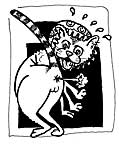
Rude kitty
|
 |
By
Blanche Poubelle
A gentle reader has asked Blanche if she could explore the etymology of the word
queef, which is a term for the fart-like noise of air escaping from the vagina. Urbandictionary.com gives the definition as "an expulsion of wind from the vulva during coitus; a
vaginal fart."
Blanche, perhaps like many of her gentle readers, is familiar with the existence of queefs in the same way that she is aware that the planet Mercury orbits the sun every 88 days. She is told that this is the case by those in a position to know, but she does not anticipate
the opportunity to verify the facts. Nevertheless, etymological duty compels her to seek the true origin of the queef puzzle. Standard dictionaries are of questionable utility on this point, but the internet is, once again, invaluable in figuring out a probable origin of the word.
F
irst, the closest word that Blanche finds in the
Oxford English Dictionary is the obsolete word
quiff, with two meanings that may be related. One meaning of
quiff is "to have sex," attested in two 18th-century English sources. Another meaning of
quiff is to refer to a woman, especially a prostitute. One entry from a 1923 word list, actually spells the word as
queef, which is exactly what we are looking for, and defines it as "an engaging girl," which is probably a euphemism for "prostitute."
However, it is not entirely clear to Blanche that this is the origin of the modern American English word. One problem is that
queef appears to be exclusively American (the British equivalent is fanny fart), while these early instances of
quiff are old and British. The other problem concerns the meaning; though we see a vaginal connection between the words, it's hard to see how a word defined as "fuck" in the 18th century or "prostitute" in the 20th century would change its meaning to "pussy fart" in 21st-century America.
Not impossible, but also not obvious.
Instead, Miss Poubelle suspects that we are dealing with onomatopoeia, which is the fancy linguistic term for words that are imitative of some sound in the world. We have lots of these in English:
bang, crash, knock, wham, thud, and
slam are a few of the common ones. One consistent feature of onomatopoetic words is their variability, since people don't agree on exactly how to imitate the sounds of the world. Would the best imitation of a dog's bark be
bow-wow or arf -arf, or woof-woof
?
Similarly, there are a lot of variant spellings and pronunciations of some word like
queef. It also appears in some places as
kweef, quoaf, quief, queaf, quof, and
quofe. There is also a variant that begins with s-:
squeef, with the same meaning. One of Blanche's
friends uses the word queeb instead of any of the variants above.
Queef seems to be a member of the class of onomatopoetic words that represent the sounds of different gasses, liquids, and solids under pressure. A surprising number of these are pronounced with skw- or kw- at the beginning and often end with a sound like
f, s, sh, or z. For example, we have
squeeze, squish, sqush, squash, and
squirt in modern English. The initial s- sound seems to reinforce the noisy quality of the word, and these s sounds come and go. In earlier forms of English, for example, modern
squeeze was instead pronounced
quease, as in this quote from 1450:
Take mellfoyle and stamp it... then after take al togedere, and put in a lynnyn cloth, and qveyse out the
jus. [Take milfoil (yarrow) and stamp it... after that take it all together and put it in a linen cloth and squeeze out the juice.]
Other early forms of the word were
squease (1548), and squiss (1558). Another word of this general family is
squash (from 1565), which also shows up overlapping in meaning with the s-less form
quash (from 1330).
The common connection between all of these standard English words is that they are attempts to imitate the sounds of things being squeezed, squshed, squirted, and squished.
Queef, like the squeeze-squish- squirt words, is probably an attempt to imitate the sound
of vaginal flatulence -- in particular, the sound of air being forced out through an opening.
Squeef is probably a variant that emphasizes the noisiness of the queef.
Miss Manners tells us that the politest manner of dealing with a public fart is to refuse to admit that it has happened, and that rule no doubt applies to queefs as well. Miss Poubelle is not one of those queens who is repelled by the female genitals, but this column
has entirely satisfied her curiosity on the subject of vaginal flatulence. Henceforth, she intends to return to acting as if queefs do not exist.
You are not logged in.
No comments yet, but
click here to be the first to comment on this
Loose Lips!
|