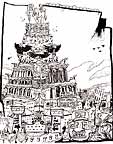
The future Bush Memorial?
|
 |
Were gays the Ralph Nader of the 2004 US election disaster?
With the reelection of Bush the US is set now for a journey into uncharted waters, maybe in the direction of Pinochet's Chile. Few gay people supported Bush yet the lesbian and gay movement is scapegoat for this year's election disaster. As Matt Foreman, Executive Director
of the NGLTF said, "There is no way to put lipstick on this pig."
G.W. Bush's first term-- the fruit of brazen electoral fraud and a loss of the popular vote-- could be chocked up as an aberration. But this time, though the electorate was sharply divided (and supposing that tales of e-fraud aren't confirmed), Americans clearly went
for Bush by several million.
Bush's (re?)-election has cast a nervous pall on us in the coast-hugging slivers of "blue" America. The fear is not just what's been Bush's extension of the law's reach-- the Patriot Act's overturning of constitutional protections against warrantless searches, the
now routine surveillance of citizens' movements on the road or the net, the no-fly lists, the embrace of preemptive and permanent war-- but what underlies that expansion: Bush's underlying contempt for the law. Whether in Florida or Guantanamo, Bush's principles boil down
to getting away with it, and as chief of the world's hyperpower, with a supine Congress and a Supreme Court waiting to be stacked, there's plenty of room for maneuver. A hundred thousand "collateral" deaths, the overthrow of any inconvenient government, torture-- all can
be winked away with a smirk or covered over with bland mumbles about freedom Despite the fraud, the lies, the sheer ineptitude -- Americans last month, like the European masses magnetically drawn to fascism in the last century, chose a politics of action and decision,
substance be damned, as end in itself.
Matrimonial squabble
And yet for all its profound implications, Bush's election, many contend, follows from an angry affair over the boudoir. From Bush strategist Karl Rove to gay congressman Barney Frank, the early conventional wisdom was that Bush had been swept back into office on the
coat-tails of sentiment against gay marriage-- the one issue on which this year's divided electorate seemed to agree.
"Gay marriage was an overwhelming factor in the defeat of John Kerry," declared ex-president Bill Clinton, complaining that Kerry, while he opposed gay nuptials, didn't broadcast his position. Was he waffling or merely being decent? In any case, hailing
from Massachusetts, Kerry was marked, ever since that state's highest court, in November 2003, ruled unconstitutional any distinction between same- and other-sex matrimony. In the name of preventing a Massachusetts from happening in their own backyards, the Right pushed
for anti gay-marriage initiatives to share space on the presidential ballot. In 11 states, some 20 million voters were asked, with various degrees of extremity, to decide anti gay-marriage initiatives, and from Oregon to Ohio, every initiative passed, by an average margin of
70 percent, with a range of support from 86 percent in Mississippi to 57 percent in Oregon.
Moreover a plurality of voters in exit polls-- 22 percent-- gave "morality" as the election's "most important issue," trumping the economy and terrorism. In American political Newspeak, "morality" means abortion, gun control, and gay marriage, not bombing
cities, torturing prisoners, or running gulags. Among those freshly moralizing voters were some from traditional Democratic blocs-- to the extent their votes were counted, Bush also picked up a little support, compared to 2000, among blacks and Hispanics.
So is gay marriage-on-the-ballot what pushed Bush to victory?
In a widely cited analysis in Slate, University of Virginia political scientist Paul Freedman argued that Bush's popular-vote win couldn't be explained by gay marriage. The ballot initiatives were likelier to be in states where Bush was enjoyed high support to begin
with, correlated only with increased voter turnout only slightly, and actually a slight decrease in Bush's share of the vote, compared to 2000. It was voters' trusting Bush more on terrorism that does a better job of explaining his re-election, Freedman argues. But Freedman's
birds-eye view ignores how matters played out in the micro-climate of particular states where results were decisive for the final outcome.
Take Ohio, whose voters approved an anti-gay ballot measure so strong that it voids the domestic-partner benefits even for unmarried heterosexual couples at the state's public universities. Did the vigor of Ohio's anti-marriage initiative capture the imagination of
the state's conservative voters? Ohio's much higher-than-usual voter turnout, by conventional reckoning, should have helped Democrats. Indeed, Kerry won more votes this time than Gore did in 2000, when the gay-marriage bugaboo was out of site. But that fact says
nothing about the motivation of the still greater number of voters who came out by comparison for Bush.
It's clear that 2004 election uniquely exercised the moralistic right wing-- born-again Christians are 38 percent of the population, by one tally, but made up 53 percent of the presidential vote.
Even if it's impressionistic, the off-the-cuff sense that gay marriage lost the election for Kerry isn't going away.
Value talk
So the butterfly-wings of gay marriage in Massachusetts may or may not have set off the thunderstorm of a second Bush term, now primed to boom around the world. But the lingering possibility that gay marriage mattered can't help call renewed attention to the
issue, in the same way that Ralph Nader's part in defeating Gore in 2000 provoked heated discussion of the whys and wherefores of third-party candidates.
The significance of the gay marriage calls attention to what a curious cause is now the lesbigay movement's centerpiece. With around 40 percent of marriages ending in divorce, often vicious and messy, heterosexuals matrimony is a failing institution. Marriage has
proved incapable of surviving without the clear family and community support-- and coercion-- on which it could formerly depend. But oddly, assertion of the value of marriage is usually only presumed by those seeking its brand-extension to same-sexers. Instead, of singing
about matrimony's joys, advocates for the gay version prefer slogans like "equality" and "fairness."
But if fairness were really the issue, what about fairness to amorous parties of three or five? And why strap singles with, say, an inability to have close friends be privileged visitors in the hospital? Lesbian and gay activists are rueing the impending loss of health
benefits to partners of lesbians and gays employed at Ohio State. But why should access to a doctor depend on having a lover?
Just as striking as the failure to defend gay marriage on any note other than "equality" is the lack of discussion of the value of alternative social arrangements. Many of the charms of gay life depend on freedom, not from committed relationships, but traditional
marriage. The wide-ranging webs of queer friendship are linked and refreshed by gay sexual opportunism, and often fruitfully cross-cut age, culture, and class. The pattern is evident in urban homosocial scenes in the ancient world, and is obvious in the West since the Renaissance.
The value of these social networks accrues not just to individuals inside; their mere existence adds spice and spark to the cities that foster them.
Nader could claim that his candidacy, whatever its consequences, seeded the public forum with vital ideas that might later sprout. At the very least, he pointed out the Tweedledum/Tweedledee quality of Republicans/Democrats, many of the latter of whom signed on
to the Bush agenda, from tax cuts for the rich to the Patriot Act to Iraq. By comparison, losing a vital presidential contest over gay marriage seems a waste, even if it was all a canny right-wing set-up. If Gore's loss to Bush by dint of Nader was tragedy, Kerry's defeat by Bush via
a national hiccup over gay marriage-- if that's indeed what happened-- is farce.
You are not logged in.
No comments yet, but
click here to be the first to comment on this
News Slant!
|