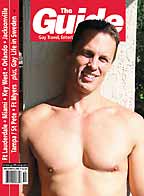
December 2005 Cover
|
 |
By
Jim D'Entremont
For five days every August, Stockholm Pride transforms the Swedish capital into a sprawling, multi-tiered queer playground. Its center is a compound in Tantolunden Park on Södermalm, the largest of Stockholm's 14 islands, but satellite events break out all over the city.
There are foam parties, church services, drag competitions, political debates. Each happening moves to the uptempo beat of
schlager, Sweden's campy indigenous popular music. On the fourth day, the Pride parade forms behind the National Museum, then pours
southward past the Royal Palace, through streets thronged with spectators waving small rainbow flags.
The Stockholm Pride Festival dates back only to 1998, when the city hosted the annual Europride gathering with such success that gay Swedes vowed to recreate the experience each year. The impetus came from a freshly discovered sense of community, from a sense
of the power of gay visibility, and from an innately Swedish need to invent occasions for fun.
This year approximately 20,000 people crowded into Pride Park for the August 3 opening. The keynote speaker was Stockholm police
chief Carin Götblad, who praised gay police officers for raising awareness of homophobia and discrimination. Extinguishing anti-gay hatred
was the official theme of Stockholm Pride 2005.
"We're working to make Stockholm the most gay-friendly city in the Scandinavian region," says 2005 festival chairman Ulrike Westerlund. That goal, pursued at some cost, may already have been reached.
In Sweden, gay couples can register as domestic partners or seek "registered partnership" status equivalent to marriage. Registered partnership was instituted throughout this constitutional monarchy by act of parliament in 1995. Inside Stockholm's elegant red-brick city
hall, site of the annual Nobel Prize banquet, there is a marriage chamber where Swedish couples, straight and gay, come to exchange vows and rings before an officiating "marriage conductor."
Gay and lesbian Swedes were granted adoption rights in 2002. The last official barrier to equality fell in June 2005 when the
Riksdag, Sweden's unicameral parliament, repealed a law denying lesbians the right to
in vitro fertilization. In October 2005, the governing
assembly of the Swedish Lutheran Church voted in favor of blessing gay registered partnerships.
Gay Swedes have been serving openly in the military since 1979. A current government campaign is aimed at enabling queer service personnel to serve
more openly. Among the largest contingents in the 2005 Stockholm Pride parade was a phalanx of GLBT police.
Discrimination on grounds of sexual orientation is prohibited in every Swedish workplace, from provincial grocery to Royal Palace.
Way back when
Same-sex attraction is a leitmotiv of Swedish history. There was no proscription against sodomy among Viking warriors in early medieval Scandinavia. Bestiality incurred criminal penalties, but not homosexuality, despite its denunciation by religious Christians. In the
14th century, Heliga Birgitta-- St. Bridget-- took King Magnus Eriksson to task for his liaison with a male courtier, accusing him of "loving men more than God or your own soul or your spouse."
Queen Christina (1626-1689) cultivated a masculine appearance and maintained an intimate relationship with one of her ladies-in-waiting. In the second half of the 18th century, gay King Gustav III (1746-1792) engendered a golden age of arts and culture during his
20-year reign. Since Gustav III's patronage of the performing arts earned him the sobriquet "the theater king," he might have been pleased to know that his assassination at a masquerade ball inspired the Verdi opera
Un ballo en maschera.
In the 19th century, repressions attending the rise of industrialization seeped into Sweden. The penal code of 1864 imposed fines and terms of up to two years' hard labor for persons caught in acts of "fornication against nature" (i.e. gay sex). This legal refinement did
at least take the egalitarian step of applying these penalties to women as well as men at a time when lesbianism was seldom acknowledged.
After 1864, gay-themed works of art became acts of courage. Artist Eugene Jansson (1862-1915), who won accolades as a painter of luminous, impressionistic vistas of Stockholm by night, turned his attention toward male nudes late in his career. His frankly
sensual depictions of sailors exercising or relaxing naked at a bathhouse encountered resistance in Sweden and remain unknown abroad.
Most gay members of the Swedish arts establishment were more circumspect. Sweden's foremost literary lesbian was Selma Lagerlöf (1858-1940), author of
Gösta Berling's Saga and the children's
classic The Wonderful Adventures of Nils. Lagerlöf, whose public
recognition included the 1909 Nobel prize for literature, led a sequestered private life not fully revealed until 1990, when letters sealed for 50 years after her death were finally read.
In the opening decades of the 20th century, some gay artists took refuge in the fledgling Swedish film industry, which managed to produce
Wings (1916), the first known feature with homosexual content. (The film preceded the German
Anders als den Anderen, often cited as the first gay movie, by three years.) Its Finnish-born gay director, Mauritz Stiller, is best known outside Sweden for discovering young actress Greta Gustafson, renaming her Greta Garbo, and bringing her to Hollywood.
By the 1930s, a growing medicalization of homosexuality in Sweden had created new styles of oppression, yet encouraged efforts to decriminalize homosexual acts. Sweden legalized consensual gay sex in 1944, but only for males 18 years of age and older-- a higher age
of consent than that imposed on straight adolescents. (Young Swedish lesbians, whose sexuality apparently posed less of a threat to civic virtue, could have sex at 15, like their heterosexual peers.) The legalization was an important step toward gay civil rights. But Swedish
authorities still considered gay men and lesbians disordered and in need of sometimes forcible treatment.
By the late 1940s, Swedes who had unsuccessfully opposed the decriminalization of homosexual activity found new ways to sell the idea of gay delinquency.
Leftist muckraking efforts teamed with right-wing family-values agitation to produce a moral panic running parallel to the McCarthy era in the United States. Groups such as the Association of Swedish Mothers mobilized against male prostitution. Sensational press
accounts purported to expose the exploitation of vulnerable youth by older men.
Both the gay decriminalization campaign and its backlash acknowledged a long-standing reciprocity between youths escaping rural poverty and prosperous middle-class men who encountered them along Stockholm's waterfront, in parks, or along the cliff walk on the
northern rim of Södermalm. One argument for legalizing gay sex had been a perceived need to stop young blackmailers from preying on older homosexuals. Crusading moralists seeking to reinstate the ban on gay sex, however, trumped up an urgent need to stop gay men from preying
on innocent boys.
In 1948, Karl-Erik Kejne, a pastor running a social-service mission in the medieval center of Stockholm, accused a male colleague of homosexual improprieties with local teens. When an ensuing police investigation stalled, Kejne spun tales of an organized network of
perverts infiltrating every branch of government. Vilhelm Moberg, the respected author of such literary classics
as The Emigrants, validated rumors of a gay cabal in a series of lurid exposés.
As hysteria spread, accusations of homosexuality forced Nils Quensel, the cabinet minister of ecclesiastic affairs, to resign. An overlapping scandal engulfed bisexual King Gustav V, whose putative ex-lover, Kurt Haijby, had apparently been paid a fortune in hush money.
These witch hunts drove many gay men into hiding, but inspired others to stand up and fight. In 1950, civil rights pioneer Allan Hellman co-founded Sweden's first gay political organization, modeled on the two-year-old Danish Club 48. The following year, Hellman took
the groundbreaking step of coming out in Se
(Look), a mainstream national magazine, and became, for a time, Sweden's only openly gay celebrity. (By contrast, Swedish diplomat Dag Hammarskjold, elected Secretary General of the United Nations in 1953, remained deeply closeted
along with most of his gay contemporaries in politics, literature, and the arts.)
Hellman's organization became known as Rikförbundet för Sexuellt
Likaberättigande (RFSL)-- the National Federation for Sexual Equality, now often called the Federation for Lesbian, Gay, Bisexual, and Transgender Rights. The RFSL's objective was to raise awareness of
gay issues and stop the witch hunts. An ancillary aim was to lower and equalize age-of-consent laws for gay teenagers.
In 1978, the legal age of consent was finally fixed at 15 for people of all sexual persuasions. That same year, a parliamentary "Homosex Inquiry" embarked on a comprehensive study. The commission's final report, released in 1984, recommended legalizing gay
partnerships, passing anti-discrimination laws, and instituting an ombudsman to deal with gay issues. All its recommendations have gradually been implemented.
In 1987-88, facially pro-gay legislative initiatives were set in motion by the commission's findings. But such evident signs of progress served the dual purpose of widening gay rights and narrowing gay relationships at a time when AIDS provided an excuse to
demonize homosexual freedom. In 1987, the same year legal domestic partnership status was introduced for Swedish gay couples, Stockholm's thriving gay saunas were shut down.
Stockholm has always had a discreet but lively year-round cruising scene-- on the island of Långholmen, in Skinnarviken Park, and elsewhere. Veteran activist Kjell Rindar recalls visiting one of Södermalm's main cruising spots in winter, "when snow was up to our knees,"
and finding men having sex there. But in major Swedish cities, as elsewhere, public sex has become more circumscribed in the age of HIV.
During the past two decades, the AIDS pandemic has hardly been the only source of mass anxiety in Sweden. This peaceable kingdom's serenity has sometimes been breached by violent crimes whose virulence seems heightened by their rarity. The most notorious have
been the assassinations of Prime Minister Olof Palme in 1986 and Foreign Minister Anna Lindh in 2003.
Tensions have arisen between ethnic Swedes and immigrants from Eastern Europe, Africa, the Middle East, and Asia. Of all the nations of the European Union, Sweden, whose population now exceeds nine million, harbors the largest percentage of foreign-born residents.
The Swedish political right has sought to stem the tide of immigration, sometimes ruthlessly.
A gay cause célèbre in 1998 was the Swedish government's refusal to grant asylum to Fahrad Miran, a gay man who had fled Iran, where his partner had been put to death. Officials claimed that since Miran could opt for the closet, returning to his homeland would not
necessarily place him in danger. Following protests, however, the Swedish Alien Appeals Board granted him permanent residence. The Miran incident was a rare instance where the groups most despised by Swedish reactionaries-- immigrants and queers-- found common cause.
Even in gay-friendly Sweden, there are gay-bashings, usually traceable to neo-Nazi fringe elements. In August 2003, the Stockholm Pride parade was pelted with rocks and bottles by a band of 30 skinheads from a hard-right nationalist group.
The extreme Swedish right had become especially incensed over enforcement of an "unfavorable speech" law. In 2002, a hate-speech statute meant to curb neo-Nazi incursions against Sweden's ethnic minorities had been amended to cover sexual orientation. The
revised provision offered no exemption for sentiments expressed at places of worship.
RFSL president Sören Andersson, who had lobbied for non-exemption of religiously motivated statements, promised that members of his group would monitor public expression and "report hate speech irrespective of where it occurs." Despite warnings from civil
rights advocates that the legislation would criminalize simply calling homosexuality sinful, it was narrowly passed by the
Riksdag in 2003.
Soon afterward, in June 2003, Pentecostal minister Åke Green earned 30 days in prison for saying from his pulpit that gay people are "the Devil's strongest weapon against God." He called homosexuality "a deep tumor that spreads through the whole body of society,"
and linked same-sex attraction to pedophilia. His resulting conviction, like the law that produced it, had the endorsement of Sweden's current gay leadership, but was by no means universally welcomed in the Swedish gay community.
"Åke Green preaches a rigid, not very Christian message," says former RFSL president Kjell Rindar, "but I think he should have the right to do this. I am critical of the law that forbids people to speak in hatred against us. If people do that openly, we know where our
enemies are. Now they hide. I'm ambivalent about our becoming a 'protected' group which everyone who claims to be politically correct must love."
In contrast to Green, evangelist Runar Sogaad of Stockholm's Filadelfia Church was accorded police protection when Muslims protested a March 2005 sermon in which he called the prophet Mohammed a "confused pedophile." The government's sudden embrace of free
speech in the Sogaad case was perhaps inspired by the voiding of Åke Green's conviction by an appeals court one month earlier.
Handsome men, strong women
The Swedish national impulse toward mandatory civility for at least some segments of the population has been fiercely encouraged by certain strains of feminism. Commendably, Sweden comes close to sexual parity; Swedish women wield considerable power in their
native land. 47 percent of the 349 members of the Swedish parliament are women, giving the
Riksdag the highest female representation of any governing body in the world.
But some Swedish feminists have joined hands with the international recovery movement, or taken positions globalized by American anti-sex firebrand Andrea Dworkin and her disciples. The result has been draconian sexual-harassment statutes, outbreaks of panic
over childhood sexuality, and efforts to subvert the nation's longtime tolerance of pornography. The Dworkinite influence in sexual politics is further reflected in the Swedish law directed at curbing prostitution, which makes it illegal to purchase sexual services but not to sell them.
In Sweden, a prostitute cannot be arrested, but the johns providing his or her livelihood can be.
In 2002, while the GLBT "unfavorable speech" provision was still before the
Riksdag, a queer feminist march reprimanded Stockholm Pride for being insufficiently inclusive of women. Subsequent editions of the festival have sought to address that imbalance. In 2004, the
RFSL, whose membership is about 40% female, adopted a feminist agenda.
Cradle to grave
Instituted in the 1930s, the Swedish
folkhemmet-- the "people's home" or welfare state-- has in recent years had strong feminist input. Right-wing complaints of communistic excesses to the contrary, Sweden's social programs are impressive. Health care is a
universal entitlement. About 97% of Swedes complete 12 years of school; high school graduates attend free, state-supported universities in large numbers. The British National Literacy Trust points out that among Western industrialized nations, Sweden has the lowest level of
functional illiteracy. (The United States has the highest.)
Sweden pioneered sex education. After 1975, when Swedish sex-ed curricula were revised to de-emphasize the doctrine of abstinence except within marriage, teenage pregnancy rates plummeted to a rate of seven per 1000. This figure stands in stark contrast to the 53
births per 1000 in the abstinence-besotted USA, where the teenage pregnancy rate is at Third World levels.
Teaching tolerance of minorities, including sexual minorities, is a part of Swedish education. Gay and lesbian speakers visit schools to talk about their lives. A typical class assignment is to write a response to a coming-out letter from a friend. Opposition to
state-supported programs fostering tolerance of gay people comes chiefly from religious conservatives. In the
Riksdag, Christian Democrats, whose party ranks fourth in terms of parliamentary representation, are leading foes of gay rights.
Swedes who declare a religious affiliation are 87 percent Lutheran. Until 2000, Lutheranism was the state religion. Legally implementing separation of church and state was simply a matter of formalizing the admission that Sweden is one of the most secular societies on
earth. Devout minorities do, however, exist. These include Muslims, Jews, Catholics, and, most controversially, Pentecostals.
Swedish Pentecostalism is centered in Jönköping, a match-factory town in the heavily forested region of Småland, south of Stockholm. The resolutely homophobic sect has American roots. An offshoot of the late-19th century Holiness Movement dedicated to "baptism in
the Holy Spirit" and literal Biblical truth, Pentecostalism emerged in 1901 at Bethel Bible College in Topeka, Kansas. From there it has spread worldwide. Converted on a 1906 visit to the US, Norwegian Baptist minister T.B. Barratt introduced the sect to Scandinavia. In 1911,
Barratt's Swedish acolyte Lewi Pethrus carried its tenets to Stockholm. Swedish Pentecostals now number 90,000.
Topeka, the American cradle of Pentecostalism, is now, perhaps not coincidentally, the home of the Westboro Baptist Church, pastor Fred Phelps (disowned, like Rev. Pethrus, by mainstream Baptists), and his ecstatically homophobic family juggernaut. Phelps, who claims
kinship with Swedish Pentecostals, was incensed by the prosecution of Åke Green, whom he calls "the first Christian martyr in Europe since the Spanish Inquisition." Phelps's website includes a "GOD HATES SWEDEN" page exulting in the deaths of up to 500 Swedes in the Asian
tsunami disaster of December 2004, calling Sweden "a land of sodomy, bestiality, and incest," and stating that King Carl XVI Gustav "looks like an anal copulator, & his grinning kids look slutty & gay!"
Many non-Swedes lacking Phelps's peerless virulence share his misreading of Sweden as a sexually freewheeling society. Swedish culture is actually a constant give-and-take between the sensual and the austere. This polarity is a defining theme of Swedish fiction, art, and
film. In Vilgot Sjöman's I Am Curious
(Yellow) and I Am Curious (Blue), cinematic companion pieces whose color-coded titles allude to the Swedish flag, a native revolutionary spirit, political and sexual, confronts the constraints of conventional middle-class life. In Ingmar Bergman's
Fanny and Alexander, warmth, art, food, and sex compete with frigidity, philistinism, abstemiousness, and prudery.
This interplay of opposites permeates Swedish gay life. Stockholm Pride attracts pro-sex and anti-sex elements, liberationists and homebodies, hedonistic disco queens and solemn activists. It draws business-oriented gay conservatives, and anti-capitalists who view the
festival as too bourgeois, too commercial, too expensive (but attend it anyway). Admission to Pride Park isn't cheap: a week's pass costs 580 kronars (about $72); a day pass costs 300 ($37). Still, more than 10,000 attendees show up daily.
Many accept the steep admission price as a cost of minimizing corporate support. Swedes have resisted turning the gay community into a market niche. Stockholm Pride is a not-for-profit operation handled by an all-volunteer staff. The festival receives corporate
contributions from Vodaphone, Scandinavian Airlines, and other sources, but the festival and parade are not as steeped in commercialism as many of their counterparts elsewhere in the world, especially the USA. Corporate logos are seldom seen; commercial involvement in the Pride parade is
kept to a minimum.
"When you allow commercialism to take over," explains Pride vice chairman Martin Johansson, "the result is not pretty, because it's like you don't know your own value."
Most urban gay Swedes, securely aware of their own value, are assertively uncloseted. The growing contingent of gay public figures in Sweden include politician Andreas Carlgren; the rock band Army of Lovers; writer/comedian Jonas Gardell and his partner, author and
children's television entrepreneur Mark Levengood; pop singer Eva Dahlgren, who came out when she applied for a same-sex marriage license; photographer Elisabeth Ohlson Wallin, whose controversial work combines gay and Christian iconography; and Hans Ytterberg, a jurist and past
president of the RFSL, who has served as state-appointed Homoombudsman or "HomO" since 1999.
Inhabiting a country that straddles the Arctic Circle, Swedes cope with summer nights flooded with light and winter days shrouded in darkness. Every season calls for strategies involving balance. Gay Swedes have absorbed old cultural lessons in countering sobriety
with exuberance, high seriousness with low frivolity. They seem poised between the weight of the world and the rhythmic seductions of
schlager. Thoughtful by nature, Swedes understand the leavening grace of silliness. This trait may make them the sanest people in Europe.
You are not logged in.
No comments yet, but
click here to be the first to comment on this
Magazine Article!
|