|
 |
A Bayard Rustin retrospective
By
Michael Bronski
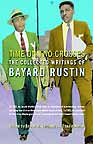
Time on Two Crosses: The Collected Writings of Bayard Rustin
edited by Devon W. Carbado and Donald
Weise
Cleis
Press
How to order
Time on Two Crosses: The Collected Writings of Bayard
Rustin, edited by Devon W. Carbado & Donald Weise (Cleis
Press, $16.95)
Reading through Time on Two Crosses is both wonderful and disheartening. Here we have writings-- political theory, journals, interviews, essays, op-ed
pieces-- crossing four decades of American political life from 1942 to 1987, and each year we can see the mind growing, the social consciousness developing
and maturing. Here is truly a unique, distinctly American, mind that has grown with, and helped sustain the political developments, of the last half century.
But who is Bayard Rustin? Unfortunately, his name does not carry instant recognition. Rustin, an African-American man who studied nonviolence with
Ghandi, helped Martin Luther King organize the Montgomery bus boycott in 1956. He was also with King in helping plan the March on Washington in 1963, and he was
seen as a visionary and vanguard leader for the black civil rights movement throughout the 1950s and 60s. He was also gay, and the disclosure of this caused
enormous friction for him, the movement, and beyond.
Rustin was always asking hard, practical questions-- in the 1950s it was "Exactly how do we get black votes in the South?" In the 1960s it was "How do
we end the war? What is the first step?" In 1967, against strong opposition in the civil rights movement, he defended Muhammed Ali's fight to be deferred from
the draft because of his Black Muslim ministry. Rustin also, in the 1970s, spoke of the political failure of black separatism at a time when even more mainstream
black activists were taken with its symbolism, if not its practicality.
Rustin's thoughts on the gay movement and his own homosexuality are fascinating. Using his background in the civil rights movement he speaks of the
quirks of organizing. In 1986, he tells a student group that "The NAACP worked for 60 years to pass an anti-lynch law, and now we don't need one. It was the
propaganda from the law that we never got that liberated us." In a 1987 interview he speaks of why he never introduced the idea of adding sexual orientation to the
civil-rights movement agendas, explaining that there are some "movements that cannot be married" and need to work cooperatively, not as a unified whole. There
are surprising moments here-- such as the idea that Dr. King was accepting of Rustin's gayness because of his own extra-marital affairs.
What is disheartening about this collection is that it points out how far we have not come in the last 50 years. The thread running through Rustin's
writings is the message that the drive for social justice includes everyone, and that issues of justice are always connected. The current
glbt movement has little concern for anything outside its own, very narrow, "rights" and "equality" agenda. It shows no interest in other social justice movements-- for women, people of
color, prisoners, or against war and the death penalty-- and little interest in many of the non-mainstream people in its own movement.
This is anathema to Rustin's vision. While he, and King, believed that promoting the civil rights movement required a variety of tactics-- one of which
was putting presentable people up front-- they were also committed to always foregrounding the issue of social justice for everyone. They constantly argued
that taking the highest moral stand was the imperative issue and tactic.
Reading through Bayard Rustin's writing we see glimpses of what the gay movement might have become. This makes
Time on Two Crosses necessary, if discouraging, reading.
| Author Profile: Michael Bronski |
|
Michael Bronski is the author of
Culture Clash: The Making of Gay
Sensibility and The Pleasure
Principle: Sex, Backlash, and the
Struggle for Gay Freedom. He writes
frequently on sex, books, movies, and
culture, and lives in Cambridge,
Massachusetts. |
| Email: |
mabronski@aol.com |
You are not logged in.
No comments yet, but
click here to be the first to comment on this
Book Review!
|