|
 |
Lost Isherwood and Huxley manuscript debuts
By
Michael Bronski
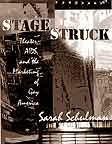
Stagestruck: Theater, AIDS, and the Marketing of Gay Americ
Sarah Schulman
Duke University Press
187 pages
How to order
Jacob's Hands
Aldous Huxley and Christopher Isherwood
St. Martins Press
140 pages
How to order
Gay and After
Alan Sinfield
Serpents Tail
225 pages
How to order
Rarely after their deaths are great artists called for surprise encores. Aldous Huxley and Christopher Isherwood have been dead for decades, but this new manuscript--
a collaboration between the two writers-- was found recently in a trunk at Huxley's estate. The discoverer was actress Sharon Stone, who was researching the
author's work for a film based on his short story "The Giaconda Smile."
Jacob's Hands (St. Martins Press, cloth, 140 pages, $14.95)
is a novella-length film treatment for a script that Huxley and Isherwood were under contract to write for a Hollywood studio in the late 1930s, and which was never produced.
At first glance, Jacob's Hands looks slight, its compact size giving the feel of a package without much content. But from the first page, it proves mesmerizing
and moving. Jacob's Hands is the story of a ranch hand who, after learning that he has the gift of healing, becomes disillusioned when he discovers that mending a
broken body does not always heal a tormented soul. Written in plain but elegant language, the novella unfolds in the present tense-- as though the writers were telling the plot
of the proposed script, an approach that lends an air of innocence and mystery to the story. While the presentation feels naive, the book's emotional undercurrents stir
up deeper, troubling responses. Is it possible, Isherwood and Huxley ask, for the gift of healing to be misused or misunderstood in the modern world?
Jacob's Hands is a complex and disquieting modern fairy tale that is unlike anything else either author has written before.
Stealing our plots
While working as a theater critic for Manhattan's
New York Press in 1996, novelist Sarah Schulman reviewed the original off-Broadway production of what was
to become the world-wide hit Rent. She did not particularly like the show and resented what she saw as its simple-minded appropriation of gay and alternative East
Village culture-- turning what began as an authentic counterculture into a Disneyesque self-parody. It was only later, when a friend pointed it out to her, that she began to
see that Rent's writer and composer Jonathan Larson had "borrowed" a good chunk of his play's plot and detail from Schulman's own 1987 novel
People in Trouble. Schulman has responded
with Stagestruck: Theater, AIDS, and the Marketing of Gay
America (Duke University Press, paper, 187 pages,
$17.95).
Stagestruck begins with Schulman's account of having her novel ripped-off by
Rent, and goes on to discuss more broadly how gay culture and AIDS is
represented, used, and distorted in the mainstream. She focuses her discussion on a range of entertainments, including the film
Philadelphia, Jon Robin Baitz's play A Fair
Country, performances by Diamonda Galas, and
Poz magazine. As with her novels
(Empathy, Rat Bohemia) and her essays (compiled in
My American History) Schulman's observations are astute and original. She takes on big topics and pushes her readers to think about the extended implications of culture and their lives.
Stagestruck is an incisive, important work of cultural criticism.
Post-mod, -gay, -human
One of the paradoxical triumphs of the gay liberation movement is that it lead to a world in which the freedom to be "gay" allowed women and men to act
and define themselves in ways that created new "identities" that broke from earlier gay culture. With gay people raising families and heterosexuals seeking more
freedom from sex and gender restraints, what does "gay" mean anymore? In
Gay and After (Serpents Tail, paper, 225 pages,
$17.95), British cultural commentator Alan Sinfield looks at how complicated "gay" has become. Sinfield is interested examining how gay identity is constructed, or even possible, in a time of social and
political contradiction: gay people are still reviled and yet perceived as a lucrative consumer market, they have more freedom then ever before and yet are told by the dominant culture to be "private." What do these contradictions mean? How do we to make sense of them in terms of our everyday lives?
Sinfield shifts through a broad range of high and popular culture-- from Stephen Spender and Jean Genet to the Pet Shop
Boys, The Wedding Banquet to ACT UP, SM to Andrew Holleran's
Dancer From the Dance-- to try and discover patterns in the endless
cracking and dissolution of a once seemingly cohesive culture and identity. He has a good, clear grasp on a wide range of cultures, and even
more important, he understands how movies, music, novels, television, and politics effect how we think and live.
Gay and After is tentative in the best sense of the word-- Sinfield, with political insight and cultural acumen, is an intrepid adventurer in this new territory and he
never tires of exploring new theories and explanations and seeing what makes sense.
| Author Profile: Michael Bronski |

|
Michael Bronski is the author of
Culture Clash: The Making of Gay
Sensibility and The Pleasure
Principle: Sex, Backlash, and the
Struggle for Gay Freedom. He writes
frequently on sex, books, movies, and
culture, and lives in Cambridge,
Massachusetts. |
| Email: |
mabronski@aol.com |
You are not logged in.
No comments yet, but
click here to be the first to comment on this
Book Review!
|