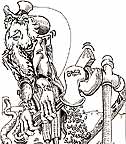
Drugs deal in Doha
By
S. Predrag
Trade negotiators from 142 countries, meeting in Doha, the capital of the Gulf state of Qatar (November 9 to 14), have finally reached a broad agreement on easing patent laws to allow developing countries easier access to
drugs in health emergency situations.
After a marathon debate, the Fourth World Trade Organization (WTO) Ministerial Conference, agreed that the Trade-Related Intellectual Property Rights, also known as TRIPS, "can and should be interpreted
and implemented in a manner supportive of WTO members' rights to protect public health and in particular to ensure access to medicines for all."
This wording, although not as precise as many human rights and AIDS activists would have preferred, has been seen by poor countries, particularly those ravaged by AIDS, as the go-ahead to produce or buy cheaper
generic drugs.
Some developing countries, especially India and Brazil, were in the forefront of the action, insisting that TRIPS should not be a stumbling block for poor countries to use cheap, generic drugs in treating HIV/AIDS.
India and Brazil, as well as Thailand, Malaysia and some other countries, are already producing generic drugs against AIDS which are much cheaper compared with patented medicines.
Africa, particularly the sub-Saharan region, already accounts for over 70 percent of the world's 36 million HIV/AIDS patients and most experts agree that the worst is yet to come.
In South Africa, it is estimated that there are 4.7 million HIV-positive people and this figure is increasing daily by more than 1,700 new cases.
AIDS has doubled mortality, tripled child mortality and slashed life expectancy by 20 years in some African countries and UN experts predict that HIV/AIDS could kill an additional 16 million people in the coming
two decades.
Although some international pharmaceutical companies have promised anti-retrovirals at a reduced price (slashed by up to 90 percent), the reality is that most African countries cannot afford even these low, low prices.
After all, it is estimated that more than half of Africa's 800 million people are surviving at one dollar a day.
In a landmark case at the Pretoria High Court last April, 39 pharmaceutical giants unconditionally dropped their case against the South African government and agreed to pay all the legal costs.
The pharmaceutical companies accepted that South Africa "...may enact national laws or regulations, including regulations implementing Act 90 of 1997 or adopt measures necessary to protect public health and
broaden access to medicine in accordance with the South African constitution and TRIPS."
However, according to some local experts, this court victory did not allow South Africa to import either generic versions of medicines still protected by patents (parallel importation) nor will it enable South African
companies to manufacture cheap local generic versions of patented drugs (compulsory licensing).
The drug companies are protected by patent rights (a 20-year monopoly to produce drugs and control over pricing) and most anti-retroviral drugs are relative newcomers to the market.
TRIPS was signed in 1994, and its critics from many poor countries claim that its main flaw is the 20-year patent protection of new medicines which in turn delays the production of much cheaper generic drugs.
Last week, South Africa blamed the US and Canada of using double standards and being hypocritical over HIV/AIDS and anthrax issues.
Canada has publicly announced its readiness to buy a generic version of Ciprofloxacin (Cipro), whilst the United States used the threat of doing so in order to force a hefty price reduction from the German patent
holder, Bayer AG.
South African analysts have stressed that so far just four people have died of anthrax in the United States, none in Canada, while around 4,800 people are dying each week of HIV/AIDS in South Africa close to the
tragic loss of life suffered by America on September 11.
"You can't apply one thing to developing countries and then, when you find you have your own problems, become willing to waive the rules," reacted an OXFAM charity representative referring to the US threat of
importing a generic copy of Cipro.
However, the US used strong-arm tactics to force Bayer to sell 100 million tablets of Ciprofloxacin for $0.95 instead of its regular price of $1.77 per tablet. As for the patent version of Cipro, the price is 35 times higher!
It costs $350 per month in the US, while a generic copy of the same drug costs only $10 per month in India.
In a statement before the conference, World Health Organization (WHO) Director-General, Gro Harlem Brundtland, said that, "The Doha ministerial conference is providing a historic opportunity for WTO members
to ensure that the agreement does not stand in the way of access to life-saving medicines, especially in the poorest countries."
Brazil's Minister of Foreign Relations, Celso Lafer, told the meeting in Qatar that, "The commercial exploitation of knowledge must not be valued more highly than human life."
"Brazil promotes and upholds intellectual property rights," he said, adding that, "If circumstances so require it, Brazil, like many other countries, will not hesitate to make full use of the flexibility afforded by the
TRIPS agreement to legitimately safeguard the health of its citizens."
The United States and Switzerland initially argued that the already-existing accord was flexible enough not to stand in the way of efforts by poor countries to get access to cheap anti-AIDS drugs.
Both countries, home to most of the largest international drug companies, also argued that any weakening in the accord would discourage pharmaceutical companies from investing in research and development.
The US Trade Representative, Robert Zoellick, warned the conference that, "This open-ended language will lead to mass erosion of patent protections from pharmaceuticals to medical software and thwart research
into medicines that can save lives."
The American delegation in fact proposed giving the least-developed countries a 10-year extension, until 2016, to implement TRIPS and a five-year moratorium on contesting any drug patent actions taken by
sub-Saharan Africa.
However, the poor nations at Doha immediately reacted by saying that this concession does not go far enough.
In the end, the American chief delegate accepted a compromise on poor countries' access to patented drugs.
The Doha agreement on access to medicines was hailed by some developing countries, and the international charity organization, OXFAM, said that, "The Doha deal on drugs is better than anyone could have hoped for a
year ago."
Still, OXFAM did not hide its disappointment that no agreement had been reached on the issue of compulsory licensing in third world countries.
There are also some skeptics who have noted that the Doha agreement on access to drugs was "rather ambiguous" because, after all, there are no
clear boundaries defining a health emergency.
You are not logged in.
No comments yet, but
click here to be the first to comment on this
News Slant!
|





 Advertise with us
Subscriptions
Contact us
Site map
Translate
Advertise with us
Subscriptions
Contact us
Site map
Translate