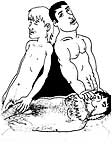
Opening up the gay trinity
|
 |
By
Blanche Poubelle
Twink as a slang term for gay men dates from sometime in the 1960s, and it is defined in the
Oxford English Dictionary as "An effeminate young man, a sissy."
Twink gained some prominence in Armistead Maupin's
Tales of the City books, where it is a frequent description of various gay men.
But what exactly does it mean? Miss Poubelle has noticed that men described on the internet as twinks usually don't seem the least bit effeminate. More often, the common factor is that they're young and handsome.
A
search of internet sources shows that "young" and "handsome" seem to be necessary parts of the definition; other commonly cited characteristics of twinks are "slender," "lightly muscled," and "having little body hair."
The Wikipedia entry on the term makes the insightful observation that
twink is often opposed to jock and
bear.
Linguists who look at the definitions of words have learned that it's often difficult to give iron-clad definitions of words in isolation; many words have meanings that describe a point or region along some spectrum of
possibilities (in distinction to other points on that spectrum).
Take "cups" and "bowls," for example. What exactly is the difference? Cups tend to be deeper than they are wide and have handles. Bowls typically tend to be wider and shallower than cups and usually don't have handles.
But readers of this column probably can think of many counterexamples. Still, given two pieces of crockery, we mostly agree on which is more cup-like and which is more bowl-like. Linguists call the most typical example of
something the "prototype," and there's good psychological evidence that when you hear a word, the most prototypical example of it is what first comes to mind.
For similar items -- such as a cup or a bowl -- there are often contrasting prototypes at either end of the spectrum. Blanche suspects that behind words describing types of men -- such as
twink, jock, and bear -- are
such contrasting prototypes. So a twink is primarily an attractive man who is not a jock or a bear. We could imagine four features that distinguish the prototypes of these kinds of guys. There is an age dimension (young v.
non-young), a hirsuteness dimension (hairy v. non-hairy), a size dimension (big v. not-big), and a muscularity dimension (muscular v. non-muscular).
Twinks are prototypically [young, non-hairy, non-muscular], bears are [hairy, big], and jocks are [muscular, big]. And by that we only mean that if you show gay men two guys that differ on these dimensions, they will
generally agree on which is closer to being a bear, twink, or jock. On everything else, they will argue about whether this person is hairy enough or young enough or muscular enough to really be considered a bear, twink, or jock.
If you start thinking about all the ways these features could combine, you can probably think of examples of many other types, some described by terms less commonly used. So slim, hairy guys are sometimes called
otters on the gay bear sites. They are basically like bears, but they differ on the size dimension. The nearly extinct "clone" look of the 1970s seems to have prototypically been somewhat muscular and somewhat hairy, but not
necessarily big.
Other combinations are imaginable, but don't have well-established names. So what do you call a fairly lightweight, muscular, non-hairy, not so young guy? Or young, big, non-muscular, non-hairy men? There are surely
plenty of guys who fit these descriptions, and lots of men who are attracted to them as well. Beyond this problem lies the larger issue of race and ethnicity, with several of these prototypes defined in terms based on Caucasian
body types and body-hair distribution.
Men who don't match one of these recognized types are often overlooked in gay culture. There's a lot of power in these prototypical images, and we often find ourselves being consciously or unconsciously attracted to the
men who are most like some prototypical ideal. Blanche thinks that the emergence of the gay bear prototype in the '80s was a real step forward because it recognized that there were lots of gay men who didn't fall into the
generally approved categories of that time. We've still got a lot of work to do, but let's hope that gay culture will continue to evolve in a direction where we acknowledge and appreciate the diversity of our bodies and our tastes.
You are not logged in.
| # |
Subject |
Author |
Date/Time (ET) |
| 1242 |
huh |
cockluvr
|
09/05/07 06:18 PM |
|