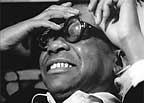
Jason Holliday, at his undoing
|
 |
A 1967 documentary portrait of a gay man outdoes Borat for mercilessness
By
Michael Bronski
Portrait of Jason
Directed by Shirley Clarke
With Jason Holliday.
How to order
It's hard to find a gay movie that really gets under your skin. Sure
Brokeback Mountain made people cry, and there are moments in the recent gay films
Poster Boy and Boy Culture that pack some affect. But they don't
gnaw at or upset you. If this is what you've been waiting for, it's back to the future.
Shirley Clarke's extraordinary 1967 cinema
verité documentary Portrait of
Jason, never released on VHS, has finally surfaced on DVD. Long considered a classic of late 1960s underground cinema,
Portrait of Jason is a disturbing, emotionally draining experience for the contemporary viewer. Considered shocking for its on-screen drug use, frank language, and openly homosexual subject when released in 1967, these attributes are now commonplace.
But Clarke's film still unnerves because the director's ruthless, at times sadistic, goading of her subject goes too far even by current standards, lower by Borat and sex-entrapment TV.
C
larke had previously gained critical attention for her 1962 film of Jack Gelber's off-off-Broadway hit
The Connection, and her 1964 film adaptation of Warren Miller's acclaimed novel
The Cool World. In 1967 she convinced Jason Holliday, a close friend of her life-partner Carl Lee, to be filmed talking. Holliday, born Aaron Payne, is a gay, alcoholic, drug-using African-American man with theatrical ambitions, though he spends most of his time on the
fringes of show business and works only part time as a houseboy/paid-companion to jazz musicians or the well-to-do. He is eager to speak of his sex life, which is prodigious but not more than many other gay men in the late '60s.
The power of Portrait, however, is in watching Holliday-- who begins the long session already drunk and probably on amphetamines tempered with marijuana-- as he falls apart before our eyes. As the film proceeds, he
becomes drunker and more stoned. By the end he has progressed from sitting in a chair to falling on the floor and from hysterical laughter, speed rapping, and long haunting silences, to a desperate begging for love and attention
that would be more heart-breaking were it not so meticulously, coldly observed, and detailed by Clarke and her crew.
Clarke films Holliday in long uninterrupted takes-- his voice continues even as the screen goes blank as new film is loaded-- in her sparsely furnished, attractively appointed, living room. The stark black-and-white images
have the emotional dislocation of a Diane Arbus photograph. It's probably no accident that Arbus had her first big show at the Museum of Modern Art in 1967; as unique as
Portrait of Jason, it is very much of product of its
time. Stylistically, Clarke's film fits in neatly with the general avant-garde aesthetic of that year-- Arbus photographs, Anthony Harvey's film of LeRoi Jones's
Dutchman, Andy Warhol's I, A Man and
Bike Boy. Clarke's in-your-face, confessional starkness is chilling and her insistence on highlighting, even exploiting, emotional trauma effective.
Portrait of Jason packs a powerful punch. Clarke's forthright style never trades on irony and her
unflinching insistence on breaking Holliday down to his inner core is merciless.
Everything short of waterboarding
But dazzling aesthetics aside, Portrait of
Jason has a deeply unpleasant aura; much of it feels overtly cruel. Holliday starts his monologue with high attitude-- this is another one of his hustles to get the attention he feels he
so richly deserves-- but he quickly loses his edge to the filmmaker, who eggs him on, knowing that he's quickly spiraling downward. We can often hear the off-camera Carl Lee (the son of Canada Lee) prompting Holliday to
tell another embarrassing story and even taunting him about being "fake." These moments are even more painful when we learn, late in the film, that Holliday has romantic feelings toward Lee. Even when he is relatively in
charge and most controlled-- as when he sings "The Music That Makes Me Dance" from the stage version of
Funny Girl-- Holliday is, at best, loosely wrapped.
As unpleasant as this is, Clarke's film is an important part of gay history: even if the exploitation of Holliday smacks of homophobia and racism, this is probably the first film to feature as subject a sole gay man. Chalk it all
up to pre-Stonewall mentality? Certainly Jason Holliday seems the embodiment of the self-destructive, unliberated homosexual, But there were complex and certainly more compassionate representations of queer people
being produced at the time. Frank Simon's The
Queen, an empathetic look at contestants in a drag beauty pageant, was filmed in 1967. Even Mart Crowley's 1968
The Boys in the Band, which certainly has its fill of self-indulgent
gay angst, is more sympathetic in portraying pre-Stonewall gay life. In this context Clarke's film-- mesmerizing as it is-- feels even more unkind and manipulative.
So why is Portrait of Jason so compelling? Why can we simply not look away? Jason is that nightmare vision of homosexuality that lurks in most gay men, most people-- a character so desperate, needy, and wounded that
he is willing to be exploited to get attention. Pre- or post-Stonewall, we haven't come that long a way, baby. Jason is a powerful, mythic figure and we respond in kind.
Editor's Note: Portrait of Jason, directed by Shirley Clarke (99 minutes, Second Run DVD,
Secondrundvd.com).
| Author Profile: Michael Bronski |
|
Michael Bronski is the author of
Culture Clash: The Making of Gay
Sensibility and The Pleasure
Principle: Sex, Backlash, and the
Struggle for Gay Freedom. He writes
frequently on sex, books, movies, and
culture, and lives in Cambridge,
Massachusetts. |
| Email: |
mabronski@aol.com |
You are not logged in.
No comments yet, but
click here to be the first to comment on this
Movie Review!
|