Wanted
|
 |
An Irish retelling of an old tale
By
Michael Bronski
About Adam
Written and directed by Gerard Stembridge
with Kate Hudson, Alan Maher, Charlotte Bradley, Rosaleen Linehan
How to order
The fantasy is always there: sex is so wonderful, so liberating, so ecstatic that it changes the world. Or at least the people having sex. One of the joys of
About Adam is that it tells the simple story-- with wit, grace, and narrative economy-- of what happens when sex
is this good. It's a fairly tale in which there are no ogres, witches, or dragons, and almost everyone-- except its eponymous character-- is a sleeping beauty just waiting to be turned on and fucked by that Edenic man who seems never to have fallen-- or perhaps fell so
well that he makes sin look both original and so-much-fun.
Written and directed by Gerard Stembridge,
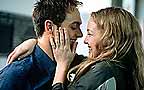
About Adam begins when Lucy (Kate Hudson), a singing waitress in an upscale Dublin bistro, meets Adam (Stuart Townsend), a new boy in town. They begin an affair that is as blissful as it is sudden. Adam is
perfect, in fact, he's so perfect that everyone in Lucy's family loves him. So much so that he begins to have an affair with Lucy's bookish sister Laura (Frances O'Connor), who falls for Adam as soon as he begins to recite Christina Rossetti, her favorite Victorian poet. After
that, it's only a matter of time when brother David (Alan Maher) begins to get his own crush on Adam, a development to which Adam happily responds. Even sensible, highly observant sister Alice (Charlotte Bradley), who is unhappily married, succumbs to Adam's
charms. Only Peggy (Rosaleen Linehan), the mother of all these fallen children, does not hit the sack with Adam-- she settles for outrageous flirting.
About Adam's working title was All About
Adam, and its structural similarities to Joseph Mankiewicz's 1949 classic
All About Eve are unmistakable-- for instance, a deft use of multiple points of view. Adam's first meeting with Laura is first seen in the
passing context of his meeting Lucy's family. The meeting is next seen, through Laura's eyes, as a fevered seduction. If
All About Eve used multiple POV to gradually reveal Eve's duplicity-- "Eve, Eve, little Miss Evil," hisses a drunken Bette Davis during one of the film's
most elegantly catty moments-- here it is used to construct an Irish
Rashomon in which there is no one truth, no one consistent narrative.
Impossible dream
Simply on this level, About Adam is a fascinating study of erotic interpolation and interpretation. But there's another film that
About Adam draws upon-- Pier Paolo Pasolini's 1968
Teorema. The title translates into English as "theorem," and Pasolini's plot
is, indeed, mathematical. A beautiful Christ-like figure (the young and beautiful Terence Stamp) comes into a bourgeois Italian family and proceeds to sleep with all of them-- mother, father, son, daughter, as well as the maid. The sexual ecstasy they all encounter with
the young man is too much for them to bear, given their middle-class mores and minds, and they all go, to varying degrees, insane. The maid, of proletariat origins, becomes a saint. Pasolini's Marxism and Freudianism clashed beautifully with his message of the
(near) impossibility of sexual freedom.
It's a nifty idea and has already found a home in Hollywood where it was also a large influence on Paul Marzursky's
Down and Out in Beverly Hills, in which Nick Nolte sleeps with a variety of family members of a spoiled upper-middle class Rodeo Drive
family. But what Stembridge has done is to pluck Pasolini's plot out of its deeply political habitant and plop it into a garden of earthly delights. No one goes crazy or gets weird in
About Adam-- they just get loosened up and sexually liberated. After sex with Adam, Lucy
realizes what a dud her last boyfriend was, Laura has a revelation and finishes her doctoral thesis on sexually-hip Victorian women, Alice gets to have a good trim, and David (after excusing himself from actually having sex with Adam-- though he is totally turned on) gets
to have a real sex with his girlfriend. It would have been a more daring film if Stembridge had allowed David to have a full-fledged fuck as well as his sisters, but the vision of
About Adam is nowhere close to Pasolini's profound vision in
Teorema. Stembridge's mise en scene is a solidly middle-class and middle-brow, one in which homosexual temptation is all the more enticing because it's not acted upon, and sex so good that it can't but help make people happier.
But as a sunny, friendly, user-funny film,
About Adam offers pleasures on its own. Pasolini's darker vision was perfectly consistent with the emerging sexual freedoms of the late 1960s-- an assertion of the depth and complexity of sex's meaning.
Stembridge's message-- in a world that is battling over the very question of sex being good-- is that sex is great and liberating. While not earthshaking or explosive,
About Adam is charming and fun and its heart-- as well as Adam's hard-on-- is in the right place.
| Author Profile: Michael Bronski |
|
Michael Bronski is the author of
Culture Clash: The Making of Gay
Sensibility and The Pleasure
Principle: Sex, Backlash, and the
Struggle for Gay Freedom. He writes
frequently on sex, books, movies, and
culture, and lives in Cambridge,
Massachusetts. |
| Email: |
mabronski@aol.com |
You are not logged in.
No comments yet, but
click here to be the first to comment on this
Movie Review!
|