|
 |
The story of boy trouble
By
Michael Bronski
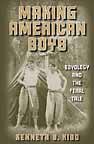
Making American Boys: Boyology and the Feral Tale
by Kenneth B. Kidd
University of
Minnesota Press
How to order
Boys, as they say, will be boys. But how do they get to be that way?
Making American Boys is a compelling, erudite-- but very readable-- analysis of how the idea of the "boy" emerged in America over the past century-and-a-half.
Obviously there've always been-- and are now-- male people under the age of 16 or 17, no longer children but not yet men. But that doesn't make "boy" a straightforward term. The very idea of children was a late-18th-century invention, contended Philippe Ariès in his
classic 1962 Centuries of Childhood: A Social History of Family
Life. On Ariès's account, there essentially were no "children" before this time-- younger people were understood to be smaller versions of adults, had clear responsibilities, and were integral social players. Was Ariès right?
A vigorous academic controversy continues. But certainly notions of childhood are at least partly culturally constructed-- the super-sentimentalized one that reigns in the West now has smeared all over it traces of its largely 19th-century Victorian British birth.
These debates give the background to Kidd's book, but its emphasis is on how the idea of the "boy" evolved in American popular culture. The key to his story is the decline of rural life starting in the early 19th century and the way it forced boys off the farm. The
anxieties around male migration to cities and industrial work spawned a myth of the boy reflected in everything from a literature about "bad boys" to the evolving ethos of the Young Men's Christian Association, with its aim of protecting youths from the temptations of the sexualized city.
The response to these anxieties was to create institutions to "protect" and "civilize" boys, as well as to separate them off as wild, even potentially dangerous, pre-men. One curious manifestation of these concerns was the "feral tale"-- and Kidd interestingly explores how
stories of children raised in the wilderness by animals impacted upon the "bad boy" in American fiction.
Wild 'n' crazy guys
So much of "boyology" (the term comes from Henry William Gibson's 1912
Boyology or Boy Analysis, a book written to garner "genuine sympathy" for the struggles of youth) was an attempt to grapple with the innate conflict of cultural boyhood. On one hand, boys
were great because they were free from the constraints of culture (thus the image of the feral). But on the other hand, they were expected to be on the path to becoming educated and responsible men.
The association between boys and the wilderness was strong. Lord Robert Baden-Powell, the founder of the scouting movement, drew upon the works of Rudyard Kipling-- and in particular,
The Jungle Books with their feral boy, Mowgli-- when he began a junior scouting
program in 1915. Kidd explores myriad connections between the animal and the boy-- from Edgar Rice Burroughs 1912
Tarzan of the Apes to Freud's case studies of the "wolf man" and the "rat man." All this leads to a lengthy discussion of Mark Twain's
Huckleberry Finn and its centrality to US culture. Kidd does a great job looking at Twain's critics and in explicating Leslie Fiedler's famous 1948 essay-- "Come Back to the Raft, Ag'in, Huck Honey!"-- on the innate homoeroticism of the book. Thus Kidd arrives at the nub of the "problem" of the boy in US culture.
The boy hovers-- in traditional psychoanalytic and cultural terms-- between the innocence of the asexual child and the heterosexuality of an adult male. In this schema boys may not be gay, but they're certainly queer.
Kidd's cultural references are far-ranging. While he begins with obscure (and some not-so-obscure) 19th-century novels and memoirs-- from Charles Dudley Warner's
Being a Boy to Horatio Alger's myriad fictional homeless boys who make good in the city-- he also
discusses such contemporary phenomena as Michael Jackson's
Thriller, the 1985 Teen Wolf with Michael J. Fox, and the 1956
I Was a Teenaged Werewolf. Kidd makes scintillating connections between monsters, adolescence, Robert Bly's "Iron John" myths, Freud's theories, children's
books, and Eddie Murphy's 1998 film Dr.
Dolittle. At the end, Kidd looks at the new "crisis" over boyhood-- with echoes of its 19th-century predecessor-- in books such as Dan Kiley's
The Peter Pan Syndrome, William Pollack's
Real Boys: Rescuing Our Sons From the Myths of
Boyhood, and James Garbarino's Lost Boys: Why Our Sons Turn Violent and How We Can Save
Them. Kidd considers such works as a measure of how far we have-- or have not-- come.
While Making American Boys isn't exactly a "gay book," it raises vital issues about how sex, gender, and age shape our ideas about sexual orientation and behavior. Implicit in all of this discussion about boys, of course, is the question about how we define men and
sexuality. Surely, if homosexuality were accepted as routine and innocuous, the "crisis" over that in-between place of boyhood would wither away. But until it does, we'll need Kidd's terrific history of American boyhood as an essential historical guide to a still-boiling problem.
| Author Profile: Michael Bronski |
|
Michael Bronski is the author of
Culture Clash: The Making of Gay
Sensibility and The Pleasure
Principle: Sex, Backlash, and the
Struggle for Gay Freedom. He writes
frequently on sex, books, movies, and
culture, and lives in Cambridge,
Massachusetts. |
| Email: |
mabronski@aol.com |
You are not logged in.
No comments yet, but
click here to be the first to comment on this
Book Review!
|





