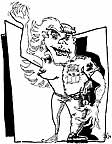
Like a Canadian vice cop scorned
In many ways Canada is a more sensitive and civilized society than its neighbor to the south-- there are no executions, no slums, and there's health insurance for all. Canada doesn't
conduct its foreign policy by assassin's bullet and drone-dispatched guided missile. But in one respect, Canada (at least its vast Anglo reaches) looks positively Burmese or Zimbabwish. Cross its
sex police-- challenge them or expose their criminal excesses-- and they'll use their considerable powers to destroy you.
Consider the cases of Kyle Rae and Robin Sharpe.
Toronto's Ward 27 doesn't show up pink on city maps, but maybe it should, for encompassing heavily gay Church and Wellesley. Openly gay Kyle Rae represents Ward 27 on the
city council. When vice cops raided the local Club Toronto in the wee hours of September 15, 2000, during its once-a-year lesbian charity night-- "Pussy Palace"-- Rae didn't mince words.
He called the officers "cowboys," "goons," and "rogue cops" on a "panty raid."
Councilman Rae's anger was understandable. Cops hadn't stormed a gay bathhouse since a series of violent raids in 1981 that-- for Toronto gay consciousness and political
organizing-- were tantamount to New York's Stonewall. Moreover, just a few months earlier, in April 2000, Julian Fantino had been appointed police chief-- to the horror of gay Toronto. Fantino had
built his career fighting victimless sex crime with a vengeance. Newly installed, Fantino had just presided over a series of tense meetings with the gay and lesbian community in which he
had promised a reign of tolerance and understanding-- a promise obviously broken the night of September 15th.
To top it off, the "Pussy Palace" raid was illegal-- the cops used a routine liquor-license inspection as a cover, in order to avoid getting the necessary search warrant, for which
they lacked basis. Using municipal code violations as a pretext for unlawful, warrantless raids is a dirty little secret of Canadian vice policing, and courts are wising up. Noting the
subterfuge, Ontario Court Judge Peter Hryn threw out the liquor charges in January 2002, ruling that the raid violated Canada's Charter of Rights and Freedoms.
Vindication, you would think, for Rae's outburst at the Toronto police. But remember that Canada is a very sensitive society, with the skins of its vice officers apparently
particularly tender. Seven of the cops involved in the illegal raid sued Rae for C$3.5 million for speaking of them out of "malice." Rae's comments had "caused embarrassment, harm to their
reputations, and lowered their esteem in the community," the cops' attorney, Michael Freeman declared in court. Rae's words "impacted them personally, professionally... and will cause them
significant financial loss for the duration of their careers."
Perhaps Canadian coppers are the sort of refined souls whose sleep is troubled by a pea under the mattress, and who wake with a start on summer mornings from the flapping
of butterfly wings in nearby meadows.
Or perhaps homophobia had something to do with the vice cops' allergic response to Rae's rebuke. Toronto's gay paper
Xtra noted that the cops' attorney noted that the five
male plaintiffs were "all involved in steady relationships" the heterosexuality of which was attested to by biological offspring. (The two female officers' sexuality was not mentioned.) Rae, on
the other hand, was described as being "an openly gay individual and advocate of gay rights." That had not stopped the Toronto Police Association from having had endorsed Rae just
before the Pussy Palace raid-- even though Association head Craig Bromell had called politicians "scumbags" (presumably with no malice intended) in a TV documentary.
Rae's attorney, John Holding, countered that "this case is not about gay rights, but the right of all Canadians to be free from unreasonable search.... Rae can only communicate to
the public through the media and... the media respond to sound bites, colorful language."
Ontario Superior Court Justice Jean MacFarland herself spoke plainly. In her instructions to the jury, she said the cops' case for economic damages was "flimsy," adding "You would
be hard-pressed to find recklessness in the circumstances of this case." But on last June 27th, the jury of five women and two men found for the police, and awarded C$170,000 in damages.
Civil libertarians were stunned. Counselors "have got to be free to criticize the police and not feel that they're going to be sued every time they do," said Toronto civil-rights
attorney Clayton Ruby. Rae had little directly to lose-- the damages were to be paid out of the City of Toronto's insurance fund. He chose not to appeal, letting the awful precedent stand.
Will a victim please come forward?
Move 2000 miles to the west, and the gentle breezes wafting off the Pacific Ocean don't make the vice cops any less vindictive. Vancouver sex police had writer Robin Sharpe
under their gun for almost eight years in a porn case that grew to international prominence. After a string of rulings in Sharpe's favor-- with Sharpe sometimes acting as his own attorney--
Canada's Supreme Court handed down a mixed verdict last year. Sharpe ended up with a slap on the wrist-- four months of home detention. And that was a slap in the face to Vancouver Vice,
which had obsessively pursued the case. And that's when the cops used the exact same evidence they'd seized years earlier to shop around for new charges.
It all began with some marijuana Sharpe unwisely had in his luggage as he passed through US Customs in Seattle on a flight back from Amsterdam in April 1995. US agents found it,
and also noticed some photos showing nude late-adolescent youths. Sharpe was let go, but the agents passed the word on to Canada Customs, who declared the nudes "kiddie porn" and
busted him. A year-and-a-half later, Vancouver Vice raided Sharpe's apartment taking 14 boxes of manuscripts, books, and photos.
When Canadian parliament rushed to pass a kiddie-porn law in 1993, the Canadian Bar Association had criticized the legislation as overbroad. The law makes no distinctions
among photographic depictions, stories, political writing, or paintings. Nor does it distinguish between five-year-olds, youths of 17, or 25-year-olds who merely "look like" teenagers: all is
and criminal to make, sell, or possess. But it took Sharpe, a retired city planner who, for lack of money, acted initially as his own attorney-- to effectively challenge the law.
Sharpe had been published in gay magazines such as
Passport and Sodomite Invasion
Review, a Canadian literary journal. His poems and novellas are variously crude, witty,
sharp-edged, and poignant. His pornographic stories tend to dwell on the theme of teenage boys getting whipped.
Police charged Sharpe for possessing kiddie porn, and given the multiple copies of his writings, added a more serious charge of "intent to distribute."
In 1999, responding favorably to Sharpe's arguments British Columbia Supreme Court Justice Duncan Shaw struck down the Canadian kiddie porn law's possession provisions.
What people keep in their homes is "an expression of that person's essential self," Justice Duncan Shaw declared in his decision. "His or her books, diaries, pictures, clothes, and other
personal things are intertwined with the person's beliefs, opinions, thoughts, and conscience."
Shaw's decision provoked a huge outcry. Parliament threatened to overturn the ruling by fiat, and anti-porn crusaders collected 300,000 signatures.
Last January, Canada's highest court mostly reversed Shaw's ruling on possession-- though they said that it was not illegal for an individual to produce kiddie porn-- i.e., write a
diary entry about themselves having sex as a 13-year-old-- so long as he didn't show it to anybody.
[In response, Parliament in Ottawa is now proposing to change the kiddie porn law to axe the "artistic merit" defense, and also to allow the prosecution of writers (or their readers)
if fictional characters appear to be violating Canadian sex statutes.]
In March 2002, Justice Shaw acquitted Sharpe on two, most serious, charges of possessing pornographic stories with the intention to distribute-- the stories were protected under
the Canada's Charter of Rights and Freedoms, he ruled. (Sharpe promptly published some of them online at www.robinsharpe.ca.)
But in May, Judge Shaw found Sharpe guilty on two counts of possession and sentenced him to four months' house arrest.
At the end of August, just before his sentence was up, the crown laid new charges. The evidence for the crime? The very same photos the Vancouver vice cops had held in
their possession since 1996, pictures on which they had launched their initial prosecution. The cops wanted to use these photos as evidence that Sharpe was having sex with one
particular teenage model.
The only trouble was-- despite years of intense publicity-- they didn't have a complainant. Without a "victim" the case couldn't proceed. So Vancouver Vice put out a press
release-- disseminated nationally over Canadian Broadcasting-- seeking the young man who Sharpe had photographed two decades before. Would he please come forward now to accuse Sharpe,
the cops pleaded.
Sharpe tells The Guide that he thinks Vancouver Vice knew all along the identity of the youth-- now a man-- in question, but that he wasn't cooperating. The national campaign to
"find a victim," Sharpe thinks, was about pressuring on the man's family to make him talk to the cops.
And talk to the cops he has-- in an interview the police videotaped, Sharpe says the man talks fondly about their friendship. He also says that more than 20 years ago, when a few
years shy of the age-of-consent, he engaged in mutual masturbation with Sharpe and got blow-jobs. Whether the youth was in fact over- or underage will be a crucial question at the trial.
The crown is now charging Sharpe under a 1971 law of "indecent assault of a male" and "gross indecency"-- under the terms of which Sharpe faces up to 10 years in prison and a whipping.
A preliminary hearing is set for June.
Vancouver's out-of-control sex police are doubtless lusting to give Sharpe the licking themselves-- that's how Canada Vice treats citizens who stand up to their injustice.
You are not logged in.
No comments yet, but
click here to be the first to comment on this
News Slant!
|





 Advertise with us
Subscriptions
Contact us
Site map
Translate
Advertise with us
Subscriptions
Contact us
Site map
Translate