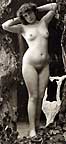
Banned beauty
|
 |
Record-keeping laws put history on the straight and narrow
By
Bill Andriette
Take a photo of two people having sex and U.S. law demands you inspect and photocopy their government-issue IDs. The law is Section 2257 of the U.S. Code, and it covers
"production" of sexually-explicit images as of November 1, 1990. Congress amended section 2257 in 2006 as part of a mega sex-crimes bill, the Adam Walsh Act. The amended version stipulates
that merely "digitizing" a photo counts as "producing" it. That can mean trying to get drivers' licenses from models who were strutting their stuff in 1869.
B
y equating "digitizing" and "copying" with "producing" for the sake of the mandatory record-keeping, the Adam Walsh Act effectively bans access in the U.S. to the world's legacy
of historic erotic photography. In virtually every case, IDs for the models and the precise creation dates of images are impossible to find or know.
An American at Paris's Musee de l'Erotisme who takes a digital photo at, say, an exhibit of 1920s porn, could be breaking the law upon touching U.S. soil. Unless he's flying from Paris
to Cleveland, Detroit, Lexington, or Chattanooga. Those are all cities in the 6th Circuit, whose Court of Appeals struck down the entire record-keeping statute as unconstitutional on
October 23.
| Author Profile: Bill Andriette |
| Bill Andriette is features editor of
The Guide |
| Email: |
theguide@guidemag.com |
You are not logged in.
No comments yet, but
click here to be the first to comment on this
Magazine Article!
|