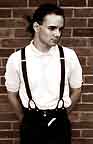
Bernard "Bee" Baran
|
 |
But grounds for optimism for man falsely accused as a gay youth
By
Jim D'Entremont
Early in 1985, after a kangaroo-court trial rife with violations of due process, Bernard Baran, a gay 19-year-old teacher's aide at a Pittsfield, Massachusetts, daycare center, was convicted of molesting five small children
and sentenced to three concurrent life terms (not two, as
The Guide previously reported). Insisting on his innocence but lacking resources for an appeal, Baran has languished in prison for 15 years. Now, following the
publication of a feature article about Baran in
The Guide's December 1999 issue, the case is progressing toward justice.
That progress, however, has recently been impeded by a serious mishap. On March 19, Baran was injured while playing basketball at Bridgewater Treatment Center, the facility that has been his home for
the past nine years. The injury was accidental, occurring when Baran rushed behind a larger man who, unaware of his presence, stepped rapidly backward and elbowed Baran sharply in the center of his face. When
Baran crumpled to the floor, bleeding, the inmate who struck him burst into tears.
Rushed to nearby Brockton Hospital, Baran was treated for a life-threatening head injury. He temporarily lost motor control in the left-hand side of his body, and suffered speech impairment. A CAT
scan showed bruising of the brain but no bleeding or fluid accumulation. An EKG has ruled out a stroke.
As The Guide goes to press, Baran has almost regained full mobility. His speech is slow but coherent. He continues to have problems with his left eye. "Whenever I lie down," he says, "the room spins."
His condition, diagnosed as "post-concussion syndrome," is being treated with steroids and other medications.
Meanwhile, attorneys are sifting through the facts to form a strategy. Newly discovered evidence discredits the flimsy physical evidence prosecutors presented at the original trial. One boy tested positive
for gonorrhea, but the test used has since been shown to have a high rate of false positives. (Baran's gonorrhea test was, in any case, negative.) Evidence has also emerged that suggests that the boy may have had sexual
contact with one of his mother's boyfriends. A tiny flaw in one girl's hymen, cited as proof that she had "suffered severe medical damage," is now known to be a common irregularity.
Circumstantial evidence amounted to little more than the prosecutor's implication that a gay man working in child care must be like "a chocoholic in a candy factory." The testimony of the children coached
and prodded by parents, therapists and police, requiring the now discredited use of "anatomically correct" dolls on the witness stand was confused, contradictory, and conducted so that Baran could neither see nor adequately
hear the proceedings.
Baran's attorneys are also monitoring another, more highly publicized Massachusetts abuse case. On April 19, lawyers for Gerald Amirault, convicted along with his mother and sister in a notoriously
politicized daycare case that also erupted in 1984, asked Massachusetts Governor Paul Cellucci to grant him executive clemency. A commutation for Amirault, whose cause has gained widespread popular support, would greatly
enhance Baran's chances of obtaining freedom as well.
It helps that the press is awakening to the outrageousness of Baran's predicament. While a prospective television interview has had to be postponed because of Baran's injury, media attention continues to
build. The Guide article reached a reader in Chelmsford, Massachusetts, whose description of the case was published in the letters column of the January 12
Wall Street Journal. In the February 21 issue of
The Nation, progressive journalist Katha Pollitt published a column on Baran noting that "for the first time in 15 years, there's a chance this shameful miscarriage of justice can be set right if it is possible to speak of setting right a wrong that has
cost a man his youth."
In the March 18 edition of the Berkshire
Eagle, Baran's hometown newspaper, Samuel Sass devoted a portion of his column to Baran, citing Pollitt's
Nation piece and calling Baran's predicament "a
truly significant human rights case."
After reading various accounts of the case, 152 donors contributed a total of $9,540 to Baran's defense fund between December 1999 and April 2000. (Attorney Robert Rosenthal, a specialist in
reversing wrongful abuse convictions, estimates that a successful bid to obtain justice for Baran will cost $100,000.) Dozens of others have written directly to Baran. His allies range from elderly nuns to young gay men. A majority
are straight.
Inquiries and donations can be sent to The Bernard Baran Justice Committee, c/o Swomley & Wood, 83 Atlantic Avenue, Boston, Massachusetts 02110 USA. Expressions of support can be sent to
Bernard Baran at 30 Administration Road, Bridgewater, Massachusetts 02324.
You are not logged in.
No comments yet, but
click here to be the first to comment on this
News Slant!
|