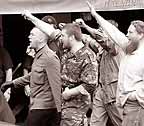
Anti-gay nationalists on the attack in Moscow, May 27th
|
 |
From Adelaide to Zurich, gay pride parades these days are mostly good excuses for a street party. On May 27th, what was intended to be Moscow's first-ever gay march, banned by the city, devolved into assaults on
gay supporters-- with rocks, fists, and some 120 arrests, of both would-be marchers and their skinhead and militant-Christian attackers. For months, Moscow's mayor and religious leaders had foamed with anti-gay
rhetoric. Even by the measure of their own demagogic aims, did authorities go too far?
Some 1000 police, a quarter of Moscow's force, bolstered by the OMON riot squad (in Cyrillic that's "HOMO" spelled backwards) were on hand to prevent gay activists from holding their march, which mayor
Yuri Luzhkov had vowed would be forbidden in "any form," and if attempted would be "resolutely quashed."
After months of legal tousling, a Moscow court upheld the mayor's ban on May 26th, with a judge invoking the fig-leaf of insufficient police manpower. Organizers quietly scaled back their plans and aimed for
a surprise, symbolic-- and in theory-- completely legal protest. First they would head toward the Kremlin, to the Tomb of the Unknown Soldier, to lay wreaths-- a gesture at once anti-fascist and patriotic. Then they
would stand in protest in front of city hall.
The Moscow Pride 2006 World Conference (which the mayor had also threatened to ban) coming before the march meant there were notable guests from outside Russia-- among them, human-rights monitors
and parliamentarians-- who might serve as "human shields."
Around 2:30pm on the drizzly afternoon of May 27th-- the 13th anniversary of Russia's decriminalization of male homosexual relations-- small groups of would-be pride marchers approached the tomb
clutching flowers.
"We were immediately set-upon by about 100 fascist thugs and religious fanatics, who began pushing, punching, and kicking us," describes British activist Peter Tatchell in
UK Gay News. "They snatched flowers out
of our hands and abused us with chants of 'No sodomy in Moscow' and 'Put the pederasts on the iron' and 'Russia is not Sodom.'"
Some 200 to 500 counter-protesters outnumbered the 50-to-100 Moscow Pride participants. The anti-gays ranged from egg-throwing Russian Orthodox grandmothers clutching crosses to skinheads and other
far-right nationalists, sometimes armed with rocks and flares.
Nicolas Alexeyev, the main organizer, was one of the first arrested as he approached the tomb with his bouquet. "This is a great victory, an absolute victory-- look at what's happening," Rex Wockner
reported Alexeyev as saying as two police seized him and led him away to a waiting van. (Alexeyev was released hours later, with bruises and a long cut on his palm to show for his encounter with police-- and the prospect of a
large fine.)
The would-be pride marchers tried to walk inconspicuously the short distance to City Hall for the planned picket, facing taunts and attacks from skinheads.
"I had never seen such a breakdown of law and order, gangs of thugs running wild on Saturday afternoon on one of the main streets of a European capital city," Robert Wintemute, University of London law
professor, declared in a first-hand account on www.gayrussia.ru.
As would-be pride celebrants regrouped at City Hall, they were again targets. German parliamentarian Volker Beck, an openly-gay Green representative from Cologne, was talking to TV reporters at the site of
planned picket when attackers hit him with a rock and punched him in the head, leaving him dripping with blood-- an image shown widely throughout European media. Pierre Serne, aide on gay issues to Paris mayor Bertrand
Delanoë (himself gay), had to be hospitalized after being beaten. Among others physically attacked were Kurt Krickler, secretary-general of Vienna's Homosexual Initiative, and Merlin Holland, an English writer and the grandson
of Oscar Wilde. (Holland's lecture May 25th at the State Library of Foreign Literature was interrupted by some 20 demonstrators who threw eggs, screamed for a "Russia free of faggots," and sprayed mace.)
Police sometimes herded gay demonstrators into the path of violent nationalists, ignoring assaults going on right under their noses, and seized peaceful gay protesters as readily as attackers. Police failed to arrest
the man who assaulted Beck, even though Newsweek's
Russian edition tracked him down for an interview. "We have to beat the degenerate pederasts who like to show themselves," the magazine quoted Alexei Napylov,
age 25. Rather than his attacker, cops took Beck into custody, and held him for two hours.
Police spokesman blamed the gay flower-bearers for the disturbances. They could be confident the mayor would back them up. "Morality works here," Yuri Luzhkov had told Russkoye Radio the day before the
planned march. "If anyone has any deviations from normal principles in organizing one's sexual life, those deviations should not be exhibited for all to see, and those who may turn out unsteady should not be invited to do so. I
thank the citizens of Moscow as 99.9 percent of them in recent days also believe it is unacceptable to hold such parades."
Moscow's religious establishment-- Russian Orthodox, Jewish, and Muslim alike-- was an ecumenical chorus in support of banning the gay march, with Talgat Tadzhuddin, the country's chief mufti, saying that "if
they come out into the streets anyway, they should only be beaten up." In the event, Moscow's Muslims-- a target of skinheads and police themselves-- were not evident among the attackers.
Unhousebroken bear?
Images of peaceful protesters getting savaged by a mob before being hauled off by cops weren't flattering to a Russia eager to assert its democratic credibility.
Ironically, Russia had just assumed presidency, for the first time, of the Council of Europe, which addresses human rights in its 46 member countries. And in St. Petersburg this month, Russia's President Vladimir
Putin hosts the "Group of Eight" summit of major Western leaders-- some of whose political colleagues have war stories from the May 27th melée.
Putin has good relations with the Russian Orthodox Church, but so far he's stayed above the fray, as if to keep what happened a purely local matter beneath presidential notice. But that may not be possible
any longer. "Between Merkel and Putin is Beck," declared a headline in a Moscow paper, suggesting the issue could be an awkwardness between the German and Russian leaders at the carefully staged G8 summit.
But as well there will be pressure to diplomatically pass over the matter. "You have to be careful not to impose our advanced liberal views on countries where they have different ideas," René Van der Linden,
president of the Council of Europe, told a Dutch paper after the Moscow Pride debacle, explaining why he did not bring up the matter in discussions with Putin, though he did say he expressed concern about nationalist violence
in general. Moscow Pride, Van der Linden went on, seemed to be a foreign initiative.
West like East?
The reality is that anti-gay bigotry is becoming a motif in retail politics throughout the former Eastern-bloc.
In Poznan, Poland, last November, demonstrators tried to hold a rights march, only to face a ban from city hall on grounds of "security." When the candle-bearing marchers gathered anyway, they were met
with skinheads and thugs from All Polish Youth, a wing of the Polish Families party, who pelted the marchers with eggs and taunted them with slogans such as "Gas the fags!" Police did nothing to stop the violence-- except
to arrest 68 of the pro-gay demonstrators for their "illegal" protest.
Poznan authorities had banned previous gay marches, including one last June. And Warsaw mayor Lech Kaczynski banned the capital city's gay march for two years running.
For now, the repression seems to morph rather than fade. Warsaw's gay march went off without a hitch June 10th, with Volker Beck a keynote speaker. But the parade was allowed in part because Lech Kaczynski
is no longer mayor. Last October, Polish voters elevated him to the country's presidency, with right-wing parties winning 77 percent of the vote. With his identical twin brother Jaroslaw Kaczynski as parliamentary leader,
the two Law & Justice-party politicians have formed a minority government of hard-right xenophobes, including the Polish Family party, which has just been handed the education ministry, and has launched an inquiry into
what it claims are gay organizations' criminal links.
Putin's Russia is right in-the-swim of those authoritarian currents. Moscow Pride organizers, as they take their case against Moscow politicians and cops to the public and maybe the European Court, will need to
watch their tongues. Putin's United Russia party has drafted a law making "libelous criticism of state officials" a form of illegal "extremism." "'Extremism' and 'terrorism' are divided by only a comma in a law passed earlier
this year," notes Garry Kasparov, former world chess champion turned political campaigner, writing in the
Financial Times. "Naturally, the meaning of these terms will be interpreted by the same officials."
Putin's heavy-handed state authoritarianism is seen by many-- and by most Russians-- as necessary to take down the robber-baron oligarchs loosed by the US-prescribed economic "shock therapy" after
communism's fall.
But growing authoritarianism, economic cronyism, and vaporizing civil liberties aren't ex-East-bloc monopolies; the terms fit Russia's former Cold War enemy as well.
In America, gay pride parades are happily normal, and rights protections-- sometimes even unto marriage-- are inscribed in law. Yet it's one of the unexamined ironies of the West's sexual liberation in the 1970s,
which cleared thickets of irrational customs and law, and stripped away veils of silence, but also heightened a taste for punishing sex. Ask anyone facing civil-commitment after an arrest for public sex, or a life sentence
for downloading cartoon porn. The terms of abuse are different in Moscow than Wichita-- and to Western ears, all the talk of "degeneracy" seems archaic. But despite the blood spilled in his streets, Moscow's Mayor
Luzhkov can probably look out his window to the West and conclude he's safe.
You are not logged in.
No comments yet, but
click here to be the first to comment on this
News Slant!
|