|
 |
What gay culture circa 1965 can tell us about the future of gay history
By
Bill Andriette
September 14 to 17, some 200 historians will gather at the University of Chicago for what is billed as the world's largest gay history conference. On the agenda are
such matters as male friendships in 11th century Europe, transgender saints in the Spanish empire, and the punishment of sodomy in colonial Massachusetts. Most of the historians attending would likely show disinterest at
a document from the gay past that turned up at The
Guide-- a mail-order book catalog from 1965 put out by Guild Book Service in Washington, DC. The 120-page compendium is pre-Stonewall, but only just, and offered
for sale familiar works that still grace libraries and bookstores. What's the big deal? Yet poring over the Guild catalog's offerings, one could be forgiven for thinking that the strangest historical mysteries lie unnoticed, right
at hand, in the near-- not the furthest-- past.
It's an oddity of the individual's relation to history: that the most recent past-- the time just before a person comes to consciousness-- serves as stand-in for the longest-ago. For someone born today, the
plentiful relics of the 1990s-- objects and events most exquisitely out of reach just for lying so near-- will be the closest encounter with everything that came before. As a child grows gradually aware of the long duration, tokens of
the era just-passed take on the mystery of the long-ago history that they are called upon to transmit. Waves of nostalgic fascination in American culture-- for the 50s, 60s, or 70s-- follow partly from this phenomenon. Time
far remote and time just-passed and can end up curiously equidistant, equally strange.
The modern gay movement, sprung now the world over, traces its origins to the big bang of New York's Stonewall riots in 1969, just as the Soviet Union saw itself born in the 1917 revolution. Claiming birth
in revolutionary chaos asserts a radical break with all that came before. Over time, the Soviet experiment-- which held itself the universal and scientific path to the future-- sank into sclerosis, with its elite becoming as
self-serving as any. In a way perhaps parallel, the movement that grew out of Stonewall today obsesses over winning nods of recognition from the state-- hate-crimes laws and gay marriage-- rather than asserting a vision
of freedom and eroticism on its own terms, and all the while ignoring fresh waves of sexual censorship and demonization.
Yet for both the Soviets and gay liberation, the claim to revolutionary novelty had real basis. Whatever Russia's tradition of peasant cooperation, Soviet Russia was a profound departure. Though there had
been a broken chain of homosexual organizing in the West going back to the late 19th century, pre-Stonewall organizations and businesses quickly ceded leadership to a new generation. Numerous gay publications-- those of
Guild Press among them-- that guided queers as stars did for the early navigators now faded in gay liberation's blinding sunrise. As with the burst of consciousness out of nothing that comes with every child's birth, these
conditions have put the time before Stonewall under a shadow of mystery.
From physique mags to lit
If in 1965, in a world without gay bookstores, you wanted to buy
The Hell of Loneliness-- a spoof on the lesbian
classic-- Confessions of a Male Prostitute, or
The Beginner's Guide to Cruising, then the
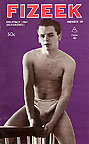
Guild Book Service in Washington, DC, would have been your best bet. Since the 50s, the Guild Press had proven itself as a publisher of physique magazines. "In the spring of 1963, in response to the insistent demands of
patrons... the board of directors... decided to enter the mail order book field," the catalog explains.
Physique mags were the gay porn of the postwar era, and among Guild Press's roster were
Fizeek Art Quarterly, Golden Gate
Stud, and Grecian Guild Pictorial. As important as providing beautiful male
bodies to ogle, these magazines offered a socially acceptable rationale for doing so: body building-- a pursuit that, as the popularity of gay gyms attests today, is close to gay hearts.
And yet by the mid-60s, there was decreasing necessity for homosexuality to veil itself in "physical culture." The Guild Press took advantage of the new openness. Still, they did not anticipate the
transformation to come. In the blurb for The Homosexual
Revolution, the Guild catalog declares that "the book has its faults-- the main one being its title.... There is no gay 'revolution' in progress, only a slow change in the status
and awareness of the American gay person." Stonewall was not on the Guild's agenda.
So close, so far
From the perspective of 35 years hence, the 1965 Guild book catalog suggests the gay world we know today as if in embryo-- at once familiar and strange, in the way that the unborn uncannily look
sometimes wholly different from the creatures they become.
Most of the themes represented in contemporary gay culture show up here. The books on sale discuss transsexuality, sadomasochism, interracial relationships, cross-dressing, pederasty, leather, the world
of Hollywood physique modeling (precursor to the
porn industry), cruising, scat, sex laws, and gay travel. Such has been the growth of the gay corpus, each of these now support their own market segments,
specialty publications, organizations, and Web sites-- but here they weave and jumble in the same space.
However, continuity in themes between our world after Stonewall and the gay scene at its cusp is accompanied by what seems sometimes a radically different sensibility.
In its passage from physique publisher to bookseller, Guild Press ripped away the veil, asserting homosexuality's value and legitimacy throughout their catalog in a way that their physique publications had
not. But much of the material the Guild Book Service sold did not made that transition. Many of the books were dime-store paperbacks produced for the mass market, books that while exploring homosexuality with some
sympathy, did so only under the pretense of doing something else-- usually sensationally exposing a seamy demimonde.
"One day he was a married man with a family.... The next day he was plunged into the half-world of homosexuality," shouts the front of the anonymously-authored pulp paperback
All the Sad Young Men, whose cover shows what seems like sodomitical zombies. "The author of this sophisticated book need not remain anonymous from lack of pride in his achievement," advises the Guild catalog blurb without rancor. "This is
an entertaining book-- it will not educate you, inform you but you could not spend a more pleasant evening than with it."
With other books about homosexuality, there was, beneath the exposé, little sympathy. Carley Mills's
A Nearness of Evil, offers "a fictional account of one of the strangest murders ever committed in
America, the Wayne Lonergan case," which "shocked the whole nation before World War II." Lonergan allegedly murdered his wife, who he met after an affair with her father, "a wealthy member of the international gay set
who relinquished him to his daughter only after having an extended affair with Lonergan himself."
Ka-Tzetnik's novel Atrocity tells the story of Moni, "a beautiful 11-year-old boy who is passed from one Auschwitz Block Chief to another." He "lives only as long as he is kept by one of the Nazi
concentration camp guards, all of whom are psychopathic homosexuals... whose greatest pleasure is to strangle a 'piepel' just as he, while screwing him, is coming to his climax." The Guild tells catalog browsers, "You will read this
book with fascinated horror, but you will not be able to resist or forget it."
Clearly the Guild Book Service showed toleration of homosexual representations that the Gay and Lesbian Alliance Against Defamation would today demand be censored. One could say that the Guild
sold such books out of self-hatred. But the choice rather seems to follow from recognition of how sex is entangled with most human capacities, for good and evil. In 1965 there was not so much capital invested in
gayness-as-a-brand-identity that thorny discussions had to be silenced.
From the same unprepossessing mindset, perhaps, the Guild catalog shows patience for psychiatric disputation about homosexuality that gay people a few years later would tune out. Among the books
featured is On the Cause of Homosexuality, in which "two eminent psychologists" debate whether "non-human animals assume homosexual roles as a defense mechanism because of the fear of incest" and whether "homosexuality
is one of the causes of alcoholism." The more sympathetic author asserts, at least, that "as far as any insight to the cause of homosexuality is concerned, almost the entire literature is worse than worthless."
Yet the Guild Book Service catalog was unambiguous in claiming homosexuality's value and ubiquity. "The simple truth is that young boys and men learn that homosexual activity is pleasant and they
continue with it to varying degrees-- few abandon or turn their back on it if it is available," the catalog notes in its blurb on Carson Wade's
The Twilight Sex, whose cover proclaims it "A bold and penetrating exposure of habits
and practices among homosexuals-- their causes, cures, and personal case histories."
The Guild catalog is, of course, innocent of AIDS, and there is no sign of the "bear" aesthetic, whose prominence today probably echoes the epidemic-- full physiques being the opposite of wasted ones.
Rather, the emphasis in the catalog is on adolescence as an erotic ideal, together with a knowingness about youth sexuality that today seems striking.
"The author stresses his belief that adolescents arouse fears in many adults because they reawaken sexual conflicts which these adults have attempted to repress," notes the Guild in touting Canadian critic
Edgar Z. Friedenberg's The Vanishing
Adolescent. That conflict and repression has grown so extreme today that when the British TV show "Queer As Folk" was imported to the US, the young protagonist's age had to be upped
from 15 to 18 so as not to offend American sensitivities-- and invoke kiddie porn laws-- when he sleeps with his 20-something boyfriend.
The present reality seems a world away from that depicted by
Never the Same Again, a mass-market paperback by Gerald Tesch in the Guild catalog. "Johnny Parish is a lonely 13-year-old who
craved understanding, companionship, and sexual release," begins the plot summary. "Ray Davis, 30, and just out the US Navy, was operating a filling station and searching for the love and friendship that always seemed so close,
but somehow eluded him." When the two get together, "Roy and Johnny were happy and both felt that life could not be better...." Clouds enter the picture only when Mr. Bentley, the local Scoutmaster, jealous for Johnny,
spoils the connubial bliss. Emblazoned on the book's cover is a plug from
Library Journal: "Very powerful first novel." The Guild begs to differ: "Gerald Tesch is not the best writer in the world," the catalog avers about the author
of this still "absorbing and worthwhile book." Clearly amidst the criminality and taboo of 1960s homosexuality, there was no hierarchy of virtue.
Enduring value
If the gay world depicted by Guild is not more surprising to us today, it is partly because so many of the works sold here are still widely read. The catalog culls from a range of important writings dealing
with homosexuality that had been recently published. From the Guild Book Service in 1965-- or your local bookstore today-- you can find John Rechy's
City of Night, William Burroughs's Naked
Lunch, Jean Genet's The Thief's Journal, Hubert Selby's
Last Exist to Brooklyn, James Baldwin's Another
Country, Gore Vidal's The City and the
Pillar, or Christopher Isherwood's Berlin
Stories. Whether any of these works will be read a century from
now is unknown, but they at least survived beyond the generation in which they were composed, and some are likely to be judged 20th-century classics. It's a wonder that there was a wave of so much significant writing
about homosexuality mid-century, coming with a wave of similarly-themed popular works. Was there some unusual ferment over homosexuality and culture going on mid-century, as there was for a time in Renaissance Italy
or ancient Greece? Will post-Stonewall gay literature have similar resonance?
The Guild catalog's affirmation of homosexuality followed not from state blessing or psychiatric authority-- these were not at hand-- but from a wide-ranging historical consciousness. With its erotica,
pulp fiction, and porn, the Guild book service aimed at the common queer denominator. Nonetheless, the catalog offered, along with its contemporary classics, books from an array of cultures and eras: scholarly and popular
works on ancient Greece and Rome, Sir Richard Burton's
Arabian Nights, and the Hindu Kama
Sutra. Gratuitously peppered throughout are pithy quotes about same-sex love from the likes of Plato, Sir Roger Casement,
Turkish sultan Selim I, Shakespeare, Walt Whitman, and King James. Matching those diverse personalities, there's a depth and breadth to the catalog's literary offerings, a
sense conveyed of homosexuality's broad tradition. Readers in Dubuque or Mobile would find out they were not alone, and had never been.
Post-Stonewall gay liberation-- following in the path of the civil rights and feminist movements-- has asserted homosexuality as a political identity justified wholly in its own right, needing no reference to time or place. Like "being Hispanic" or
"being a woman," one is understood to be "born that way." As with Soviet ideology, this forefronts gayness's supposed novelty. Never before has sex been so politicized, and the past so irrelevant. As with the Soviets, gay identity post-Stonewall is
essentially about the future. With its older continuities for now denied, will the future of gay history be a matter only for academics?
| Author Profile: Bill Andriette |
| Bill Andriette is features editor of
The Guide |
| Email: |
theguide@guidemag.com |
You are not logged in.
No comments yet, but
click here to be the first to comment on this
Magazine Article!
|