|
 |
Whose murder is a hate crime?
The 68-year-old former priest was strangled and stomped to death August 23rd by Joseph Druce, a fellow inmate at a
Shirley, Massachusetts prison. Druce is an avowed neo-Nazi in serving a life sentence for murdering a gay man in 1988. Father Geoghan was at
the center of the Boston's priest sex scandal, accused of homosexual encounters with dozens of boys. But in fact he had been convicted of
only one crime. In 2002 a Massachusetts court found Geoghan guilty of touching a boy's buttocks at a public pool ten years before, and
sentenced him to nine-to-ten years.
"His murderer pretty much all but said I'm going to kill this guy because I hate him, so yes, it would be a hate crime," says
Clarence Patton of the New York City Gay and Lesbian Anti-Violence Project. Yet hate crimes laws-- which allow for increased penalties when a crime
is motivated by bias against certain specified groups-- aren't intended to cover hate, per se. "If someone is murdered because they go
around stabbing puppies or kicking old ladies by definition it is not a hate crime," Patton says.
Which groups get covered by hate crimes laws depends on political horse-trading. Such laws almost always cover crimes motivated
by racial or religious bias. Of 46 US states that have hate laws, sexual-orientation is included in 29. Gender and disability are often included as
well-- even though violent hate based on gender or handicap-- or, for that matter, being Presbyterian-- is rare. Hate-crime laws never
grant protection to groups-- abortionists, the homeless, sex workers-- that often are targets of deliberate violence. And certainly, people of
convicted of underage sex-- or in Father Geoghan's case, touch-- aren't a community that legislatures have chosen to protect from hate
violence. On the contrary-- by permanently broadcasting the names, addresses, and photos of persons ever convicted of breaking sex laws,
the government-- with a wink-wink-- abets hate and violence.
Nonetheless, Geoghan's killing appears to fall under Massachusetts' hate statute, which covers sexual orientation, owing the
murderer's overt anti-gay bigotry.
"If the stated reason of the perpetrator was that he murdered him [Geoghan] because he was gay, obviously-- that is a hate crime
by any body's definition," says David Smith of the Human Rights Campaign. "As I understand it from news reports, the perpetrator has said
that he murdered this man because he was gay, that he hated homosexuals, he thought this man was a homosexual, and that he murdered
him because he was a homosexual. Then that is a hate crime."
Jesuitical distinctions
The question is academic: Druce is already serving a mandatory life-sentence-without-parole for his first murder-- of a 51-year-old
man who picked up him as a hitchhiker 1988, and may or may not have proposed sex. Druce can't be further punished for his new killing, let
alone receive, in the lingo, a "punishment enhancement."
But Geoghan's murder shows the subtle and perverse distinctions on which hate-crime prosecutions often hang. Many gay
activists would say that Geoghan couldn't be gay, given his predilection for boys. But just because his killer held a contrary-- and what many would
say bigoted-- view, Gheogan's murder does count as an anti-gay hate crime. A gay-basher whose target is merely a straight man in a pink shirt
is still a hate criminal. Conversely, the murder of a gay man ceases to be a hate crime if the perpetrator states that his motive came from
seeing his victim making eyes at a 17-year-old, and so was provoked by hatred of "child predators."
Hate crimes laws are a curious amalgam-- a mix of the mercury of right-wing "lock-em-up" authoritarianism and the silver of
leftish identity-politics. But it's not obvious that violent crimes motivated by certain designated kinds of bias are intrinsically more serious than
those arising from other motives.
The drive to give more leeway to DAs to prosecute and punish hate crimes assumes that the state can be trusted with that power.
But that faith founders when the state proves an active party in hate violence. Extraordinary hatred was whipped up against Geoghan by
ambulance-chasing lawyers and sensationalizing media. Then it was amplified by a Massachusetts court and its prison system. One lawyer
reportedly solicited clients from among all the former youngsters Father Geoghan had ever been in the vicinity of, promising huge payoffs if they
could "disclose" abuse. Those who filed claims are in line for tens and hundreds of thousands of dollars without any serious scrutiny. When it
came time to try Geoghan in court, there was only a single charge of groping-- suggesting the shakiness of the allegations. Two other charges
were pending-- another fondling and a blow-job, portrayed over and over in the media as "rape." In prison, at least one guard threatened
repeatedly to kill Geoghan. Even pleas from another prisoner that the former priest was in danger were ignored.
A wag would say that any time anti-hate laws are trumpeted and anti-violence movements flourish, it's a sign that hate and
violence have become accepted and indispensable gears in the political machinery. Those twin and paradoxical realities crashed head-on with the
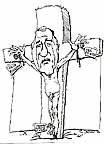
murder of Father John Geoghan-- hate crime.
You are not logged in.
No comments yet, but
click here to be the first to comment on this
News Slant!
|