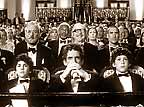
Geniuses together
|
 |
Boring to watch on screen
By
Michael Bronski
Royal Tenenbaums
directed by Wes Anderson
with
Gene Hackman, Ben Stiller, Anjelica
Huston, Luke Wilson, Gwyneth
Paltrow, Owen Wilson, Bill Murray
How to order
Every happy family is alike" wrote Tolstoy in
Anna Karenina "and every unhappy family..." well, take it from there. The problem with Hollywood movies about families is that they are-- happy or unhappy-- all alike. That is
to say, mostly heterosexual and most rather dull. Even dysfunctional families in Hollywood movies are mostly uninteresting-- the exception being families in Woody Allen movies (but their distinctly neurotic Jewishness makes
them queer, not particularly normal, folk). Hell, even gay families in Hollywood movies usually come off as mostly normal-- isn't the point of
The Bird Cage (and La Cage aux
Folles) that gay families are more loving, honest,
and acceptable and heterosexual families?
Which is why Wes Anderson's The Royal
Tenenbaums is something of a relief from the mundaneness of movie families. While everyone in the film is heterosexual, the film-- and the Tannenbaums themselves-- are out
of whack enough to be queer. Written by Anderson and Owen Wilson,
The Royal Tenenbaums charts the ups and down of the wacky, brooding, and magnificently miserable Tenenbaum brood-- a family whose brilliance is
only matched by their ability to wallow in their inability to deal with life.
The film is something of a cross between the charming Vendehoffs of Kaufman and Hart's classic Broadway farce
You Can't Take It With You and the high-pitched, carefully cultivated emotional manias of J.D.
Salinger's Glass Family of child "quiz kid" geniuses. The Tenenbaums are weirdo geniuses who do their best to accomodate life even as it ends up screwing them. Sired by the flagrantly irresponsible Royal (Gene Hackman) and the
devoted Etheline (Anjelica Huston), the Tenenbaum kids include the mathematical wizard Chas (Ben Stiller), the consummated tennis pro Richie (Luke Wilson), and their adopted sister, the enormously talented writer Margot
(Gwyneth Paltrow). Add to this a Tenenbaum wannabe, next door neighbor and best friend, Elijah "Eli" Cash (Owen Wilson) and you have the makings of a
menage ą folles. All of the children have grown up to be more than a little
disturbed. Margot loves Eli but married the noted psychologist (modeled on Oliver Saks) Raleigh St. Clair (Bill Murray). She won the Pulitzer prize in drama, but has gone into seclusion. Chas has become terrified of the dangers in the
world after the death of his wife. And Richie, who is in love with his adopted sister, gave up tennis after he broke down during an important championship match. But their charm, if not their method, is in their madness. As
youngsters, the Tenenbaums were famous for being prodigies; they just fucked up as adults.
The plot of the film-- what there is of it-- revolves around Royal's pretending that he is dying to get the attention of ex-wife and kids, whom he essentially abandoned. But this is really just Anderson and Wilson's pretext
for reveling in non-conformity. The best parts of the film celebrate its characters' quirkiness-- Chas's fretful fearing of catastrophe, Margot's self-absorbed, wan, passive craziness-- and it is here when we have some sense
of Anderson's ability to venerate the oddball. This, of course, was what he did best in the 1998
Rushmore and its Homeric ode to the deviant love of a 13-year-old misfit (who looks and acts gay) for his female teacher. And in
The Royal Tenenbaums he pursues a similar course. The results are not only very funny, but often touching. There are moments here that remind you of Bunuel's sensibility crossed with that of Frank Capra, or a fractured fairy
tale version of R.D. Laing's masterwork Sanity, Madness, and the
Family. At his best, Anderson is a poet of the extraordinarily unnatural-- even though everyone here is straight, they all certainly qualify as some sort of queer.
Unfortunately Anderson is unable to take this to its logical, and unnatural, conclusion. Bunuel would have pushed this material to the limits as he did in
Belle de Jour or The Discreet Charm of the
Bourgeoisie but alas, Anderson opts for the sentimentality of Frank Capra. In the end, all of the Tenenbaums morph into one, big fuzzy family that learns to love and respect one another. This is the meaning of fiction. It's a shame because for
three quarters of the film, Anderson really has his finger on the pulse of what makes people-- and families-- interesting. He understands "the trouble with normal," and has the good sense to laud and applaud it.
The Royal Tenenbaums has the urge to be queer and bring us into the surreal, but far-more-interesting world of the outcasts and the different, but loses its nerve before it can make a final commitment to the exceptional. It settles for the ordinariness
of Tolstoy's dreaded "happy families."
| Author Profile: Michael Bronski |
|
Michael Bronski is the author of
Culture Clash: The Making of Gay
Sensibility and The Pleasure
Principle: Sex, Backlash, and the
Struggle for Gay Freedom. He writes
frequently on sex, books, movies, and
culture, and lives in Cambridge,
Massachusetts. |
| Email: |
mabronski@aol.com |
You are not logged in.
No comments yet, but
click here to be the first to comment on this
Movie Review!
|