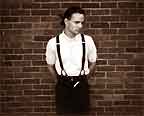
Bernard "Bee" Baran
Further Reading
In the Belly of the Beast
When I visited Baran for the first time at the Bridgewater Treatment Center,
I asked him about visiting...
|
 |
How hysteria railroaded one gay teenager to prison for life
By
Bob Chatelle
&
Jim D'Entremont
Being a gay teenager-- anytime, anywhere-- has never been easy. But few teenagers have
paid as terrible a price for their sexual identity as 19-year-old Bernard Baran did in 1984. Now in
his mid-30s, Baran is still paying that price behind bars.
Baran's arrest and conviction occurred at the apex of a US hysteria over "ritual abuse"
in daycare centers and elsewhere. The panic was fueled by right-wing campaigns against
"socialistic" daycare, left-wing feminist victim culture, anti-gay and anti-feminist backlash, and
an AIDS-driven resurgence of erotophobia and homophobia. Child molesters were perceived to
be everywhere. Daycare centers were believed by many to be theaters of abuse.
Tales of orgiastic rites, animal sacrifice, and murder were given widespread credence.
Law enforcement officials and therapists affirmed the existence of vast underground networks
of devil-worshippers and child rapists, offering little evidence beyond their own murky
imaginings. Ann Burgess, a Boston-area psychiatric nurse, promoted the myth of a wide-ranging
homosexual conspiracy to collect young boys for abuse and to manufacture child pornography
for the international gay market. Although this notion had no link to reality, it was taken
seriously and used politically by the Reagan Administration Justice Department, and by police
officials throughout Massachusetts and across the nation.
In Manhattan Beach, California, accusations hurled in August 1983 at the staff of the
McMartin Preschool led to the longest, most expensive criminal trial in American history.
Cross-pollinated with "information" shared by prosecutors, police, and social workers, other
daycare-abuse cases soon erupted from California to Maine. In some instances, prosecutors failed to
obtain convictions; in others, convictions were reversed when it became certain that innocent
people had been incarcerated for imaginary crimes. After six years of struggle, all the McMartin
defendants were acquitted.
At work, in love
Bernard Baran was not so lucky. The youngest of three children, Baran was born in
Pittsfield, a Western Massachusetts working-class community of 50,000, on May 26, 1965. His
father left when Bernie was three. Bertha, Baran's mother, held the family together. Bernie
realized when very young that he was gay. Bertha accepted it because she loved her son. But
school was not easy for Bernie, whose gentleness advertised vulnerability. When he turned 16,
he quit.
Baran sought employment through CETA, the federal Comprehensive Employment
Training Act. In 1983 he was assigned to a Pittsfield daycare center, the Early Childhood
Development Center (ECDC). Bernie liked kids; he'd had a lot of experience baby-sitting. The following
August, ECDC directly hired him as a teacher's aide. Except for a period of tardiness early
in 1984, his performance was good to excellent. Until the trouble started, no parent ever
complained.
Baran was then happily, openly gay. He had come to love another young man, a few years
his senior. Ricky, a musician who played in a band, taught Bernie the skills of a sound
technician. Although Bernie lived at home with his mother, he often spent nights at Ricky's.
The destruction of Baran's life began when homophobic suspicions were raised by the
drug-addicted parents of a troubled three-year-old, Peter Hart. (All children's names have
been changed.)
Peter's father, James, had left his wife, Julie, shortly after Peter's birth. James's
cousin David soon moved in. Both Julie and David had histories of chemical dependency and
sociopathic behavior. Julie mainlined cocaine, but also used morphine, Dilaudid, Nembutal,
Seconal, and Percodan. She often showed up at emergency rooms suffering from overdoses. David
once stole the paregoric Julie's doctor prescribed for Peter's baby brother.
In December 1982, at the suggestion of the Department of Social Services, Peter was
enrolled in ECDC, although he was below their age limit. He sometimes came to daycare
with mysterious bruises. Peter spent periods in foster care, but was always returned to his
turbulent home, where David once held Julie from a second-story window by her ankle, and in
March 1983, David allegedly stabbed himself in the heart, necessitating open-heart surgery.
(Julie's next live-in boyfriend also allegedly stabbed himself in the chest.)
In September 1983, ECDC placed Peter in the room where Baran was working. The boy
had severe behavioral problems. He swore, physically abused other children and teachers,
threw things, and defecated in the play patch. He frequently wet himself. Julie was asked to send
in extra clothes with him every day, but she seldom did.
As he joined in efforts to control Peter Hart, Baran was oblivious to the growing number
of sex abuse cases ignited by parents from dysfunctional homes accusing male daycare
workers of molesting little boys. The McMartin case, progenitor of hundreds of copycat cases,
erupted when an alcoholic paranoid schizophrenic accused 25-year-old Ray Buckey of sodomizing
her two-year-old son. On September 5, 1984, police arrested Gerald Amirault, a worker at
the family-owned Fells Acres Day School in Malden, Massachusetts. Amirault's original accuser
was the mother of a four-year-old boy whose erratic behavior appears to have been caused by
the stress of his parents' divorce-in-progress. Subsequently, however, Gerald's sister, Cheryl,
and his mother, Violet, were arrested as well.
When Gerald Amirault's arrest made headlines and became fodder for hyperbolic TV
news reports, David Hart called ECDC to complain that Bernard Baran was a homosexual and
shouldn't be allowed to work there.
On Monday, October 1, 1984, Peter Hart was removed from ECDC. Three days later,
David Hart called the Pittsfield Police and said that Peter "had come home from school
yesterday [sic] with... blood on or coming out of the end of his penis." This allegedly had been
discovered while Peter was being bathed the previous evening. Julie Hart later admitted that she
"didn't see any blood because he was in the water, but he said it hurt." When asked if anyone
had touched him there, Peter had supposedly said, "Bernie."
On October 5, the police went to ECDC. They were informed that it was ECDC policy never
to leave any adult alone with children. In each room, there was a head teacher, an
assistant teacher, and a teacher's aide. In addition to paid staff, there were CETA workers and
volunteers. Bathrooms adjoined classrooms. Bathroom doors were kept open in case toddlers
needed assistance. The logistics of child molestation were extremely difficult.
Baran had no idea he was under investigation. But word spread quickly among ECDC
staff. ECDC Coordinator Carol Bixby called Judith Smith, an ECDC board member whose
three-year-old daughter Gina had been assigned to Baran's room from April until she left the school in
mid-July. Gina and Baran were in the same room only five hours a week, during the busy
breakfast period.
Smith began interrogating Gina, asking about Bernie and whether Bernie ever touched
her "in a funny way." Gina said she and Bernie played the "Bird's Nest Game." When Smith asked
if Bernie ever touched her fanny, Gina said that Bernie touched her "privies" sometimes.
Smith called ECDC executive director Janie Trumpy, who told her to call the police because
Gina wouldn't make something like that up. (Subsequent research-- by Stephen Ceci, Maggie
Bruck, and others-- shows that young children frequently produce such "accusations" when
subjected to suggestive questioning.)
Late that evening, two detectives and a social worker went to the Smith home. Gina was
not talkative, but when prodded said again that Bernie touched her privies. Gina also said Baran
had found a bird's nest containing a dead baby bird still partly in its shell. Baran allegedly said
that if the "pretend" police found out, they would come and take the bird away, and that
would upset the bird's mother. (Baran never found such a nest, though he did sometimes read to
the children a Dr. Seuss book about a bird who goes looking for his mother.) Gina would go on
to create-- with help from the "investigating" adults-- the most bizarre of the abuse tales.
Parents panic
From that point on, the Baran case was a runaway train. Baran was arrested on October
6. Peter Hart and Gina Smith were interrogated, first by police, then by Jane Satullo of the
Rape Crisis Center, who did videotaped interviews using the anatomically correct dolls that
were commonly employed by therapists and investigators at that time. (Responsible
professionals no longer use these dolls, since research has shown that they produce mainly false
accusations.)
Gina Smith and Peter Hart were taken to their pediatrician, Dr. Jean Sheeley. Gina had had
a checkup after leaving ECDC, and no problems had been found. This time Sheeley closely
examined Gina's rectum and vagina, and found a 1-2 millimeter (1/20th of an inch) tear in
her hymen. Sheeley believed the tear consistent with penetration by an adult penis or several
adult fingers. Her evaluation was in accordance with medical knowledge then current; no one had
yet studied the vaginas or rectums of non-abused children. Subsequent studies, by Dr. John
McCann and others, have revealed that such hymeneal flaws are common.
During the examination, Gina also said that she'd had blood on her privies, but that
Baran cleaned it up while assistant teacher Eileen Ferry watched. Later, Gina would say that it
was Stephanie, the head teacher, who had been the witness.
A meeting was held for the panicked parents. Police and social workers provided a
symptom list for sexual abuse-- bed-wetting, nightmares, fear of the dark, eating problems,
genital curiosity, and other conditions common at one time or another to all children. The
young alleged victims were also treated to "good touch/bad touch" puppet shows performed by
Jane Satullo and others. Four more accusers were produced.
One was Virginia Stone, who had never been in Baran's room, but whose mother was one
of Julie Hart's friends. Virginia at first denied abuse, but later "disclosed." (According to
ECDC's insurance-company report, Virginia later told a therapist that nothing had really happened,
but that her mother told her to say it had so they could get a lot of toys and money.) Baran
had also allegedly jointly abused two little boys in a shed at school and in the woods during a
winter field trip. (The shed was kept locked and Baran had no key. There was no such field trip
while the two boys were in Baran's room, which was during the summer.) The final accuser
was barely three. At some point she told an inquisitor, "Bernie touched my tuku."
The children were tested for gonorrhea. Peter Hart's throat culture was positive. While
the test used was considered reliable at the time, a Center for Disease Control study showed
in 1988 that in instances where children tested positive, the infection was something else in
over a third of the cases. The possibility nevertheless remains that Peter might have had
gonorrhea. Subsequent to Baran's conviction, according to the insurance report, the boy made a
spontaneous, detailed, credible disclosure of abuse by someone other than Baran-- the man
who became Julie's live-in boyfriend after Julie threw David out, a week or so after Baran's arrest.
Baran's gonorrhea test was negative. Nevertheless, at trial prosecutor Daniel Ford
elicited testimony from a doctor who stressed that gonorrhea is most common among prostitutes
and male homosexuals, impressing upon the jury the notion that gay men are sources of disease.
Courtroom circus
The children were rehearsed by parents, police, and social workers. The Smiths hired
child psychiatrist Suzanne King, who saw their daughter once a week. Gina's story soon
became more preposterous. When Gina had originally said her vagina had bled, she said that Bernie
had cleaned her up with toilet paper. Now she claimed that Baran had scraped the blood from
her vagina with scissors. Baran then supposedly stabbed Gina in the foot with the scissors,
making her foot bleed as well-- in an effort, according to DA Ford, to cover up her vaginal
bleeding. This allegedly happened in a bathroom with an open door adjoining a classroom filled
with children and other teachers.
During testimony all six child witnesses were seated facing away from Baran. Not only
was Baran denied confrontation rights, he could scarcely follow what was going on. Despite
rehearsal, the children were poor witnesses whose competence to testify required a balletic
leap of faith. They ignored questions, shook or nodded their heads, gave monosyllabic or
one-word answers. Ford was allowed to ask blatantly leading questions. Whenever a child gave the
"wrong" answer, Ford repeated the question until the "right" one emerged. When a child was
uncooperative, Ford would ask if he or she was scared, implying that the children must be in terror
of the monster, Baran, whom they couldn't even see. Most of the kids responded to the
anatomically correct dolls, however, eagerly poking the inviting orifices.
When Peter Hart was brought into the courtroom, he broke away and ran over to
where Baran was sitting. "Hi Bornie
[sic]!" said Peter to his alleged tormentor. When
prosecutors dragged Peter away, he said, "I don't like these people."
Peter responded to Ford's questions with silence or obscenities. He said he didn't
know Baran, never saw him before. Ford handed him a doll, but Peter showed no interest in it.
"After you talk with us," Ford promised, "you can go back to McDonald's." Peter ignored him.
When the boy began responding, "Fuck you," Ford gave up.
Ford's other star witness, Gina Smith, wasn't much better. When asked if she bled,
Gina responded "I forget it," perhaps meaning she forgot the right answer. Ford followed up
with, "What did Bernie do when the blood came out?" and she gave the right answer-- "He
scooped it out with scissors!" But then she claimed it happened it the classroom. Ford reminded
her that it happened in the bathroom, then prodded her about the Bird's Nest Game. Gina
only would say, "the baby bird got killed." Ford suggested that Gina was too scared to talk.
Other children sometimes consistently gave wrong answers. Under cross-examination,
one boy said he had been telling "fake stories." The youngest victim said she liked Bernie and
that Bernie was a good boy. But the parents were compelling witnesses, most whom
sincerely believed that Baran had done unspeakable things to their babies.
The teachers, on the other hand, supported Baran, swore they had never witnessed
suspicious behavior, and pointed out the utter lack of opportunity to do anything unseen at
ECDC. A measure of courage was required for the teachers to do this. Eileen Ferry told
Baran's mother that Dan Ford had hinted to her that he might "expand" his inquiry if the teachers
were too cooperative with Baran's defense.
Dismissing contentions that the children's stories were incredible or contradictory,
Satullo and King testified that children were not suggestible. Satullo stated, "There haven't been
any cases of children falsely accusing somebody." King said that a parent's anxiety was not
transferable to a child. Satullo and King's beliefs were standard at the time. Subsequent
research has shown that children are highly susceptible to suggestion.
Baran answered all questions politely and thoughtfully, and denied ever doing anything
improper with any child. Under cross-examination, Ford prodded Baran about his relationship
with his boyfriend, while repeatedly asking whether he liked children and enjoyed working
with them. When Baran mentioned coming in early because he didn't want to be fired, Ford
shot back, "Because you liked working there at that daycare center with those little children!"
Ford never established a motive on Baran's part. That nothing in Baran's history
suggests sexual attraction to small children was irrelevant. All Ford needed to do was demonstrate
that Baran was a gay man who liked kids. The Pittsfield jurors readily accepted the premise
that homosexuality implies predisposition to abuse.
In his closing statement, Ford said that nothing he "could say could possibly be as
persuasive or as convincing as the testimony of those little children... the great Clarence
Darrow himself would pale in comparison to them." Ford stated that Baran had plenty of
opportunities for molestation at ECDC, and said "he could have raped and sodomized and abused
those children whenever he felt the primitive urge to satisfy his sexual appetite." Ford
compared Baran to "a chocoholic in a candy store."
Ford explained to the jury why Gina Smith-- who allegedly had been brutally penetrated,
then stabbed in the foot-- hadn't screamed out at the time or ever told what had happened to
her to any adult. It was because of the Bird's Nest Game. "If she told anybody about what
Bernie did to her," Ford said, "the baby bird's mother would be taken away by the pretend police
and the baby bird would be hurt. That one frightened Gina so much she couldn't even tell us
about it here in court. She could talk about being raped, she could talk about being sodomized,
but she wouldn't repeat the bird's nest story. That's how much that one scared her."
Deliberating for three-and-a-half hours on January 30, 1985, the jury found Baran guilty
on all counts. Preceding Gerald Amirault's guilty verdict by nearly 18 months, it was the
nation's first daycare sex abuse conviction.
Before sentencing, the late Mrs. Melinda Ward, an ECDC mother, appeared as a
character witness for Baran. Calling Baran "a miracle worker" who had "started my son on the path of
a normal childhood," she told the Court, "I just can't believe that Bernie isn't entitled to a
little compassion and fairness and dignity."
Baran was sentenced to two concurrent life sentences. His direct appeal was denied.
Parole is unlikely because people who deny their guilt are not eligible for parole.
Deaf ears
Bernard Baran is a small man who weighed less than 100 pounds at the time of his
conviction. In prison, he has suffered physical, emotional, and sexual abuse in the course of
being shuffled through the Massachusetts prison system. Today he resides at the Bridgewater
Treatment Center, a facility for sex criminals. Baran wanted to get into Bridgewater because
he knew he would be relatively safe there, though in order to get in, he had to be civilly
committed, from one day to life, as a "sexually dangerous person." Under Massachusetts's
lifetime civil commitment system, he could be detained even if granted parole.
Because his family lacks financial resources-- at the time of his arrest, their only asset
was his mother's car-- the legal help Baran has received has thus far been minimal. The lack
of attention has been acutely disturbing in the aftermath of a 1995 civil trial in which Julie
Hart's long-standing $3.2 million lawsuit against ECDC ended in a small out-of-court settlement
after Julie and Peter Hart's credibility was demolished by lawyers representing ECDC's
insurance company, whose investigation into the matter all but exonerated Baran.
But Baran's steadfast protestations of innocence have fallen on deaf ears. In advancing
the cause of falsely accused daycare providers, the
Wall Street Journal's Dorothy Rabinowitz
and other advocates have emphasized the plight of straight women like Cheryl Amirault,
recently permitted to remain free under the terms of a legal agreement, and her late mother,
Violet Amirault.
Journalists have been drawn to the most outlandish aspects of these cases: stories of
abuse tunnels, robots, lobsters, bad clowns, blood sacrifice, torture, bacchanals involving
peanut butter and jelly-- drawn from children during months and years of coaching and
interrogation. There are no exploitable lobsters or robots in the case against Baran, whose trial occurred
with a speed that may have nipped such embellishments in the bud.
As the only openly gay man convicted in any of the high-profile '80s daycare cases,
Baran has attracted far less attention than imprisoned husbands and fathers like Gerald
Amirault (whose profoundly dubious conviction has yet to be overturned). In their groundbreaking
book Satan's Silence, Debbie Nathan and Michael Snedeker stress the role of "popular
anxieties about unconventional sexuality" in bogus abuse cases. "To turn the community and the
jury against defendants," they point out, "prosecutors routinely denigrated their character by
introducing evidence when they could find it, and rumors when they could not-- such as
that defendants were homosexuals."
Since Baran's homosexuality was uncloseted, that program of denigration worked well.
The 1988 conviction of Kelly Michaels, a Maplewood, New Jersey daycare worker who was in
a lesbian relationship at the time of her arrest, was also abetted by homophobic
insinuations. During their successful campaign to free her after she had served five years in prison,
however, some of Michaels's supporters swept the inconvenient fact of her bisexuality under the
rug, portraying her as a model of heterosexual respectability. Baran's openness about his
identity makes such a portrayal impossible.
Gay activists who might in another context have been inspired by Baran's insistence on
living his life as an out gay man have shunned him, as they tend to shun anyone tainted by
accusations of child molestation. The gay community has expended far more energy
dissociating itself from such people and reciting the gay-people-are-not-after-your-children mantra than
it has spent looking at ways in which homophobia and sexphobia have warped our justice
system. In allowing Bernard Baran to remain in prison, the gay community has endorsed the
homophobia that put him there. **
You are not logged in.
| # |
Subject |
Author |
Date/Time (ET) |
| 1158 |
Bernie Baran |
blondecapricorn
|
05/08/03 04:16 AM |
| 1142 |
Bernard Baran |
veezreality
|
01/27/03 04:52 PM |
|