|
 |
The politics of gay domestic violence
His first gay relationship started off "intense and fulfilling," recalls Bostonian Curt Rogers, 38. But his three-and-a-half-year relationship with Gary was also punctuated by increasingly violent outbursts, followed by
apologies and reconciliation. Finally a drunken Gary pushed Curt onto the bed, pinning his arms. "If I can't have you," Curt recalls him saying, "then I can't stand for anyone else to have you. I'm going to kill you." A few tense
hours later, Curt says he talked him down enough for them to go outside for a walk. Once out the door, he ran off; Gary was too drunk to pursue him. Desperate to get away from his boyfriend, Curt sought refuge at eight
different shelters for battered spouses and was turned down. In the eyes of 90s professionals, a man could only be a perpetrator of domestic violence, not a victim.
Thanks partly to Curt Rogers' efforts, this is not true in Boston now. Gary hanged himself a year later, and Rogers went public with his story. He founded the Gay Men's Domestic Violence Project (GMDVP),
of which he is now executive director. Today, Massachusetts state funds constitute most of the group's $300,000 dollar annual budget. In April, the Massachusetts Victim and Witness Assistance Board gave Rogers an award
for his work, indicating, says the GMDVP, "a dramatic shift in its perception of gender roles in domestic violence by honoring a gay survivor." Offering counseling and-- uniquely-- a network of safe houses where battered
gay men can escape violent partners, the GMDVP presents itself as a model provider of a social service available nowhere else. Is it a program gay communities everywhere should emulate?
On the edge
"Domestic violence isn't just a single assault-- it's a whole pattern of abuse to gain power and control over another person, and it can include physical or sexual violence or emotional or financial abuse,"
Rogers says. He argues that domestic violence varies little in character or frequency between straight and gay relationships, though the latter provide a batterer additional weapons: he can threaten to "out" his partner, or
take advantage of what may be his companion's estrangement from his family. If his partner does call the police for help, the batterer can point up the likelihood that when cops arrive and see two men caught up in a fight,
they'll simply arrest both without probing to find out who started it-- in marked contrast to domestic spats between a man and a woman.
"As a general rule, violence tends to get worse over time," Rogers contends. "You can have a plateau of three to four years where the person who is in control is able to get what they need, so maybe the
violence stays at that level. But as a general rule, it tends to escalate"-- however slowly and interrupted enough by reconciliations to keep the abused partner entangled.
GMDVP's volunteers, agree to host in their homes men for periods of up to eight weeks-- long enough, hopefully, to distance themselves from their violent partner and arrange other housing. Usually, that
is enough to effect a break-- moving to a new city and creating a new identity is rarely necessary, Rogers says. But once in a protective shelter, the battered man must not have contact with his ex- it would be too risky for
the host. Sometimes, to the dismay of victim advocates, a spouse who faced violence at the hands of a partner will go back. In the year since it has begun offering safe houses, the GMDVP says it has closely counseled or
housed some 30 men, and fielded around 400 telephone inquiries.
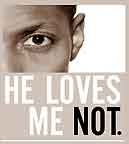
To publicize the issue, GMDVP, with $120,000 in state funding, sponsored advertising campaign in Boston last summer that brought the message of gay domestic violence seemingly to every bus and
subway platform. A repeat is in the offing. Though the ad campaign was as artfully vague as any hawking Calvin Klein underwear-- a shot of an attractive model with the tag line "He loves me
not"-- in the past, publicizing gay domestic violence has generated hostile responses to the target community. "I remember being turned down by gay groups as their dinner meeting speaker because they would say, 'Our organization is not about furthering
the image of the homosexual as a victim,' or 'You're just airing our dirty laundry,'" Rogers tells
The Guide. But attitudes now have changed. "If anything, this makes gay people more normal, because it just shows abuse
is happening everywhere"-- to one in every four gay men, trumpets the GMDVP web site (www.gmdvp.org).
A downside?
Gay domestic violence activists, like all groups trying place a new cause on people's radar screens, need compelling storylines and characters to make their claims stick. The liberation movements of the
1960s brought a cavalcade of new identities marching out of the closet: Black Power, gays, feminists, sadomasochists. But after these movements blazed their trails, in their path grew curious new weeds: identities conjured up to
be imposed on others. A generation ago there were no such things as "The Pedophile" or "The Batterer," categories that now are entrenched and have grown legal teeth. These imposed identities sustain whole social-service
and law-enforcement industries. But do those who fall under these labels really share some underlying essence? Or are the stories and imagery that glue these categories together reflect, at heart, large cultural anxieties? In
Satanic daycare abuse cases, for example, stories and character types compellingly real to many were developed without any underlying reality whatsoever.
"I think the word 'batterer' is horrendously poor," Rogers grants, "because you'll have people who are abusive but who never physically batter, and you have judges and courts who won't sentence a man as
a batterer because they don't want to attach a stigma to him that's going to last his entire life. Right now it's pretty much the belief that your chances of changing are slim-- once a batterer, always a batterer"
That batterers are necessarily male is another theme, going back to the domestic violence movement's feminist roots, that may be flawed. "You'll hear the statistic put out that women are the victims of
domestic violence 95 percent of the time, men only five percent," says Rogers. "But we see reports from the Massachusetts Department of Public Health that one-third of those reporting intimate partner violence are men. Yet even
they won't use that statistic, because a lot of these people worry about the backlash that might come once men are able to say, 'Well, no I'm the victim.'"
If there are questions about who gets cast in the roles of batterer and victim, there are also questions about the frequency their drama is performed. If one in four women or gay men are victims of
domestic violence, and batterers follow a path of continual escalation in their violence that without intervention tends toward murder, where are the bodies?
If physical violence of some sort is so common in intimate relationships, maybe it is usually without much consequence. Extreme violence is clearly unacceptable. But police today are required to make
arrests where there is any physical evidence of violence, whether or not the private parties who are the only ones involved desire that outcome. But whether a couple fights-- and they will-- with silent glares, screaming words,
or pummeling fists could be just a matter of cultural preference.
Too clean?
The idea that any aggression always tends toward some extreme denies the basic human fact that more often than not, physical violence is often mutually chosen and self-limiting. A generation ago,
boys fighting on the school playground would be left alone to work it out among themselves, at the expense of bloody noses and black eyes, and the gain of a lesson in politics. Today, a regime of zero-tolerance over violence
in schools is punctuated by extreme outbursts of mass shootings. The two may be related-- just as routine use of disinfectants sets the stage for grooming epidemics of virulent
über-bacteria. While post-modern sadomasochism
insists it's concerned only with purely staged, clearly-bounded scenes, the underlying eroticism of power and violence spills out from movies and kink playrooms into unscripted human relationships. It's a cliché but true that
fights among friends and lovers often set the stage for passionate and erotic reconciliation
The assumption that victims of domestic violence are women "creates significant barriers to men self-identifying themselves victims and to service providers screening men of intimate partner assault," says
the GMDV, which cites the case of a volunteer "who spent 82 days in the hospital over the course of a year, suffering a broken jaw and losing his spleen and over half his intestines. If a woman had come to the hospital
presenting these injuries, she would have been screened for domestic violence and guided to local resources." But the very idea of victimhood emphasizes passivity and suggests there is some outside force that can save us. Someone
hit out-of-the-blue by a sniper's bullet may be an archetype of a pure victim. In ongoing human relationships, the lines of fire are too convoluted to tease out. At the least, someone who stays partnered with a person who
sends them to the hospital with lifelong injuries has made a severe misjudgment.
A politics centered on promoting victimhood is one way of evading responsibility-- for the fact that all human relationships are dangerous. It is an illusion that some greater authority-- police,
doctors, therapists-- can somehow protect us from our own choices. Acts of extreme violence have to be confronted and punished. But distinctions between degrees of violence are vital too. The domestic violence movement
provides valuable services to people in need. But movements and governments that encourage people to identify as victims and impose villainous identities must be watched closely-- just like a lover with a violent streak.
You are not logged in.
No comments yet, but
click here to be the first to comment on this
News Slant!
|