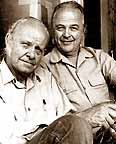
Hay (left) and lover Burnside in the late 70s
|
 |
He was founder of the modern gay movement. But Harry Hay, who died last month, never faded away
By
Bill Andriette
Freed from the timetables of reproduction, flitting along on fairy-wings atop the cultural foam, the gay generations cycle not every 30 years, as for ordinary humans, but merely
every five- or so John Mitzel has calculated. By which measure Harry Hay, father of modern gay liberation, who died in San Francisco October 24th, was even more Methuselean than his
90 years suggest. But by other yardsticks– those of heart and mind– Harry Hay died young. Almost to the end, he was twinkle-eyed and relevant, sharp of wit and tongue, and quick
to anger at what he deemed gay compromise for sake of respectability.
Long after his most famous work– as key inspiration and organizer for the Mattachine Society in 1951– Hay was making waves. In 1978, he helped spark creation of the
Radical Faeries, a loose gay men's movement whose heady mix of sex and spirituality drew on Hay's ideas about unique gay consciousness. And in 1986, when he was 74, Hay strapped on
a sandwich board to protest the exclusion of boy-lovers at the Los Angeles gay pride parade, prompting the poo-bahs of the movement he helped forge to threaten him with arrest.
Hay managed getting old without fading away.
Americans of all stripes tend to ignore their history. Even when we don't, we tend short-shrift the radicals who helped shape it. So the attention paid Hay at his passing
is remarkable.
Of course, in newspaper obituaries and the condolences from lesbian and gay groups, Hay's radicalism has been deflected or dumbed-down. The Human Rights Campaign or
the Metropolitan Community Church in its press release encomiums didn't mention Hay's vigorous defense of
NAMBLA when the International Lesbian and Gay Association kicked them out
in 1994. They do not subscribe to his inclusive vision, his call for decisions by consensus, and the sharp contrast he painted between Homo and Hetero consciousness. These ideas
of Hay's are, in the gay or liberal mainstream, unfashionable.
But Hay, at his death, also won the regard he did because when a bold move succeeds, it no longer seems far-out. Oddly enough for an organization inspired partly by Stalin's theory of
nationalities and based initially on secret Communist-style cells, the Mattachine Society helped spark a global movement still going strong.
Peasants rising
Hay named the group, founded in Los Angeles, after medieval fraternities of peasant monks that performed– in disguise– forbidden pagan fertility songs and dances.
"The mattachine troupes conveyed vital information to the oppressed in the countryside of 13th- to 15th-century France," Hay said, "and perhaps I hoped that such a society of
modern homosexual men, living in disguise in the 20th-century America, could do similarly for us oppressed queers."
At a time when it was illegal in California for "sexual deviates" to congregate, the modern Mattachine recruited members the way the Communist Party did– seeking to enlist
existing members' friends, and approaching likely candidates under subterfuge. The summer of 1950 found Hay and his new lover, the designer Rudi Gerenreich, cruising Malibu beach,
their gaydar tuned up high, approaching promising men with a petition for peace in Korea. And, oh, would you care to attend a discussion on some of the new findings about social deviancy?
Kinsey's Sexual Behavior in the Human
Male had just been published (Hay had been one of Kinsey's interviewees), and homosexuality was in the air– as well as flourishing in
LA's cop-infested parks and tearooms. When Dale Jennings was accosted and arrested by an LAPD agent, his Mattachine fellows rallied to his cause. Jennings mounted a vigorous
defense, granting at the trial he was a homosexual, but insisting he had been entrapped. For the first time in California history, the jury refused to convict an admitted homosexual in a
tearoom case, and word spread through gay networks about the Mattachine's seemingly amazing powers. Within a year, the group grew to number a few thousand members and supporters
in California.
These gay pioneers were rallying around a platform that– though the wording has changed– remains perfectly comprehensible today. "The Mattachine Society holds it is possible
and desirable that a highly ethical homosexual culture emerge, as a consequence of its work, paralleling the emerging cultures of our fellow minorities– the Negro, Mexican, and
Jewish Peoples," the group declared in its 1951 "Missions and Purposes."
But with growing visibility, Mattachine fell into the sights of McCarthyite crusaders. Hay's Communist background had been noticed in the LA papers. Later he was to be call
to testify before the House Un-American Activities Subcommittee. As Mattachine grew larger, it became more conservative. Under the gun, the group insisted homosexuality didn't
mean disloyalty to the American Way; some vowed they would betray commies in their ranks to the authorities as proof. To avoid a catastrophic split, Hay and the Mattachine's
other founders resigned in 1953.
Probing the gay roots
Hay's sudden reprieve from political work (he also now left the Communist Party) and for a time his isolation (he had just divorced his wife of 13 years) led him to a course
of voracious reading, a study of how homosexuality was manifested in other cultures at other times. In the late 1940s, he had first envisioned organizing gays under the banner of
a "Bachelors Anonymous," a group focused, like its alcoholic sibling, on limiting self-destructive behavior. Now Hay was exploring a vision of homosexuality's intrinsic value.
Hay immersed himself in the ferment of the 60s. He worked with Indian cultural movements and supported gay draft resisters. In 1963 he met his lover, John Burnside, who
survives him. Burnside was an engineer who had gone on to invent and manufacture a successful kaleidoscope, anticipating fascination with psychedelia. Hay went to work at
Burnside's workshop, which for years became a center of gay activism.
With the Stonewall riots in New York in 1969, gay politics transformed, and the Mattachine faded. Hay helped found Los Angeles's Gay Liberation Front. Though he found the
new militancy a refreshing break from what the later Mattachine's jacket-and-tie stodginess, he still felt something missing.
In 1970 Hay and Burnside moved to New Mexico. They wanted to steep themselves in the Native American berdache or "two-spirit" traditions– men in numerous native
cultures whose androgyny was seen as a spiritual calling. As well, they wanted to sprinkle seeds of gay consciousness in rural soil. At the end of the decade, they returned to LA–
partly disappointed at how much Indians had lost touch with their traditions, partly from excitement about how such traditions might be realized anew within the Radical Faeries, the group
that was to remain Hay's spiritual home and the focus of his energies.
Early years
Harry Hay's life had taken a course his comfortable parents would not have imagined. But Harry, the boy, was clearly father to the man.
Born in 1912 near Brighton Beach, England, Hay moved with his family two years later to Chuquicamata, Chile, where his father managed a copper mine. In 1916, after his Hay
père was injured in an accident, the family relocated to Orange County, California.
One of Hay's earliest memories was, as a three-year-old, hearing Quechua villagers sing the traditional four-octave Inca Hymns to the Sun. At around ten, Hay joined a
Woodcraft Ranger Boys' Group in Los Angeles, a sort of Boy Scouts sans militarism, with emphases on classical music, Indian lore, and the outdoors. Though in retrospect Hay granted that
the Woodcraft Rangers' rituals could seem corny– as indeed some might find those of a Faerie gathering– Hay lapped up the male camaraderie. He sensed his own difference, but didn't
have a name for it. When as an 11-year-old he got his hands on a copy of Edward Carpenter's
The Intermediate Sex in the library, and first saw the word "homosexual," Hay felt
instant affinity. At 13, his father sent him to work summers pitching hay on a relative's ranch in Nevada. An Indian team mate took him along to a feast, where a blind elder pronounced the
boy as one "who will someday be a friend." The next summer, Hay had his first sexual experience, when, by his own account, he seduced a sailor on a steamship taking him from Nevada
back home to California.
It was in the Nevada hayfields that Harry got his introduction to radical politics, from migrant workers who were Wobblies. In the fall of 1930, he entered Stanford, where
he discovered a talent for acting, and immersed himself more in drama, poetry, and relationships than course work. Two years later, a bad sinus infection forced him to leave school,
and poor finances prevented his return.
Hay worked various jobs in Hollywood during the 30s, as a bit-part actor in B movies, in repertory theater, and as a screenwriter (his ghostwritten film
Heavenly Music won an Academy Award). Will Greer, later grandpa on the 70s TV show "The Waltons," became a sometimes lover, and encouraged Hay's involvement in the Communist Party. Seeing
police shoot picketers during the San Francisco General Strike in 1934 further cemented Hay's radical commitments. As a party activist, Hay documented conditions LA's slums and
taught courses on Marxist theory and folk music (in preparation for which he learned of the medieval mattachines). Under pressure, he married a close Party friend, and he and Anita Hay
(née Anita Platky) adopted two daughters.
Hay and his work
Hay had a knack for being in the right place at the right time and connecting with key people. The Mattachine Society could never have succeeded had Hay lived in Dallas
or Dubuque. When he was cruising in San Francisco's Pershing Square at 17, he met Champ Simmons, who knew first-hand of the first, failed attempt at gay organizing in America–
the Society for Human Rights– shut down by Chicago police in 1920. Hay was interviewed by Kinsey. He worked with John Cage, performing his songs, and knew Pete Seeger,
Woody Gurthrie, and Paul Robeson– all figures in the cultural and political transformations to come.
A range of influences fed into Hay's thinking– sometimes adopted directly, sometimes curiously reflected. From Edward Carpenter came a notion of homosexuals as, indeed,
an "intermediate sex," capable of special cultural sensitivities and contributions. Hay's immersion in Communist theory acquainted him with Stalin's writings on nationalism– which
presented a benevolent vision of peoples with a shared culture and traditions freely developing their character under socialist guidance. The picture was never realized under Stalin's iron fist,
but the ideal shaped Hay's notion of gays constituting a separate people. In Hay's readings in anthropology he came upon the view that cultures before civilization had been more
gender-balanced, if not matriarchal, and sometimes welcoming of androgynous and same-sex oriented men. Even if the Communist Party gave Hay the theory and political skills to conceive
of organizing gay people, his instincts had less in common with Communist ideologues than 17th-century English radicals– such as the Quakers and Levelers– with their egalitarianism in
all things, including sex. This mix of scouting, Stalin, Indian lore, English radicalism, music history, and Marxist anthropology were the snips, snails, and puppy-dog tails that the
Mattachine Society was made of.
Hay's thought
Hay's life and work, like that of any interesting thinker, were riven by tensions– some would say contradictions. Like the positive and negative poles of a battery, some of
these oppositions generated the electricity that powered his work. Others sometimes seemed powerful enough to rend the battery's casing and leak the acid.
Respect for cultural difference and local autonomy were Hay's watchwords, yet as a loyal Communist, he joined a movement with universalist pretensions. Communism was
second perhaps only to American consumerism and Hollywood in dissolving local cultures around the world– think of Tibet and Chechnya. Marxism imputes objective interest to classes of
people who don't always find themselves believing what they're supposed to. Hay was happy to chalk up such discrepancies– whether of the American working-class or Indians forgetting
their customs– to false consciousness.
For all Hay's embrace of homosex as an intrinsic good, he meant a homosexuality that almost never showed up in civilization. The homosexuality that flourished in ancient
Greece, feudal Japan, Arabia, or at Eton in the heyday of the British Empire was one connected to militarism, serving to hone and sharpen masculinity. But equally Hay rejected
modern conceptions of homosexuality as a simply a behavior, a quirk of neural wiring or family dynamics, tied to nothing else.
Hay insisted that gay people were essentially different– gifted in affairs of culture, spiritual insight, and ability to connect subject-to-subject– but that these potentials could only
be realized with nurturing– in a cultural context that only clearly existed in some small-scale societies before civilization (and how often even then must be a matter of speculation).
It sounds like skating on thin ice. Yet Hay can't be dismissed. The contemporary gay movement says that homosexuality deserves rights and respect even though, at heart,
it means nothing, is no better or worse than any other form of desire, is perhaps merely a surface social construction.
In the spare, less obviously differentiated societies to which Hay was drawn, nothing is wasted and everything is put to use. It is here, Hay contended, that the real value of
the Homo reveals itself in a way that is a lesson for people for all time.
Maybe homosexuality simply isn't needed in the modern world. But since traits that are useless or indifferent tend not survive, whether homosexuality has a future may depend
not only on Hay's being correct, but on our stewardship of gay consciousness, so that we don't merely sell it off to the highest bidder, but cherish it and prove and discover its value.
A Pacific Sailor: Harry's first time
From a talk Harry Hay gave at the Pride Center in San Francisco, October 7th, 1984.
Finally, I want to simply say that I have love and honor to a man named Matt. I don't know his last name. At this point now, if he's alive, he must be close to ninety. This is
something that happened to me in 1926. I'm 14 years old. As far as the law is concerned, I'm a child. For two years I had been sent by my father to work in the hay fields in Nevada. In
the summertime, I am doing a man's work and getting a man's pay and I'm living a man's life. I would go with the rest of the migratory workers to a town 30 miles away on a Saturday
night– and I can get drunk with the fellows at the speakeasy, because this was Prohibition times.
On the way home, I come down through San Francisco and I figured that instead of spending money on the train coming home, I'll get a job on a freighter. And I did this. And
right next to me swabbing deck was this very nice 25year-old guy, and he suddenly appeared to me to be one of the people like us. He was the first one I felt I could really trust. And I
felt that I was trusted with love. He told me one wonderful thing that I have never forgotten: "Once you meet a place like Zanzibar, or Dar-es-Salaam"– he had obviously been on the
African coast– "you know, you can be in any one of these towns, and you can be in a place where there isn't a language or a word being spoken that you'd recognize, and there isn't a
custom being carried out that you're familiar with, and the smells are all strange, and you're in a strange place, and you look across the crowd and you see a face, and all of a sudden your
eyes lock in to that pair of eyes, and all of a sudden those eyes glow through to the world, if you move yourself to glow back, you're gone, and you're safe."
Wherever he is, I want him to know that my love and my gratitude followed him all my days, and all his days.
–transcribed by David Thorstad
Going Underground: Sissies flee to fight another day
Comments made by Harry Hay at a panel on censorship and pornography in Los Angeles, November 8, 1986.
I find this particular situation that we're coming into, in a way, a sort of replay of things I've seen before in my life, and I would suggest that it's very possible that we are moving into
a period where, as the speaker [Dan Tsang] pointed out, we may find ourselves being moved against on all fronts. Which would suggest, then, that we're going to have to go back
to various forms of underground activity.
I would say that in my life, I've spent more time being an outlaw than being an inlaw. And consequently, I would say that I know a good deal about how you operate as an
outlaw, how you operate underground, how you operate in defiance, how you operate, presumably, almost in parallel, but actually in opposition to it. One of things that I think we have to
be concerned about– and here again, I think this is where we begin to see what we can do and how far we can advance ourselves– is the march on Washington that comes up next
October. I think this is a place where we have to find very imaginative ways to reach all kinds of elements of the community that we up to now haven't thought of touching. Not only to reach
all kinds of elements of our own community, but to find the weak spots, shall we say, within the left, within the progressive forces in the hetero community who might find themselves
in parallel with where we are, or in parallel with the way that we feel we are going to go, and make of them willing– or even unwilling– allies in this whole regard. I think, as a matter of
fact, we can count on the fact that we're probably going to see far more repression on the part of the government for a while. I don't think we've peaked. I think we're seeing ourselves
on the beginning of a rising tide. And we're going to have to fall back on our inventiveness and our creative imagination.
And here, honeys, I might say that the Radical Faeries are way ahead of you, because don't forget that faeries can always vanish. This is one of the things that we're going to
have to learn to do again.
We have to learn to remember that when people lean on us too hard, we just simply aren't there anymore. There are ways and means by which we can do that. I do pass on to
you the remark that was passed on to the revolutionaries by Maksim Gorky long ago: he who fights and runs away will live to fight another day.
–transcribed by David Thorstad
Among the Pueblo
A visit with Harry Hay & John Burnside, spring '72
I was 21 in 1972, in LA doing volunteer speaking at local high schools for the Gay & Lesbian Community Services Center. When I said I was hitching back east, the staff said, "Oh,
you should see Harry and John." They were living in San Juan Pueblo, New Mexico, and were just recovering from loss of their kaleidoscope factory that had burned down. Harry had long
had an interest in the berdache phenomena of the Pueblo Indians and was exploring it as antecedent to gay consciousness. They had left LA, the bad urban jungle, for what they hoped
to find– a utopian community among ancient traditions and they needed a way of making a living: custom-making kaleidoscopes. They took me around to meet the local tribes.
They'd fallen in love with the area and the people. But the people there weren't open to the idea of gay liberation per se. They acknowledged the history of the berdache, but spoke of it as
a curious part of their past, not relevant to modern life. Or maybe they weren't ready to share it with white guys from LA. Harry and John were disappointed that he couldn't make
the contact they'd hoped for. Gay men, Indian or Hispanic, traditionally expected to have relationships with "real" men, not with their "sisters" and this was contrary to the theories
Harry was exploring.
I hitched rides as far as Espanola. They came to take me to their place- a small rambling shack of a place at the end of a road among some beautiful cottonwood trees. Otherwise
all around the land was open, except along the river, a tributary of the Rio Grande. I was happily trapped there by the rising waters and the couple of days I'd planned to stay became
a week to ten days. It was one of my life's most magical times.
They had a nickname for me– Cricket– and were very gracious to me. They had a big old red pickup truck and on a trip up to one of the sacred mesas, we passed a
teenage hitchhiker on the side of the road. Harry drove right by. I was astounded– this was my means of travel. I asked, "why didn't you give him a ride?" He could get the back of the
pickup truck. Harry admitted that he was really afraid of teenage hitchhikers. He hadn't really thought of it in a conscious way. But he admitted he was probably wrong, and that he'd take
my advice and reconsider next time.
They were definitely a couple; it was right hand, left hand. John was the nurturing, mothering kind, with Harry being the male type– no-nonsense, get things done. If they'd
been parents, Harry would have been the disciplinarian, with John being "Oh don't be so hard on the child."
They were never apart. Yet the basis of their relationship was never to say that they were married or were an item for life. They would get up each day and commit themselves
for one more day together, with the understanding that tomorrow they could go off and maybe do their own thing. It allowed them space to have other sexual or romantic flings on
the side. John didn't seem to have the need for that– he was much more home-and-hearth. But Harry did, and was always flirting with the young things. He wasn't aggressive about it,
but he enjoyed flirting.
–Michael Thompson
| Author Profile: Bill Andriette |
| Bill Andriette is features editor of
The Guide |
| Email: |
theguide@guidemag.com |
You are not logged in.
| # |
Subject |
Author |
Date/Time (ET) |
| 1137 |
Harry Hay |
wilyum4u
|
12/11/02 05:20 AM |
|