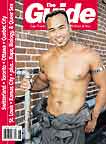
Facial hair fan
Finally! As someone who has been an avid reader of your magazine since 1996, and also having a facial hair fetish, it is great to finally see a cover boy/man with facial hair [Munich's handsome Wolfgang Günther on the July 2000 cover].
The usual cover models do not represent the taste of the overall gay community and are only representative of a certain sector. I applaud your attempt at diversity and look forward to seeing future covers.
T
.C.
ticboston@aol.com
Brit offers Polari correx
Blanche Poubelle was brave to write about Polari ["How bona to vada your eek!", May 2000, available at www.guidemag.com], but I-- as a gay Brit and longtime fan of Jules and Sandy (and notorious anal-retentive)--
would like to correct a few errors in the article.
It's true that Polari comes from a variety of sources, but the main one is the group of Romance languages including Romanian, the Swiss Rhaeto-Roman dialect, and the gypsy language Romany. The
name "Polari" itself comes from the Romany "palare," meaning talk. In Barry Took and Marty Feldman's book of
Round the Horne scripts, they say: "Most of the words are of gypsy origin or fairground and circus slang now
used by actors and dancers in other branches of the theatre. Some words are Kenneth Williams' and Hugh Paddick's own natural form of expression!" So working out what is Polari and what is not in the dialogues can be tricky.
"Paliasse" is not Polari, but a regular English word meaning a straw mattress. Doubtless Jules and Sandy chose the word for its last syllable!
"Spark out" or "sparked out" is a regular slang expression in common use, at any rate in Southern England, to mean "lying down"-- both my parents used it frequently, and they were not Polari-speakers!
"Vada" comes from a common Romance language root meaning "see", and is found (eg) in the French word "voir," but the nearest forms are in the Rhaeto-Roman languages: there is a village in
Switzerland called "Guarda," which means "look!" in the local Rhaeto-Roman dialect.
"Sable plage" is not Polari either; these are French words for "sand" and "beach", but the joke is that a Frenchman would say "plage a sable" for "sandy beach," not "sable plage."
The radio show Round the Horne, from which the Julian and Sandy
dialogues are taken, began in March 1965, and it is amazing to think that they were broadcast at 2:30 pm on a Sunday afternoon, when millions of British families were listening to the "wireless" after their Sunday
lunch, hearing exchanges like this (to take one at random):
Sandy: We are your Bona Caterers-- that us to say-- Jule and me-- we can cater for your every function....
Julian: We can do you something pretty bizarre in marzipan.
Sandy: How about Dundee, Jule?
Julian: Yes-- I could let myself go in Dundee.
Sandy: He could let himself go in Dundee Mr Horne-- he could.
Makes South Park look positively innocent!
Paul
paul.bailey@wanadoo.fr
perso.wanadoo.fr/paul.bailey/
Blanche Poubelle responds: Many thanks for your comments. Miss Poubelle always appreciates keen-eyed readers who keep her on her feet. Her only quibble with your comments is that Romany (the language of
the Gypsies) is not a Romance language, despite the deceptive name. It belongs to the Indo-Iranian family. She agrees with you that deciding what is polari and what is not is quite a difficult task. For most of the words
mentioned in the column, I used a source at nz.com/NZ/Queer/Polari/polari.html, which does include "vada". But you're right about "sable," "paliasse," and "spark out."
You are not logged in.
No comments yet, but
click here to be the first to comment on this
Letters to the Editor!
|





 Advertise with us
Subscriptions
Contact us
Site map
Translate
Advertise with us
Subscriptions
Contact us
Site map
Translate