Concerned about the state of guys
|
 |
By
Michael Bronski
In the Valley of Elah
Directed by Paul Haggis
Starring Tommie Lee Jones, Jonathan Tucker, Jason Patric, Charlize Theron
How to order
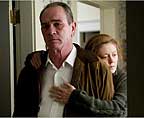
In the Valley of Elah is many things. Foremost it's a passionate cry against the continuing U.S. occupation of Iraq in all its political, military, and personal disaster. And then it's a critique of traditional ideals of American manhood.
Few films about the war against Vietnam were made during the years during that deadly fiasco --
Deer Hunter and Coming Home were released in 1978 and
Platoon (1986) and Full Metal Jacket
(1987) came more than a decade after the 1975 liberation of Saigon. So
it's heartening that dramatic critiques of the ongoing Iraq war, no matter if imperfect, are getting written and made now.
H
ollywood critiques of masculinity are more common. Films as diverse
as American Beauty (1999), Dude Where's My Car?
(2000), and Jarhead (2005) may have cleared a path to the grave site, but
In the Valley of Elah puts last nails in the coffin.
On the surface this is a dyed-in-the-wool all-American detective story with the shape, scope, and feel of classy 1940s detective
noirs such as Murder, My Sweet (1944) and
Farewell, My Lovely (1946), or the more modern
Chinatown (1974).
Based on true events, In the Valley of
Elah begins with Hank Deerfield (Tommy Lee Jones) -- a patriotic, retired military MP who had served in Vietnam -- receiving word that his son Mike (Jonathan Tucker), on leave from Iraq, has gone AWOL. This seems
unlikely, and Hank goes to the military base to try to find him. There the father meets with resistance in the persons of Lieutenant Kirklander (Jason Patric), Mike's immediate commander, and Emily Sanders (Charlize Theron), the local police detective. Soon Mike's body
-- brutally stabbed, dismembered, and burned -- is discovered and Hank and Sanders join forces when it grows clear that the military is covering up the circumstances of Mike's death.
While noir has its roots in post-war existentialism ("Man is alone," could be the motto), this very sense of alienation from the conventional helped the genre work as a conduit of cultural criticism. As Hank uncovers what happened to Mike he is faced with
devastating truths -- about Mike, about the military, about American power. As in
Chinatown, the rottenness runs so deep and is so corrosive that no one is spared. The corruption shown here is intertwined with an American masculinity that has turned -- as Anthony Lane calls it
in his New Yorker review -- feral.
The film is convincing and stirring, helped by its roots in fact and event. Director Paul Haggis co-wrote the script with Mark Boal, the investigative reporter who covered the original story in
Playboy. With a series of extraordinarily potent images, it's hard not to
be moved at the closing. Haggis takes some visual and dialogue cues from his earlier hit
Crash, but refines them here for a more cohesive, sustained, less messy narrative. Compared to his message about American racism in
Crash, Haggis's message about American masculinity here is more nuanced. The complexities multiply in the person of Hank Deerfield himself, who is forced to question his unfailing allegiance to a masculine ideal and a country that deploys it to enforce its foreign policies.
Ascent of man?
Macho American manhood got channeled in the 1970s and '80s with films such as
Rocky (1976), Terminator (1984), and
Die Hard (1988) -- but were these macho's last hurrah? Maybe these films were a late reaction to Vietnam or an immediate reaction to
Platoon and Full Metal Jacket. It was just after this when we began to get silly teen-sex comedies such as
Porky's (1982) and its successors in the American
Pie series (1999), which then morphed into the dumb-stoned young guy films --
Bill and Ted's Excellent Adventure (1989)
Billy Madison (1995), and Dude, Where's My Car?
(2000). While generally dismissed as stupid teen movies that promoted drugs and celebrated immaturity, these films were really political manifestos for a new type of youthful American masculinity that was not
about being brave, courageous, and manly enough to kill people -- but rather glorified the exact opposite. Their popularity suggested a hunger for new standards of masculinity contrary to those Hollywood had long pushed.
It's not a big leap to understand that the plethora of gay films and TV shows during this time
-- In and Out (1997), Edge of
Seventeen (1998), Will and Grace (1998),
Queer Eye for the Straight Guy (2003), and dozens and dozens more -- while a response to the
gay movement's inroads, were also in reaction to the decline of traditional masculine norms.
In the Valley of Elah is a culmination of these trends. It's a profoundly political film -- like
Coming Home, Platoon, and Full Metal
Jacket -- in its anti-war sentiment. But it's also
a more radical film than these predecessors because its roots in
noir ground it in a very American idea of masculinity. It all adds up to a superb meditation on what it has meant to be a man in America.
| Author Profile: Michael Bronski |

|
Michael Bronski is the author of
Culture Clash: The Making of Gay
Sensibility and The Pleasure
Principle: Sex, Backlash, and the
Struggle for Gay Freedom. He writes
frequently on sex, books, movies, and
culture, and lives in Cambridge,
Massachusetts. |
| Email: |
mabronski@aol.com |
You are not logged in.
No comments yet, but
click here to be the first to comment on this
Movie Review!
|





