|
 |
Flame's not out on old gay lit
By
Michael Bronski
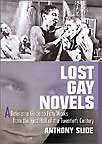
Lost Gay Novels: A Reference Guide to 50 Works from the First Half of the 20th Century
by Anthony Slide
Haworth Press
How to order
It would be easy to say that gay literature is often lost to history. Novels, poems, stories, and diaries with homoerotic content are often
viewed as indecent or threatening, and swept under the critical or archival carpet, if not simply destroyed. But the reality is that very little
literature really stands the test of time. Consider even high, well-awarded, literature-- can you name any Pulitzer-prize winning novels and plays from
the 1920s and 1930s or identify any Nobel-prize writers from those decades? All the more so does popular literature disappear into
history's dustbin. With a few exceptions over the past century-- Frank Baum's
The Wizard of Oz (1900), Margaret Mitchell's
Gone With the Wind (1937), and maybe Jacqueline Susanne's
The Valley of the Dolls (1965)-- most popular novels, even best-sellers, have been consigned to the
three-for-a-dollar table at church rummage sales or just pitched into the rubbish.
What a treat then to have Anthony Slide's chatty, informative
Lost Gay Novels, which gives the narrative and critical rundown of
50 works of homo-fiction that were published between 1900 and 1950.
Lost Gay Novels works best not so much as a reference work-- it is
too anecdotal and often idiosyncratic for that-- but as a reading list for all those books you never knew that you had to read. Some of the
novels he mentions have not been completely lost. Charles Jackson's wonderful 1946
The Fall of Valor is still in print (he is most famous for his
crypto-gay masterpiece The Lost Weekend), as is Willard Motley's 1947
Knock on Any Door. And James M. Cain's 1937
Serenade is considered a minor noir work by that noted author, and still available. But most of Slide's 50 have pretty much vanished from literary and queer history.
One of the amazing facets of Lost Gay
Novels (which is reflected in my own new anthology
Pulp Friction: Uncovering the Golden Age of Gay Male
Pulps) is that there was an active, very open gay-lit subculture before Stonewall. These were not books of porn, or self-published
bad novels, or released by independent-gay-presses (of which there were, actually, a few) but mainstream literary novels from staid and
respectable publishing houses. This is a major facet of gay history that has been, essentially, ignored by most historians and literary critics. Slide
gives us glimpses into 50 of these works (in Pulp
Friction, I identity more than 275-gay themed novels between 1940 and 1969) and whets
our appetite for reading them in their entirety.
Some of the highlights of Slide's research are his essay on Harlen Cozad McIntosh's 1940
This Finer Shadow, a wonderfully dense,
smart, weird novel of gay sex and gender transformation. McIntosh's novel received quite a bit of attention when it was published, and is
not completely unknown. Its odd, often disturbing, mixture of philosophy, cranky Freudian theorizing, and extravagant dream sequences
makes this a near-prototype for post-modern meditations on gender. Slide also writes well on George Eekhoud's
A Strange Love: A Novel of Abnormal
Passion, which was written in Flemish in 1899, and first published in English in 1930 by the Panurge Press (a mostly alternative book club
that sold erotica through the mail). The Panurge edition was rare-- only 1500 printed in a limited edition-- but Eekhoud's novel got a second
life when Guild Press published a more popular edition in 1965. A historical romance with the most stilted
prose, A Strange Love isn't a very good book-- indeed, to contemporary tastes it's nearly unreadable, even though Eekhoud was one of the most acclaimed Belgian writers of his
day. But Slide writes well about it, and it is an important milestone in Western writing about homosexuality.
There are also some problems with Lost Gay Novels.
Slide sometimes gives inaccurate readings of some of the works. Stuart
Engstrand's The Sling and the Arrow, is not a novel of "latent homosexuality" so much as of trangenderism. Slide also has a tendency to see some of
these works as "offensive" when they present less-then-sterling portraits of gay men. Certainly Lew Levenson's 1933
Butterfly Man has its share of non-admirable characters, but the novel itself (while badly written) is far more complicated. The same is also true for Slide's discussion
of Michael de Forrest's 1949 The Gay Year (also not a very good book), and his essay on Harrison Dowd's (1949)
The Night Air makes odd remarks about the main character's "feminine side," whatever that might be.
Still, Lost Gay Novels, is a treasure-trove of books that the contemporary gay reader might want to explore. Certainly not all of them
are great literature, and some are downright pulpy. But they are all important to the understanding of gay literature.
| Author Profile: Michael Bronski |
|
Michael Bronski is the author of
Culture Clash: The Making of Gay
Sensibility and The Pleasure
Principle: Sex, Backlash, and the
Struggle for Gay Freedom. He writes
frequently on sex, books, movies, and
culture, and lives in Cambridge,
Massachusetts. |
| Email: |
mabronski@aol.com |
You are not logged in.
No comments yet, but
click here to be the first to comment on this
Book Review!
|