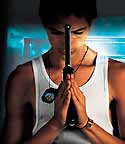
Boy and toy
Further Reading
Shooting Midst Shooting
Cinematographer Rodrigo Lalinde used a prototype high-definition video camera. The resolution is about...
On the Web...
Cinematographer Rodrigo Lalinde used a prototype high-definition video camera. The resolution is about twice the existing HDTV broadcast standard. Look...
|
 |
By
Mark McHarry
Our Lady of the Assassins, a
new film
based on a novel by one of
Colombia's leading authors, opens a
window onto a torrid, tragic world of
passion and violence.
Violence from the drug trade and a
civil war has kept Colombia in the
headlines. We'll likely see more
stories as the US escalates military
assistance for Plan Colombia, a
billion-dollar initiative
to stanch the drug flow. In Colombia
the drug war has met with little
success-- other than encouraging the
proliferation of violent criminal
cartels. The city of Medellín is
ground-zero for the
cocaine merchants. Medellín is also
the birthplace of a new breed of
criminal,
sicarios, teenage contract
killers. Thought to be the brainchild
of drug lord Pablo Escobar, the
sicarios are recruited from the
slums to settle scores between rivals.
As gang factions shift, many are left
to fend for themselves, joining
paramilitary groups or committing
street assaults. Medellín has become
among the
most violent cities in the world.
A new and highly-acclaimed
movie from Barbet Schroeder,
Our Lady of Assassins, is set
there. It tells the story a man and a
16-year-old
sicario who fall in love.
Leading Colombian
author Fernando Vallejo wrote the
screenplay and the novel of the same
name (in Spanish,
La Virgen de los Sicarios) from
which it was adapted.
This was Vallejo's first book
published in the US and Europe. In
Latin America he has been admired as
an intellectual
cum literary bad boy for some
time.
Vallejo has authored a number
of respected works, including a book
on grammar and the definitive
biography of Porfirio Barba-Jacob, a
bohemian homosexual who penned
Whitmanesque odes to adolescents and
marijuana in the early 1900s.
Vallejo has written and
directed movies in Mexico. But his
notoriety derives from an
autobiographical saga wherein he
depicts his precocious adolescence
spent in the dives of Medellín
and Bogotá, immersed in drugs and
homosex: "Ruin yourself, get wasted,
fuck up, that's the only way to get
the words off your venomous tongue.
The greater your disgrace the happier
you'll be....
I get high on your civic indignation.
'Faggots!' Medellín shouts to us from
a corner when it sees us go by...."
(El Fuego Secreto, 1987)
Some say El Fuego
Secreto-- which translates "The
Secret Fire" was the soil in which
La Virgen de los Sicarios grew.
The autobiography won high praise, as
did
La Virgen when it appeared in
1994.
One review in the Latin
American press called
La Virgen "a delirious canto to
love and hell." Reading it is indeed a
sublime experience. Vallejo is an
absolute master of language and
culture. Another termed it "social
vivisection," and it is that, too.
Vallejo's language scythes
through the conservative Catholic
status quo. His prose is hard-hitting,
exquisite, alive in its turns of
phrase, at times lyrical, at times
brutal. Vallejo, in the guise
of Fernando-- a middle-aged writer
coming home, he says, "to die"-- pulls
us in on a nihilistic tour of what had
been a pretty provincial city, now in
a moral free-fall. His companion in
this
anti-Baedeker is the love of his life,
Alexis, a
sicario.
In Barbet Schroeder's movie of
the same name, Fernando's mordant
comments about a crime-ridden city,
its hateful people and its rapacious
politicians, are funny and
provocative. But in
the book Fernando engages us directly,
much more powerfully.
When, early on, the boy tells
him he's never thought about going to
bed with a girl, Fernando reflects,
"So then that's what it was behind
those green eyes, a purity
uncontaminated by
women. The absolute truth, fuck what
you think, that's what sustains me.
That's what I fell in love with. His
truth."
In the book Fernando's
observations are more deeply felt,
often stunning. We see clearly the
chaos could apply to any place that
becomes as corrupt; perhaps, one day,
to us all.
The book paints a far bleaker
picture than the movie and its
contradictions are more acute. Alexis
can't bring himself to shoot a fatally
injured dog, yet his devotion to
Fernando is such he
uses his Beretta at the slightest
provocation to his lover. Fernando's
anguish about the degeneration of his
country is palpable, the more so
because he sees in his exterminating
angel the embodiment
of and solution to its problems. It's
a terrible irony made worse as their
love awakens in him a glimmer of hope.
We root for them even as we see
Fernando increasingly involved in
Alexis's
murders, determined at all costs to
protect the sole reason he has to live.
Schroeder's movie-- for which
Vallejo wrote the script-- sharpens
the characters' humanity. It turns
Fernando's intellectual soliloquy into
an emotional one. The movie brings
Alexis to
life, while in the book we see him
only through Fernando's eyes. The city
also becomes a character, depicted as
a colorful-- if deadly-- place, alive
to the rhythms of music familiar to
the director
from his childhood in Bogotá. The
choices-- vallenatos and even a
pasodoble-- are inspired.
Schroeder, Vallejo, and the cast did a
remarkable job adapting the book to
the screen.
In both works Vallejo's
dialogue for the boys is dead-on. This
should be no surprise, since Alexis
and probably some of the others were
not fictional at all. In reading what
he and Schroeder
told the press about the movie and
book, some interesting facts emerge.
Sicarios who love men
are real, as is their violence. Mario
Vargas Llosa, the Peruvian author, has
noted
sicarios are as legendary in
Colombian culture as cowboys in
Wyoming and
samurai in Japan. In his book, Vallejo
comments caustically on those who
would study them. Schroeder told
interviewers he met gay-identified
sicarios during the shoot,
while Vallejo said simply,
"people are much more ambiguous than
one might think and their sexual
inclinations much more extensive than
they say."
Vallejo was more forthcoming
to other journalists, rhapsodizing to
one about Medellín's boy brothels and
declaring to another, "The brightest
moments of my existence have been in
bed
with boys. Man is a biological machine
programmed to ejaculate and everything
else is hypocrisy, pretext, crap."
He's also excoriated the Pope's
opposition to birth control, saying
that the
many unwanted kids of the Medellín
slums "grow up to be
sicarios and I will minister to
their pain, not him."
Schroeder said the owner of
the apartment in which Fernando and
Alexis met is a real person, and this
man not only found the boy who plays
Alexis, but introduced the real Alexis
to the
real Fernando. He described Vallejo as
"the same as the character in the
movie, dressed the same, doing the
same things, exactly the same person."
At one point, in a hallucinatory
sequence, the
movie shows us Vallejo's full name on
a crypt, making it clear the
protagonist and the author are one.
If so, does
Fernando-the-author share
Fernando-the-character's complicity in
his lover's murders? Many journalists
asked him just how much of his novel
was autobiographical. To most
he said, "All the dead in it I killed
in my heart," but to one he replied,
"If I answer your question, I'll go to
jail."
Don't look for this at the
website of Paramount, which, is
distributing the movie in the US. In
keeping with North American
sensibilities, Paramount censors the
actors' ages and even
changes the word "boys" to "actors"
when it translates the same material
on the director's more informative
site (see below).
If you can, read Our Lady
of the
Assassins before you see the
movie. If not, read it after. It is a
beautiful, disturbing masterpiece.
| Author Profile: Mark McHarry |
| Mark McHarry keeps an eye on Latin
culture from the Bay Area |
You are not logged in.
No comments yet, but
click here to be the first to comment on this
Magazine Article!
|