Unholy trinity
|
 |
By
Michael Bronski
Harold and Kumar Escape From Guantanamo Bay
Starring Kal Penn, John Cho
How to order
Brideshead Revisited
Directed by Michael Lindsay-Hogg
Starring Anthony Andrews, Stéphane Audran, Claire Bloom, John Gielgud, Jeremy Irons
How to order
Mainstream pop culture can breath a sigh of relief: wildly overpraised, The Dark Knight -- the new Batman movie -- does not have the queer Batman-Robin romance. Instead our hero loves Maggie Gyllenhaal (whose brother Jake, in Brokeback Mountain, got fucked by Heath Ledger, who plays the Joker here). Those crazy Hollywood people!
With that problem out of the way, we can look at what was gay in theaters this summer.
Step Brothers, with Will Ferrell and John C. Reilly, was quasi-gay but never had the balls to really go there -- although we do get a good look at Will Ferrell's balls (or those of a comely understudy).
And Journey to the Center of the Earth, with ever-handsome Brendan Fraser, had none of the homoeroticism that Pat Boone and James Mason brought to the far better 1959 version of the story.
Hancock and Wall-E were queer-less to their shallow souls, and All-American Girl, well, lives up to its title.
Return recursively
But not to worry -- two of the gayest films of the summer (one in theaters and one just out on DVD) are queer enough to make up for this deficit while simultaneously denying that they are very queer at all.
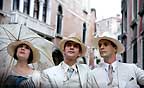
Julian Jarrold's gushy, elaborately designed and directed film of Evelyn Waugh's Brideshead Revisited is a big, engaging bon-bon of a movie. Its reverential Masterpiece Theaterish tone and affect are manifested in sumptuous sets and overripe cinematography. It's a treat for the Anglophile in withdrawal since seeing Atonement months ago. And on top of all of this, the plot features a love story between two men -- both quite pretty in that 1930s Oxbridge sort of way.
Brideshead Revisited has always been claimed by queer readers as a gay novel -- despite the fact that the homosexual love story opening the narrative gives way to a far lengthier heterosexual romance. The 1981 Granada TV version (later on PBS) became a gay icon for portraying the intense relationship of Charles Ryder (Jeremy Irons), a middle-class artist, and Sebastian Flyte (Anthony Andrews), an upper-class decadent, was touted in the gay media as the most romantic thing since Leopold and Loeb.
But the surging homo/Anglophilia of the times (these were the golden days of Merchant Ivory Productions) was alluring as well as misleading.
The problem is this gay reading of Brideshead ignored the real essence of the story -- which is, at least as Evelyn Waugh wrote the book, a parable about Roman Catholicism.
On the surface, Brideshead is a dysfunctional family drama. Sebastian Flyte is flighty and fruity -- he's famous for bringing his teddy bear to high tea. Sebastian meets Charles Ryder at Oxford and they begin an intense affair. Charles meets Sebastian's intense arch-Catholic family and falls in love with their wealth, aristocratic taste, and religious fervor. Sebastian's mother, Lady Marchmain, was a staunch Catholic who has deeply imprinted guilt and fear onto her children. But Charles's erotic love soon moves from Sebastian to his sister Julia, a woman no less insecure or unstable than her sibling. Not a great deal happens -- some diseases, a few deaths, people lose and regain their faith, some commit adultery while others don't. By the end Charles has transformed himself into a great artist and probably a believing Catholic.
This new Brideshead, with a very literate script by Jeremy Brock and Andrew Davies, still retains the gayness of the first part of the novel. Matthew Goode's Charles and Ben Whishaw's Sebastian generate more erotic heat than Irons and Andrews in the 1981 production. We even see them swimming naked, hugging, and almost kissing. But what's so good about this film is its faithfulness to Waugh, taking from his book its moral and narrative center. No matter what happens, no matter how far we stray from God's plan, we will always go back to Him. This is out of step with modern thinking about sexual liberation and personal freedom, but taking Waugh seriously lets us make our own judgments. And it's hard for anyone who thinks about it not to see the sheer destructiveness of Lady Marchmain's religion and how it hurts her children. In Waugh's Catholic vision, Julia is saved by breaking off her illicit affair with Charles, and Sebastian ends up in a monastery after almost dying. We're able to see Waugh's point here -- but as easily reject it in view of the results of Marchmain's homophobia and moralism. For what it is -- a high-toned, literary, British soap opera -- Brideshead Revisited is smart, savvy, and for all of its flaws, quite good.
Close calls and cigars
Harold & Kumar Escape from Guantanamo Bay is just out on DVD. Funnier than their first film and often outrageously homophobic, this also one of the queerest films to ever out of the stoner genre. Male nudity, prison-rape jokes (the homophobic part), dick jokes, more dick jokes, and what used to be called "suggestive situations" -- like when Kumar is on the toilet discussing Harold's pubic hair as he steps out of the shower.
You really have to wonder what the writers and producers are thinking about their target audience here -- most probably 13-year-old boys. Does this demographic really want to hear endless jokes about penises? What do they think about Kumar saying to Harold as they parachute out of an FBI plane on which they're being kidnapped -- "Hey dude, are our dicks touching?" I understand that jokes alleviate sexual anxiety -- but, my god, do teenage boys have this much?
| Author Profile: Michael Bronski |

|
Michael Bronski is the author of
Culture Clash: The Making of Gay
Sensibility and The Pleasure
Principle: Sex, Backlash, and the
Struggle for Gay Freedom. He writes
frequently on sex, books, movies, and
culture, and lives in Cambridge,
Massachusetts. |
| Email: |
mabronski@aol.com |
You are not logged in.
No comments yet, but
click here to be the first to comment on this
Movie Review!
|