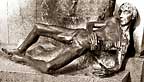
In Wittenbergplatz
|
 |
German capital stays sexy despite overdoses of history
By
Frank Laterreur
Berlin's official slogan is "Berlin ist eine Reise
wert," or "Berlin is worth the trip." For homosexual travelers since the early 1800s, and for all who seek erotic adventure and prefer the sexual underground, the slogan
has more than held true.
I lived in Berlin 45 years ago (God, almost half a century!), and have returned many times. The most memorable visits were in 1985 and 1989, before and after what Berliners call die Wende, or "change" -- the fall of
the Berlin Wall and the official end to a divided city.
M
ost whom I met this year -- especially people in gay commerce or in the upscale western districts of Schöneberg, Charlottenburg, and Wilmersdorf -- told me, "Everything has changed! You must scarcely recognize
Berlin today!"
If they meant that there are now hundreds of glass and steel highrises and spiffy shops in areas that were bombed-out as late as the '60s, or were ugly no-man's lands with guard towers and barbed wire until the Wall
went down in 1989, they are right. If they are speaking of the vivid street life of yesteryear, or differences in culture and ways of life in East and West Berlin, they are wrong.
In many ways, Berlin remains the same: a haven of erotic experiment and just plain
gemütlichkeit (untranslatable, but "warm friendliness" comes close).
Not always under the radar
Berlin has arguably gone through more extreme changes than any other modern city -- but throughout circumstances unbelievably trying, it maintained an active homosexual life. Through most of that time,
homosexuality was criminalized, under the terms of the notorious "Paragraph 175," not repealed until the 1980s.
Nonetheless, Berlin fostered some of the very first openly gay writings
(Der Eigene, a gay magazine published from 1896 to 1932) and organizations (Magnus Hirschfeld's Institute for Sexual Research, from 1919
to 1935). The patriotism spawned by World War I brought increased censorship and homophobia. Afterwards, Berliners lived through the shame and depression caused by a crippling debt to the victorious Allies. There
followed a brief revival during the Weimar Republic, when gay life was increasingly open, as described by Christopher Isherwood in
Goodbye to Berlin and the musical,
Cabaret. The Nazis' rise marked the most virulent
political movement of a very violent century, when gay books were burned along with many others and Hirschfeld's institute was destroyed.
Berliners have a keen sense of this complex history, kept alive by the Schwules Museum
(Queer Museum),
which contains an extensive archive, plus elaborate public exhibits. It is located in Kruezberg, a
working-class, ethnically diverse neighborhood where many gays live, too.
The Third Reich centered in Berlin, and those days must have been incredibly painful for homosexuals, among others, who had to hide themselves ever more deeply in the shadows or face concentration camps
and extermination. World War II brought indescribable horrors to Berlin, which perhaps vies with Tokyo as having the largest civilian population targeted by dense bombardment. As late as 1963, when I moved to Berlin,
the rubble remained uncleared in many areas. My landlady served coffee in a garden that was little more than a charred ruin, and daily walks took me through vast empty spaces where mere shells of buildings hulked.
There was also the lingering poison of anti-Semitism. That same landlady naively let on that she "picked up a few nice
objects d'art" from a shop suddenly vacated by Jews in 1938. Jews were the primary object of one
of the worst genocides in history -- and there were many Jews (possibly 200,000) in Berlin at the outset of the Nazi reign. At the end, fewer than 1,000 remained. Yet queers suffered this awful extermination, too (as
did Gypsies, the disabled, and other groups). The gay group associated with the East German magazine
Die Andere Welt studied the records of the Sachsenhausen camp, and they suggested the number of
homosexuals exterminated to be twice what had been previously estimated.
When Russians and Americans met on the Elbe in 1945, Berlin had been destroyed. But incredibly, Berliners -- including those few remaining Jews and many homosexuals -- came out from beneath the rubble. Here and
there a few great buildings remained, as did a few original subway stations where people slept during the relentless Allied assault. One is the Wilmersdorfer U-Bahn, where classic murals and ceramics remain, as do marks from
the bombing.
Even through the war a few gay pubs remained mostly open, often in cellars, behind closed doors to an invited clientele. Among these were the original El Dorado bar on Motzstrasse (which dated to the 1920s), as well
as a bar operated by a unique married couple -- a lesbian who dressed as a man and a male transvestite. Its final incarnation as Herbert's Bar near Wittengbergplatz, in the gay center of Schöneberg, was open until at least
the 1970s.
A fresh chill
Resilience in the face of tragedy continued during the Cold War, the Berlin blockade, and its accompanying rationing. And then the notorious Wall, which went up with amazing speed in 1961. Families were divided,
lovers separated. Over the decades, many were shot as they attempted to cross this ugly barrier, as were two teens killed as they lay flat on top of an S-Bahn train I rode to cross the Wall in 1963. As a student at
Humboldt University in the East, but living in the West, I crossed over daily (as Berliners could not) using S-Bahn lines operated by the East, carrying Germans who could not exit where I could at Friederichstrasse. One can still see
the horrors of this barrier at Checkpoint Charley, or by riding the U-Bahn along Bernauerstrasse, where the wall literally cut through apartment buildings.
As is so often the case, reality was more complex than a Good and Evil saga. Much in the East was better than in the West -- health care, free education (including university, for those who passed exams), and support
for literature and the arts. There was an active gay life in the former German Democratic Republic. One bar across from the Alexanderplatz S-Bahn, the Besenkammer Kneipe, flourished from the 1940s and is still there. When
I visited recently, I felt I had stepped into the past.
In its final years, the GDR repealed paragraph 175, still in force in the West at that time. Laws were passed to guarantee equality for gays in schools, publications, and housing -- something not yet replicated in the
West. The GDR age-of-consent was 14 -- that in the West, 16. Germany has argued over this since reunification, but appears likely to adopt an even higher age of 18. A gay disco, the Busch Allee, was located in a
government center next to a school (Busch Allee events still take place from time to time). Gay socialist groups such as Courage sprang up. Burgfrieden was a popular cafe in Prenzlauer Berg. It was in that bar that the
GDR-sponsored gay film Coming Out was shot. It premiered the night the Wall came down. Many gay patrons preferred to watch the film rather than flock across to the West a few blocks away.
Fading ink
East Berlin gay neighborhoods -- such as Prenzlauer Berg, Pankow, and Friedrichshain -- remain palpably "different" from those in West Berlin, though of course the difference is fading, especially in Prenzlauer Berg,
as gentrification spreads. During my first stay in the '60s, as during my visits in the '80s, I found the East less competitive, less pushy, and with little of the "attitude" one finds often in the West. The East was so
comfortable -- and I find that it remains so.
"At first those from the East rushed West to sample sex and commercialism," says Colin de la Motte-Sherman, an Englishman who has lived in Berlin since the '70s, and who was a participant in Courage and
Die Andere Welt. "Those from the West came East to find the simpler, friendlier life. Many from the East came back, dissatisfied. Many from the West, moved over -- for one thing, the rents were, and still are, far cheaper."
"The change of society to capitalism changes people individually," he added, "and often not for the better."
A former SED (GDR Communist Party) leader named Lothar told me, "It is a paradox. More freedom has not made people freer. I would never go back to the old days, certainly not to the Wall, but I hate the
shit-government and shit-economy of the West. I only wish a government could be found that would not push wealth and consumption, but would want people to be happy, one that would focus on human worth."
Colin is active, as are more and more Germans in both parts of Berlin and now even in West Germany, in the Left Party, which includes elements of the former SED. Lothar completely avoids politics and refuses to vote.
In every period, the gritty, street-sweaty, sexualized nature of gay Berlin -- especially the hustling life and the inter-class and inter-age mixing -- has remained constant. John Henry Mackay described such a Berlin
from about the year 1900 in his novel, Der
Pupenjunge. (The title on the English version is badly translated as
The Hustler, thus bypassing the play on words in German -- Doll Boy / Fart Boy -- the latter because the hustler
is fucked a lot and must often fart.)
Mackay painted a clear picture of a "hustler table" in a working-class bar. A dozen or so young men sit around this table joking and relating life stories, as older men at nearby tables buy drinks. Some were regular
hustlers, some part-time commercial, and some gay youth finding a way to be themselves. Christopher Isherwood immortalized the Berlin homosexual scene in his books. He said of Mackay's 1900 portrayal that it was
clearly authentic, because the very same "hustler tables" existed in the 1930s.
Such "tables" were still there when I stood around them at Der Keller, a Savignyplatz bar in the 1960s, and again at Burgfrieden in the 1980s. Today, there are many, at bars like Blue Boy and Tabasco, even in the heart
of trendy Schöneberg. One difference is that the tables today often have an ethnic quality -- a Polish table, Romanian table, perhaps a Turkish table, but still also an "echt Berliner" (genuine Berliner) table. As in each
earlier period, hustlers mix with non-hustlers, and queens with toughs. (Some of the Romanians I encountered are rough gang members; others, naive loners.)
In the mix
There are alternatives to the "hustler tables" where old meet young, queer men and women mingle, and the working-class hobnob with the rich. Among these are the numerous "naked parties," where incredibly
gorgeous bodies are cheek by jowl (pun intended!) with wrinkled and flabby ones, and no one seems to care. Or discos such as House B in Friedrichshain, where fabulous cross-dressers and truck-driver lesbians mix with muscle
men and twinks. Or Flax, in Prenzlauer Berg, with its periodic karaoke evenings and brunches featuring a throng of teens and twenties, as well as the elderly, who need not fear ostracism.
There are countless other venues for class and age promiscuity. Among these are the parks, such as the enormous Tiergarten in the West near Zoo (especially the Lion's Bridge), and the Volkspark in Friedrichshain
(near the Swan Pool or the Maerchen Bruennen, which means "Fairy Fountain"). As well there are the peep shows, t-rooms, and street cruising around Bahnhof Zoo, a train station that has hosted homosexual liaisons
for generations. The scene reminds one of Times Square in New York or the Combat Zone in Boston, similarly famous until they were swept clean and Disneyfied in the 1990s. And don't forget the public swimming pools
and saunas, including some that are nude (for addresses see
Fkk.de
). There are so many of these, often free, that Berlin has fewer commercial gay saunas than most large cities.
Pleasure and danger are inseparable in Berlin as elsewhere, and in such scenes there can still be repression, threats, danger. Razias (raids) exist even in a Berlin today with a gay mayor. But they are raids "with a
difference." Back in the 1960s, I was present when police showed up at the most popular gay bar of the day, Kleistkasino. Patrons knew they were coming, and a few of us, including me, slipped out the back. I was astounded to
watch as most of the customers meekly lined up, allowing arrest without protest. With names published in the newspapers, many lost jobs and a few committed suicide.
Today's raids often go with little notice. One such took place at Bahnhof Zoo while I was there, with a score of arrests, mostly of young hustlers, whom one paper described as "willing participants." The next day,
business was as usual!
Homosexual Berlin remains lusty through countless and violent upheavals. There is in Wittenbergplatz, a fountain with a number of statues of totally nude people, from children to the aged. To me, one statue represents
the spirit of Berlin. It is of a naked youth, his head turned so that his eyes connect with onlookers. He seems to smile wryly, his hands poised ambivalently, and his pelvis thrusts provocatively forward. The Berlin of
Mackay, Isherwood, of the bars that stayed open during the war, the GDR Courage group, and all those hustler tables and naked parties is summed up in that face and pose: brash, in-your-face, and above all defiantly and
openly sexual.
You are not logged in.
No comments yet, but
click here to be the first to comment on this
Queer n There!
|