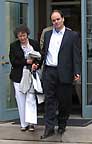
Bernard Baran & his mother upon his release
(photo: J. D'Entremont)
|
 |
But not too late-- a court frees gay man swept up in 1980s sex hysteria
By
Jim D'Entremont
Bernard Baran was 19 when, on January 30, 1985,
he entered the Massachusetts correctional system.
Twenty-one years and five months later, on June
30, 2006, the gay former daycare worker walked
out of Berkshire
County District Court and into the arms of his
family. Now 41, Baran has spent more than half his
life in prison for crimes he insists he did not
commit.
Two weeks before Baran's release, Judge
Francis Fecteau of Worcester Superior Court
awarded him a new trial, overturning his 1985
conviction on three counts of child rape and five
counts of indecent assault and
battery on a child. Fecteau's 79-page Memorandum
of Decision directly addresses just one of Baran's
grounds for appeal-- ineffective assistance of
counsel-- but preserves others, including
prosecutorial misconduct, for future use.
The ruling came one year after the end of
evidentiary hearings on Baran's first motion for a
new trial, and two years after the motion was filed.
Following negotiations over the terms of his release
(and some stalling
on the part of the Berkshire County DA's office),
Baran was freed on $50,000 bail pending a new
trial that may never take place. He had been serving
three concurrent life sentences.
Out, and on the outs
In 1983-84, Bernie Baran was probably the
only uncloseted gay daycare worker in the Western
Massachusetts industrial city of Pittsfield. Despite
Baran's stated preference for working with the
elderly, the
Berkshire Training and Employment Youth Program
placed the young high school dropout in a teacher's
aide position at the Early Childhood Development
Center (ECDC), a preschool serving low-income
families.
Baran had been working at ECDC for about
18 months when a woman named Julie Heath began
complaining that the preschool, where her son Paul
was enrolled at a social worker's insistence, had
"a queer" on staff.
(In a later deposition, Heath said she thought gay
people "shouldn't be allowed out in
public.") In September 1984, when local
media were hyping the arrest of Malden, Mass.,
daycare worker Gerald Amirault on
child-molestation charges, Heath's live-in
boyfriend called ECDC to take the administration to
task for allowing a homosexual to work with
children.
On October 1, Ms. Heath removed her son
Paul from the school; five days later, her boyfriend
told police that the boy had come home from
school
the day before with blood on his penis,
and had said that Bernie
was responsible. The boy's penis showed no sign of
injury, but when police appeared at ECDC and
revealed that Baran was suspected of sexually
assaulting a child, the resulting hysteria spawned
more accusations.
The first of these, coming from a middle-
class member of ECDC's board of directors, served
to validate allegations made by Julie Heath, whose
history of drug abuse and domestic turmoil-- well
known to local
authorities-- did not enhance her credibility. Then,
through a test now known to produce a high rate of
false positives, Paul Heath was found to have
gonorrhea of the throat. (See
The Guide, December 1999, May 2000,
and December
2004; a detailed chronology of this complex case
can be found at www.freebaran.org/chron.html.)
Baran was arrested on October 6. The
Berkshire County DA's office readily obtained
indictments after showing a grand jury edited
videotapes of children's interviews with therapists
and police. The case expanded to
five alleged child victims, with a sixth thrown in at
the last minute without grand jury review, and
proceeded to a jury trial with exceptional speed.
The children's testimony went into rehearsal weeks
in advance.
Lawyer lazy
Baran's mother hired Leonard Conway, a
lawyer who failed to inform her of his inexperience
at criminal defense, on a $500 retainer. Conway did
minimal pretrial preparation, making no effort to
investigate the
allegations or to screen witnesses, and all but
waiving the fact-gathering period of discovery that
normally precedes a criminal trial. Once the trial
began, Conway's defense was a series of pratfalls.
In awarding Baran a new trial more
than 21 years later, Judge Fecteau states that
"counsel's failings were so grave, so
fundamental," that the original trial process
"cannot be relied on as having produced a
just result."
Fecteau cites Conway's failure to obtain
and/or make use of videotaped interviews of the
alleged victims; his failure to retain and/or consult
with a psychologist or other expert, or to conduct
any investigation; his
failure to challenge opinion testimony on the truth-
telling of children; his failure to attempt to exclude
specious evidence concerning gonorrhea; his failure
to protect Baran from improper "fresh
complaint" hearsay evidence; his
failure to protect Baran from the introduction, with
no probable cause hearing, of the additional child
whose evidence had not reached the grand jury;
and his failure to protect Baran's Sixth Amendment
right to a public trial by
readily acceding to the closing of the courtroom
during the children's testimony.
Kisses & cudgels
Perhaps Conway's worst blunder was his
failure to address the prosecution's use of edited
interview footage Baran's present chief counsel,
John Swomley, calls "compilations of naughty
bits." The unedited tapes show
the children denying that Baran had touched them,
accusing others of abuse, and responding in
confusion to leading questions, trick questions,
bribery, and dogged nagging. Interviewers
sometimes brought in parents to help
coax the children toward the desired response--
i.e. they had been molested by Baran.
"Standing alone," Fecteau notes,
"without further comment from an expert, the
unedited tapes would likely have had impact on the
jury's consideration of the credibility of the
children, and, perhaps more significantly,
on the credibility of the interviewers
themselves."
It seems not to have bothered Leonard
Conway that he, his client, the grand jury, and the
trial jury only viewed edited tapes. Nor did he
attach much importance to examining the interview
footage in any form.
Halfway through the nine-day trial, he admitted he
had just begun to look at the tapes.
(Years later, the unedited tapes were
conspicuously missing and thought to have been
destroyed. But Baran obtained most of them at the
end of a four-year struggle, after Berkshire County
DA Gerard Downing, a
member of the original prosecutorial team, suffered
a fatal heart attack in December 2003. Downing's
successor, David Capeless, perhaps failing to
understand the implications of that strand of
evidence, soon located the tapes
and handed them over to Baran's legal team.)
Judge Fecteau states that Conway also erred
by portraying Baran to the jury in his opening
argument as a "19-year-old
homosexual." Fecteau points out that by
introducing Baran's sexual orientation, an element
he
calls "both irrelevant and highly
prejudicial," Conway reinforced prosecutorial
efforts to suggest that Paul Heath must have
contracted gonorrhea from Baran since the venereal
disease, according to one of the DA's experts,
was rampant among homosexuals. That Baran
himself did not have gonorrhea was made
irrelevant. (That Paul Heath had credibly accused a
likelier source of infection-- one of his mother's
many boyfriends-- emerged only after
the trial.)
The prosecutors' ethically carefree use of
gonorrhea evidence continued even after the
charges involving Paul Heath, the original accuser
and presumed gonorrhea sufferer, were thrown out
of court. When he entered
the courtroom to testify, four-year-old Paul yelled,
"Hi, Bernie!" and tried to run over to his
purported rapist. On the witness stand, he refused
to cooperate, saying to Assistant DA Daniel Ford,
"I don't like you," and "Fuck
you!" Judge William Simons dropped Paul
Heath from the case, though the Heaths' evidence
remained before the jury with no objection from
Conway.
Fecteau observes that "following the
involuntary dismissal of the only indictments for
which this [gonorrhea] evidence was concerned,
even if relevant and otherwise admissible, it is
inconceivable that no effort was
made to seek a mistrial, or, at the least to move to
strike all such testimony from the jury's
consideration, as it had no further place in the
trial."
The trial ended, however, in the first of
many hysteria-driven molestation convictions of
American daycare workers in the 1980s. Baran's
conviction resulted from a perfect storm of bigotry,
delusion,
prosecutorial ruthlessness, and lawyerly ineptitude.
Leonard Conway did not appear as a witness
at any of last year's evidentiary hearings or offer
testimony by any other means, pleading fragile
health.
Odyssey continues
Berkshire County DA David Capeless, who
continues to insist that Baran received a fair trial,
has vowed to challenge Fecteau's ruling in the
Massachusetts Court of Appeals. The ruling is
carefully crafted, firmly
grounded in precedent, and facially difficult to
contravene. But observers of the highly politicized
Bay State justice system know that in
Massachusetts, anything is possible.
If Capeless loses his appeal, he says he
intends to bring Baran back to trial-- a prospect
Baran lawyer Harvey Silverglate calls "
insane." Many Pittsfield residents believe that
Capeless, now campaigning to retain the
office he inherited from the late Gerard Downing, is
simply posturing.
Baran, meanwhile, is living at an
undisclosed location near Boston. As he awaits a
final outcome, the conditions of his release
resemble those imposed on a parolee. He must
wear a GPS monitoring bracelet at all
times, observe a ten o'clock curfew, avoid
unsupervised contact with persons under 16, and
report to a probation officer once a week.
For Baran, freedom presents an array of
challenges. These that include learning to be alone,
coping with new technologies, and living in
compliance with court-ordered limits. "In
prison I was locked in every night at
nine-thirty," he recalls. "Now I'm locked
in at ten. That part feels the same."
The best aspect of being free, he says, is
"spending more time with family and friends,
people I love and who love me, who are around me
because they want to be, not because they have to
be. I'm just taking each
day as it comes, and trying to stay open to
everything new. Each experience marks the start of
my new life."
You are not logged in.
No comments yet, but
click here to be the first to comment on this
News Slant!
|