|
 |
In two recent movies, queers testify for the plaintiffs
By
Michael Bronski
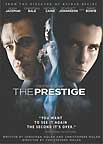
The Prestige
Directed by Christopher Nolan
Starring Hugh Jackman, Christian Bale, Michael Caine, Piper Perabo, Rebecca Hall
How to order
The Illusionist
Directed by Neil Burger
Starring Edward Norton, Paul Giamatti, Jessica Biel, Rufus Sewell, Eddie Marsan
How to order
There's always been something gay about magic and magicians. Sure, they look pretty fruity with their top-hats and cloaks waving about wands and suddenly-appearing flowers. But there's more. On some basic level,
magic-- either the manipulation of reality that's the magician's stock-in-trade-- or real magic,
ą la Harry Potter and company-- is queer. It's anti-normative, an aberration from the expected, the sheer flouting of logical and
scientific conventions. By and large, rabbits don't come out of hats, pretty female assistants can't be sawed in half, nor the human body transported instantaneously through space.
The visceral thrill of magic, the longing-- even need for-- for the unexpected is the same thrill that many heterosexuals experience with gay culture. It isn't so much that magic and queer culture "think outside of the box,"
but that they prove that the "box"-- accepted, normal reality-- is a conceptual trap, a constricting, well, box.
Thus, in part, the extraordinary popularity of Harry Potter: children, and many adults, get a thrill from the idea that the dreary, stupid, shortsighted world of the Muggles is complemented by the exciting, fabulous,
dangerous world of magic. Whatever its flaws, the Potter series is one of the best advertisements for non-normative myth-making that's appeared in popular culture for years.
Two new films about magicians-- both pretty gay in different ways-- were released in late 2006 and are now on DVD. The Prestige, directed by Christopher Nolan, is the gayer of the two. But Neil Burger's The Illusionist also
has a queer subtext, even if it's a little harder to pin down.
It's difficult writing about The Prestige
not so much because you don't want to give away the 67 major plot twists that keep coming at you with the speed of Britney Spears on meth, but because you aren't quite sure
what's actually happening, even when it's over.
Written by Christopher and Jonathan Nolan (from the popular novel by Christopher Priest),
The Prestige is the complicated story of a rivalry between Robert Angier (Hugh Jackman) and Alfred Borden (Christian Bale). Both
are magicians in Victorian London who-- after the death of one of their wives-- engage in an all-out war over their tricks, careers, and personal lives. The film plays-- rather, taunts-- us with the idea that magic is always an
explainable illusion that we can't stop watching but know, in our hearts and minds, is simply a trick. The plot is far too complicated to detail here, or fully grasp-- but it revolves around the very queer idea that fake, invented lives can
be extremely useful-- even necessary-- in negotiating the world.
You can't help but be reminded of Oscar Wilde's
The Importance of Being Earnest, and that play's Jack and Algernon's-- those mismatched, long-lost brothers-- dedication to "bunburying": their conjuring of an imaginary
friend to cover the increasingly complicated tracks of their lives.
It's hard to imagine that Christopher Priest didn't have Wilde's manic, disorienting plot in mind when he wrote
The Prestige-- and that the Nolans (who had already made a career out of confusing people in their
Memento) followed suit.
The levels of homosexual and homoerotic shenanigans here are astounding-- this is the now-you-see-it-and-now-you-don't school of pseudo-queer cinema. Having the always-cute Christian Bale and Hugh Jackman on
hand reinforces that subtext. As well, glitter-queen gay icon David Bowie playing weird scientist Nikola Tesla is pretty queer. Especially when Tesla has lines like "You're familiar with the phrase 'Man's reach exceeds his grasp'?
It's a lie: man's grasp exceeds his nerve," or "Society tolerates only one change at a time."
Smoke, mirrors
Neil Burger's The Illusionist, from Steven Millhauser's short story "Eisenheim the Illusionist," covers similar material: the complicated lives and loves of a magician as he figures out how to survive in late 19th-century Vienna.
The narrative here is less complicated, but more immediately satisfying, in part because we can mostly figure out what's going on, even if the movie ultimately pushes fewer boundaries.
The Illusionist is a tale of forbidden cross-class and interfaith romance in a late-19th-century context of a crumbling aristocracy and an emerging middle class. The magician Eisenheim (Edward Norton) is a Jew who learns
quickly the "queer" lesson that pretending to be someone you are not-- as well as being able to fool everyone about everything-- can be a survival strategy.
The simplicity of The Illusionist's plot, which does contain a full hand of twists, follows from its dependence on characters clearly defined as good guys and bad. Among the latter, Crown Prince Leopold is beautifully played
by the sexy Rufus Sewell. By contrast, The
Prestige keeps turning in on itself, and its characters, with unnerving ferocity. Yet both
The Prestige and The Illusionist are highly entertaining films, and if enjoyed with the right eye,
quite queer.
| Author Profile: Michael Bronski |
|
Michael Bronski is the author of
Culture Clash: The Making of Gay
Sensibility and The Pleasure
Principle: Sex, Backlash, and the
Struggle for Gay Freedom. He writes
frequently on sex, books, movies, and
culture, and lives in Cambridge,
Massachusetts. |
| Email: |
mabronski@aol.com |
You are not logged in.
No comments yet, but
click here to be the first to comment on this
Movie Review!
|