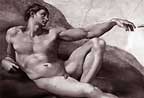
Adam had a lot of descendants for a guy with such a
little one�
|
 |
By
Michael Thompson
You see them, teenagers
holding index finger and thumb one inch apart, looking and giggling
to one another just below classic or Renaissance statues. Older folk
smile, but pretend not to notice. In our time bigger is better, and
porn gods sport 9-, 10-, or more-inch boners they casually pound
into one another. What happened? What changed?
Aesthetics for one thing.
The Greeks and Romans considered a more petite penis (always with
foreskin enough to cover the glans) to be more attractive. Noble
youths were almost always depicted so. Even erect, the foreskin
would cover the glans, preserving modesty at sport or in the
bathhouse.
That's where the
kynodesme came in, the little leather foreskin ties you can
see on Greek vases (evidence that ancient youths were no less prone
to inopportune hard-ons). With male nudity commonplace, it was
showing the glans that signified immodest exposure. The
Romans were hard-line on the question: for citizens, circumcision
was a deportable or even a capital offense.
Slaves, barbarians, and
Egyptians (despised as practitioners of circumcision) or people
being ridiculed, were shown with big, pendulous penises and bare,
bulbous glandes (that's the plural of glans!).
A golden mean?
You can forgive the Greeks
for not getting around to appreciate size. They had a lot of other
work to do. In particular, they were busy civilizing nudity.
Earlier rituals are what
segued into the Greeks' practice of "civic" nudity. The Greeks
prided themselves on this comfort with the undraped body that set
them apart from neighboring barbarians. Greeks honed their sense of
ideal physical proportions, and big dicks weren't part of the
pretty picture.
But there was a place for
size in other realms. Giant carved phalli can be seen at temples,
such as that of Dionysus on Delos. Around the house, the herm
(a plinth with a head and an erect phallus at the front) was a
common protective charm. Springtime phallophoria festivals to
honor Dionysus featured processions of satyr-costumed revelers
endowed with giant members trading crude insults and jests, and
singing praises to Phales, the satyr god. These songs were called
komedia, from which came the "comedy" of the Greek stage.
Huge cocks were the key comic stage prop -- the most "invariable
accouterment of male charactors," notes classicist Stephen
Halliwell, "a sign of comic masculinityƒ there to make the boys
laugh." Thus was the threat of immodesty reduced to farce.
Depictions of sex in Roman
art were considered in good taste so long as mores were observed.
Anal penetration was okay -- just look at the British Museum's
Warren Cup. But oral sex wasn't -- a "purity of the mouth"
issue.
While large phalli
weren't desirable on men, they were put to other symbolic uses: as
good-luck charms, used near doorways and still seen today as the
winged penises sold as trinkets outside Pompeii. Priapus, depicted
with full erection, was more in service to agricultural rather than
human fertility. Priapic figures watched over gardens, vineyards,
and acted as a scarecrow in fields. He was also protection against
theft -- with the implication that transgressors would suffer the
consequences. As one Roman epigram put it: "If a woman, man, or
boy thieve from me, she shall pay me with coynte, that with his
mouth, this with arse."
Who's the
barbarian?
"To those on whose
genius we've built our civilizations, we, with our preoccupations
on rock-hard massiveness, would likely be seen brutish and
grotesque," contends Jaime Morrison on his blog Thenonist.com.
Still not moved by the
diminutive member? At least a tiny bit of ancient evidence shares
your bias. Morrison cites a Wikipedia entry on Priapus -- so we
can, too -- discussing an incident in Petronius's Satyricon.
"[W]hen the heroes arrive in Crotona, they come across a youth who
is exposed and found to be very well endowed. As a result the
townspeople (including women) hold him in reverence and literally
trip over each other to touch his phallus for good luck" -- no
sense of disgust implied.
Ancient art and
sculpture may have hewn to one standard when it came to big cocks,
but for the ancient man- (and woman-) on-the-street, maybe bigger
was, at least, luckier.
You are not logged in.
No comments yet, but
click here to be the first to comment on this
Queer n There!
|