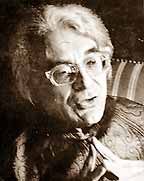
Roger Peyrefitte
Further Reading
Peyrefitte on California
These popular Neapolitan cinemas were, especially on Sundays and holidays when they were full to bursting,...
|
 |
By
Roger Moody
Now here's a coincidence in November 2000, the 93-year-old Roger Peyrefitte died in France a century to the very month that Oscar Wilde threw off his own mortal coils in that same country. Both were inveterate
gossipers, raconteurs, and poseurs. Men of noted sartorial elegance, adherents of the good life, they strutted the streets and the salons of respectable society, firing fusillades of sometimes dubious taste and egotistical
bon mots (Oscar declared nothing but his genius; Roger claimed he was one of only two true humanists left in France). They were both bisexuals who advocated passionate romantic relationships between older and younger males, while
often pursuing their partners in the gutter and getting caught.
But here the comparison fades. While Oscar claimed to have put his genius into his life, Roger spent 50 years painstakingly inscribing his into books. During Wilde's lifetime, the "love that dare not speak its name"
was almost exactly that. In contrast Peyrefitte trumpeted it from the Parisian rooftops. From there, he swooped down Zeus-like on often-willing Ganymedes, gathering them from the hillsides of Greece, Taormina, and La Touraine,
the dingy cinemas of Naples, Rome, and Paris, and the beaches and squares of colonized north Africa. Surprisingly, Peyrefitte never ended up in court on either sex or libel charges, though he was several times arrested. On
such occasions, he would shamelessly flash his credentials as an ex-diplomat, or drop evocative names (a distant cousin was the Gaullist minister of Education, Alain Peyrfitte).
With the publication in 1944 of his first book
Special Friendships, Peyrefitte at 37 became an overnight sensation, winning the prestigious Prix Theophraste-Renaudoux, and just missing the Prix Goncourt itself.
This eloquent and gripping account of the passion between an older and younger schoolboy violently thwarted by the creepy Father de Trennes, himself secretly in lust for the younger 13-year-old has surely never been
bettered, though scores have tried.
Friendships was based on his Peyrefitte's own experiences at a Catholic college, and triangular, intergenerational emotional relationships were to become the template for some of his most affecting output.
From the early 1950s until the '70s, Roger mercilessly trounced or satirized, in turn, the old French royal family
(The Prince's Person), lubricious, scheming Catholic clergy
(The Keys of Saint Peter), the freemasons
(Les fils de la lumiere) and the diplomatic corps
(Les Ambassades and La Fin des
Ambassades). Both anti-semitism and J. Paul Getty were targeted in
The Jews, followed by the French nation as a whole
(Des Francais) and then the USA (Ironically
Les Americains was the only work for which he had to issue a public apology thanks to libel action by that formidable gay icon, Marlene Dietrich).
Meanwhile, Peyrefitte was also crafting slimmer, somewhat less tendentious, profiles of then little-known homosexual personages. He claimed with some justification to have rediscovered the erotic photography of
Baron von Gloeden (Les Amours Singulieres published in 1949). He also brought to wide public attention the escapades of another Mediterranean sexual refugee, Count Jacques Adelsward de Fersen, the "Exile of Capri."
Most intriguingly, he took up cudgels for Fernand Legros, one of the richest men of the postwar years, Legros allowed Peyrefitte to depict him (in
Tableaux de chasse) as an arms merchant, spy, art dealer (possibly forger?) and
collector of exquisite teenage males. It was murky territory with which Roger was familiar, and he trod it with a firm step.
Before he turned 70, Peyrefitte had established himself as one of Europe's leading literary hitmen. In particular there seemed no limit to his gay "outings." These included a Vatican-load of popes and cardinals, the
famous Club Mediteranee (who but Peyrefittee would dare reveal that this was originally a group of boy-loving "sex tourists"?) and numerous closeted contemporaries. One was the UN Secretary General, Dag Hammerskjold
(who apparently enjoyed vistiing the Egyptian oasis of Siwa, where man-boy marriages were celebrated until quite recently). Another was Prince Philip (allegedly enamoured of his male secretary, before he hitched up to the Queen
of England). A third was the renowed novelist Julien Green. It was familiar knowledge Green was gay... but a lover of
young boys? It took Peyrefitte to record how Julien once masqueraded as a "Monsieur Simon,"
en route to purchase sensual portraits of handsome Boy Scouts, from the atelier of German photographer Karl Egermeier.
For more than 30 years, Roger turned his pen to recycling almost any "revelation." Some proved sound, but others were little more than "purple pap." It began to show. True, he had helped launch the serious gay
journal Arcadie, while Gai Pied (a magazine now sorely missed) took a surprising shine to him and his work. But
Roy, published in 1979, and Peyrefitte's attempt to satirize Hollywood morals through the eyes of a 13-year-old
gay prostitute fornicating with the elite of Bel Air, hardly rose above a masturbatory fantasy. The master of schlock had become increasingly out-of-touch if not sympathy with active gay movements. Even if his readers were
too young to remember that he'd worked under the wartime Vichy regime (though in no sense as a Nazi sympathizer), many couldn't easily forgive his support for the US assault on Vietnam during the 1970s, or his distaste for the
left-wing views of homosexual liberationists, like Jean Genet.
Nor, while exposing the weaknesses of others, could Peyrefitte hide his own prejudices and hypocrisies. A perennial butt was gay Nobel prize winner André Gide, whose self-revelatory
Journals and other personal writings are among the bravest documents of the 20th century (and who prophetically announced in 1944 that
Special Friendships would endure indefinitely). Roger dubbed André "the leader of a sect of which he wasn't a
member" meaning Gide eschewed the buggering of his partners and was attracted primarily to penurious young Arabs. In reality, Gide's French affairs ran along remarkably similar and enduring lines to Roger's own. Another target
was the pathetic Professor Robert Achard, a notorius seducer of pre-pubertal boys. Peyrefitte claimed he himself selected only
adolescents en emoi (sexually aroused youths). But wartime correspondence between Henry
de Montherlant and Peyrefitte (not published until 1983), along with Roger's highly explicit
Propos Secrets (1977 and 1980), graphically show the younger Roger in salacious positions with people as young as nine or 11 some
of whom were actually introduced to him by Achard!
Similarly, Peyrefitte couldn't resist chiding Marcel Proust, for "cross-dressing" his young male objects of desire in the monumental
Remembrance of Things Past. Yet, in their wartime correspondence, both Peyrefitte and
de Montherlant feminized their many boyish partners, so as to fool the censors. (The device became demonstrably absurd when describing pick-ups of young labourers from their place of work, or treating a 14-year old to a
steamy ejaculation in the back stalls!)
Transcendent?
Can we then speak of a Peyrefitte gay legacy, deserving to last another decade let alone another century? Of his more than 30 books, less than a third have been published in English and none are still in print. Do they
deserve to be?
My answer is a qualified "yes." I find it unacceptable that Peyrefitte's two most deeply-felt works are still without an English edition. In
Notre Amour (1967) he describes his relationship with Alan-Philippe Malagnac,
first met as a 12-year old choirboy extra during filming of
Special Friendships in 1964. Fourteen years later, the evolution of that love into a frank, engaging
drole de drame was commemorated in L'enfant de
Coeur Although Peyrefitte protected the young Alan-Philippe by claiming
Notre Amour wast a montage of different affairs, there is no disguising the passionate, sexual nature of this relationship, nor its reciprocity as reflected in letters from the
beloved. These two works are among the most significant treatises on
pederastie every penned. And in this very term perhaps lies the key not just to Roger's personal survival, but his lasting significance in gay social history.
For over half a century he managed to reclaim by plundering a vast jumble of historical and contemporary sources the essence of male-desire-for-male, in its transcendence of class, national boundaries, fashionable
norms, and chronological age. To Peyrefitte, defending
pederastie was neither the pretext for creating an enclave movement, nor the self-fulfilling political agenda of any party. On the contrary, it was deeply and irrevocably
embedded in the human condition, and would therefore always reveal itself whatever the repressions it attracted, however bizarre its forms.
Editor's Note: Works cited here in French have not been published in English.
You are not logged in.
No comments yet, but
click here to be the first to comment on this
Magazine Article!
|