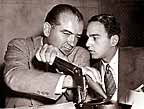
Diabolic lovebirds-- Sen. Joseph McCarthy, & sidekick Roy Cohn
|
 |
McCarthyism's queer side
By
Michael Bronski
The Lavender Scare: The Cold War Persecution of Gay and Lesbians in the Federal
by David K. Johnson
University of Chicago Press
How to order
Many Americans are aware of the anti-communist "red scare" of the 1950s, taking shape in McCarthyism and the blacklist that cost so many their livelihoods. But few also realize that, at the same time, the Federal government launched an all-out attack on homosexuals in
many branches of government. David K. Johnson's superlative
The Lavender Scare readably recovers this history and is a terrific contribution to queer history. Not only does Johnson expose and elucidate a strain of homophobia with which we are still living today-- that queer people
by their very sexual nature are unable to be good citizens-- but he also maps the vibrant 1950s gay and lesbian culture that has been largely lost to history.
The seeds of this queer purge were planted by Senator Joseph McCarthy in February 1950, when he first began crusading against a "communist menace" in the State Department and claimed that every communist was "twisted mentally or physically in some way." But it
was a week after McCarthy's speech that the queer card was laid on the table. While the State Department denied that there were communists in their employ, they did admit to dismissing 202 employees as "security risks." When questioned further about this, John Peurifoy, a
deputy undersecretary for the administration, finally admitted that another 91 people were forced to resign, and that "most of these were homosexuals." This made front-page news and "gave credibility to McCarthy's vague charges" of government infiltration "and enhanced his
standing. Indeed, it completely changed how the very subject was discussed: only a quarter of the 25,000 letters written to McCarthy after this were concerned with the "red menace"-- the other three-quarters were obsessed with "sexual depravity."
Thus "non-normative" sexual desire and behavior became a yardstick with which to measure patriotism. Often, in the popular as well as the political imagination, the concepts of the "queer" and the "commie" became conflated-- both were "security risks," were unable,
or refused to be, "loyal" to the US.
The damage wrought by this war was enormous-- not only were thousands of people fired (during the height of the frenzy, one person a day was fired for suspected homosexuality), but it launched a culture of secrecy and betrayal in which personal lives were ruined and
the closet reinforced. By the end of the decade, McCarthyite repression helped ignite the political organizing, mainly through the Mattachine Society, that in the end successfully fought the government on this issue.
Johnson's book is marvelous when tracing the myriad permutations of this witch hunt and the ways it affected both government and queer cultures. But along with this, Johnson also tells the story of an exciting and quite open gay scene that flourished in Washington
during the New Deal and into the 1950s. During World War II, the US capital was filled with men and women from all over the country who were leaving homes, finding new lives, and discovering themselves. The city became a hotbed of sexual, artistic, and political freethinking.
Johnson documents the varied night life-- in bars, clubs, and restaurants, as well as street cruising in places such as Lafayette Park. And none of this was kept particularly secret-- books such as Jack Lait and Lee Mortimer's
Washington Confidential were enormously popular homophobic
exposés of the queer scene. While Lait and Mortimer's book wildly exaggerated-- they called DC a "garden of pansies" and said "there are at least 6,000 homosexuals on the government payroll, most of them known"-- they did capture a sense of the excitement of queer life. Ironically
while they may have publicized this life for other gay people (chapters in
Washington Confidential can almost be read as a "gay guide" to the city, complete with addresses of gay bars), they also increased the vigilance of the attacks on queer culture.
The Lavender Scare is best when Johnson brings together the political and social histories, especially in his detailed stories of specific people. Johnson has written a necessary and extraordinarily compelling social history of mid-century homophobia. His book lifts a lid on
times past, and-- in what is a new era of cynical anti-gay manipulations by the Right-- reveals much about present.
| Author Profile: Michael Bronski |
|
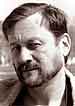
Michael Bronski is the author of
Culture Clash: The Making of Gay
Sensibility and The Pleasure
Principle: Sex, Backlash, and the
Struggle for Gay Freedom. He writes
frequently on sex, books, movies, and
culture, and lives in Cambridge,
Massachusetts. |
| Email: |
mabronski@aol.com |
You are not logged in.
No comments yet, but
click here to be the first to comment on this
Book Review!
|