The book behind the soap opera
|
 |
How gay people did it
By
Michael Bronski
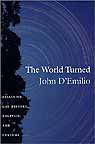
The World Turned: Essays on Gay History, Politics, and Culture
by John D'Emilio
Duke University Press
How to order
The recent death of Harry Hay has prompted many people who think about gay politics and history to ponder the intellectual state of the movement. While Hay was an important
thinker and activist he pretty much invented the concept of an American gay movement in 1950 his passing points to a sad fact: there have not been many thinkers (or activists) of
lasting note throughout the relatively short history of gay lib. While there have been a plethora of books about politics, most of them were not very good and many faded into oblivion
soon after they were published. Thinkers who have original ideas that actually matter and have an effect on the world are few and far between (ditto for heterosexuals).
The early years of the movement produced some striking thinkers. Carl Whitman's "Gay Manifesto" was a landmark (and written before the Stonewall Riots). Essays by
Charlotte Bunch for the Furies collective were also very influential. Dennis Altman's
Homosexual Oppression and Liberation was a watershed, as was (although more about feminism) Kate
Millett's Sexual Politics. There were essays in
Fag Rag and Gay Sunshine and several lesbian journals that shaped many people's thinking, but for the most part this early wave of radical
work disappeared. Since then truly groundbreaking essays and thinkers have been more rare than not. Jonathan Ned Katz's
Gay American History, Alan Bray's Homosexuality in
Renaissance England, Alan Bérubé's
Coming Out Under Fire, Jill Johnston's Lesbian
Nation, and John D'Emilio's Sexual Politics, Sexual Communities
were all important books. They average 20
years old as well. While Katz is still producing thought-provoking work we generally hear very little from many of these other writers, with the exception of John D'Emilio whose
newest collection of essays The World
Turned has just been released.
Aside from Sexual Politics, Sexual
Communities which uncovered and beautifully delineated the radical roots of the gay movement D'Emilio's most influential essay has
been "Capitalism and Gay Identity" from his collection
Making Trouble: Essays on Gay History, Politics, and the
University. Here D'Emilio elucidated, from a progressive view, how
shifting trends in capitalism and economics affected both the heterosexual family and thus the social construction of homosexuality. It was a revolutionary essay and profoundly influential.
While there is nothing this great in The World
Turned no surprise, any writer should be overjoyed to produce
"Capitalism and Gay Identity" once in a lifetime there are many that come
close and the rest are simply pretty great.
The joys of reading John D'Emilio are myriad. He is literate, knowledgeable, fair-minded, and smart very, very smart. It's difficult to pick out the best pieces here his two essays
on queer civil rights leader Bayard Rustin are terrific; sensitive to the nuances of race, cold war politics, and sexual desire he illuminates not only Rustin's personal struggles (and
the homophobia of the leadership of the black civil rights movement) but digs deeper into how US culture has jointly constructed race and sexuality in ways that has made a full
appreciation of the man (from a black or queer perspective) almost impossible.
But it is his writings about sex here that inform so much of
The World Turned. There's no doubt that D'Emilio is an old time gay and sexual liberationist. He writes about
how important sex has been to the continuing evolution of his personal identity and his relationship to the world and the movement. But as important, he is clear that sexual freedom
is about choosing to engage in sexual activity. He writes about how in his high school years his only sexual partners were men he met in movie theaters and parks and how while
these encounters were connections for him they were not what he wanted. Arguing that anonymous sex is great if freely chosen such forms of promiscuity (when enforced) are less
then liberating.
D'Emilio also writes about the backlash against some of Larry Kramer's more negative statements about gay sexual activities. While sexual liberationists have compared
Kramer's statements to those of Jerry Falwell in equating gay sex with death, D'Emilio moves the conversation a little further, insisting that there has to be some difference between the
intent and meaning of what either man said, and insisting that our usual demarcation of "oppression" and "resistance" as always diametrically opposed opposites is not always correct.
D'Emilio is as comfortable writing about science his piece detailing the never-ending discussion of the "gay gene" is remarkably free from cant and completely persuasive
about the pointlessness of this discussion as he is in discussing the enormous pitfall in "identity politics" in "What Does Gay Liberation Have to Do With the War in Bosnia?" The best
thing about these essays there are 16 of them is that D'Emilio always speaks for himself, from his own experience, and yet maintains a secure connection to the truly radical thought
that has informed our lives up until now.
In an age when political thinking is knee-jerk (from both the left and the right) or as is so often the case, just nonexistent these essays by John D'Emilio are truly a breath of
fresh air, and one of the best signs yet that the vision and the energy that erupted in 1950, with the Mattachine Society, or in 1969 with Stonewall and Gay Liberation, is still with us today.
| Author Profile: Michael Bronski |
|
Michael Bronski is the author of
Culture Clash: The Making of Gay
Sensibility and The Pleasure
Principle: Sex, Backlash, and the
Struggle for Gay Freedom. He writes
frequently on sex, books, movies, and
culture, and lives in Cambridge,
Massachusetts. |
| Email: |
mabronski@aol.com |
You are not logged in.
No comments yet, but
click here to be the first to comment on this
Book Review!
|