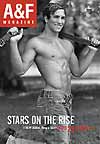
Not black, not queer, not accidentally
|
 |
Race, homosex, & Abercrombie
By
Michael Bronski
Why I Hate Abercrombie & Fitch: Essays on Race and Sexuality
by Dwight A. McBride (New York University Press, $19, 240 pages)
How to order
First of all: what a great title. While the sauciness of
Why I Hate Abercrombie and Fitch is not completely indicative of the tone or scope of the essays in this collection, it's representative of Dwight McBride's incisive contribution to how we think about race, sex, and gay culture.
In taking on Abercrombie, McBride addresses the sort of public homosexuality-- embodied in that clothier's soft-core porn catalogues-- that we've all become far too used to over the past decade.
While the title essay here is at the heart of this collection, McBride's primary concern is the way race is discussed in America. In 2003, while reading an article about the social lives of middle-class black women in
Newsweek, McBride came upon the sentiment he
suspected-- against all hope-- was going to appear: "You're not going to find one [a black man] out there because most of them are either in jail, gay, or taken." So this is where gay black men end up in mainstream American culture: between prisoners and husbands.
The reality is that gay black men hardly ever get represented, discussed, or even much noticed in mainstream (or, for that matter, gay) culture. Even the endless-- and often homophobic and racist-- media discussions of the "down-low" have essentially erased the
specificity of gay identity in black men's lives.
Why I Hate Abercrombie and Fitch is an attempt to correct and rectify this erasure.
McBride, chair of African-American studies at Northwestern, has written ten smart, provocative essays on the ways that gay men (and African-American men) are discussed and represented. In the case of Abercrombie and Fitch-- as McBride documents-- they are
almost completely missing. At first this essay seems to be complaining about the bland whiteness, and stereotypical "hot" sexualized photos, that appear in the A&F catalogues. But beneath these lazy, highly commercialized images, McBride finds a pattern of racial profiling. The A&F
Look Book-- the employee handbook that details how to dress on the job-- is quite clear in banning most forms of specifically African-American dress and grooming.
Of course it's no secret that the target audience of A&F is upwardly-mobile white teens and young-adults. But the mandated A&F "look" for employees is so specifically aimed at producing a white-skewed staff that that the company paid out $50 million to settle a
class-action discrimination suit filed in San Francisco in 2003.
McBride also argues that A&F's "cool" and "classic" style-- the firm's own words about their clothing-- is rooted in a sexualized-- but essentially sexless-- homoerotic image that is pervasive today in mass media and popular culture.
McBride takes aim at other instances of black gay male invisibility as well. "Straight Black Studies"-- the book's first essay-- discusses how both mainstream academic scholarship as well as African-American scholarship has tended to "de-gay" black gay writers such as
James Baldwin and Langston Hughes-- or, at the very least, refused to act in full "engagement" with the content of their work. Critics have yet to really take seriously the sexual and racial complexity of Baldwin's groundbreaking 1956 novel
Giovanni's Room (or for that matter, his
1961 masterwork, Another Country). McBride's arguments are potent and persuasive-- even in 1986, Langston Hughes's biographer felt the need to dismiss the "speculation" of his subject's homosexuality.
In "It's a White Man's World: Race in the Gay Marketplace of Desire," McBride discusses race's large role in gay porn. He has an engaged discussion of interracial gay porn-- and the construction of black men as potent sex machines, with "give me that big black dick"
the emblematic hallmark. As aficionados know, gay porn is generally segregated except for the small interracial genre. McBride isn't interested in just criticizing gay porn (or magazines like
The Advocate or Out) for being racist (though that charge could certainly be leveled at
them), but rather in looking at how "blackness" and "whiteness" is used, manipulated, and marketed in gay male culture.
McBride's prose is smart, on-target, and very readable. These essays are not simply illuminating, but some of the most eye-opening commentaries on gay culture to be published in years.
| Author Profile: Michael Bronski |

|
Michael Bronski is the author of
Culture Clash: The Making of Gay
Sensibility and The Pleasure
Principle: Sex, Backlash, and the
Struggle for Gay Freedom. He writes
frequently on sex, books, movies, and
culture, and lives in Cambridge,
Massachusetts. |
| Email: |
mabronski@aol.com |
You are not logged in.
No comments yet, but
click here to be the first to comment on this
Book Review!
|