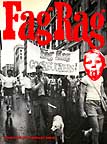
After the march, the cops called...
|
 |
By
Mitzel
My friend Amy Hoffman has just had her second book published:
An Army Of Ex-Lovers: My Life at the Gay Community
News (trade paperback from the University of Massachusetts Press, $22.95).
Gay Community News (GCN) had a small circulation but had an enormous cultural impact.
Hoffman's account is part personal story, part history, and part overview of the advancing gay and lesbian movements in the years she covers. Hoffman joined the staff of
GCN in 1978 starting as features editor. For years
she was a central figure at the paper. Full disclosure: I started writing for
GCN right after it started in 1973 and continued to contribute through the 1980s. The paper continued to publish until the early 1990s, albeit in a
different format. GCN was the first weekly newspaper for our community. It ran on a shoestring, and staff made just a pittance. There were endless meetings -- Hoffman is rather affectionate in recounting them. The paper never
missed a pub date -- not even in July 1982 when the office was firebombed.
T
he paper had been founded at the Charles Street Meeting House. Within a year, office space had been located at 22 Bromfield Street. The space was shared between
GCN and Fag Rag. The latter started publishing in
1971 as an occasional radical voice of gay liberation. Many of those who contributed to
Fag Rag also wrote for GCN. The cohabitation of these two papers was, by and large, amicable. The offices
GCN and Fag Rag were, in the early days, a de facto community center. When an emergency happened, a community meeting was called and met there.
Other meetings had to do with what GCN's mission was. I recall one meeting, at which a gentleman was being interviewed for an editorial position (or perhaps he had offered to buy the sheet). He was asked his plans for the
paper. He wanted to transform GCN into a NYC-style dress rag! Then there was the meeting at which the gay Neo-Nazis (who knew?) showed up and were angry they had been denied the opportunity to buy ad space. They were
politely shown the door.
The charm was that it was all in fact new.
GCN was determinedly co-sexual -- staff half male, half female. Their commitment was to cover women's news as much as that of the men. Over the years, one heard men
complaining that GCN was too much a "dyke rag."
Other weekly papers around the country started publishing -- in Philadelphia, Chicago, Los Angeles, many places. Most were owned by individuals or corporations. Each aggressively built up an advertising base. This was
GCN's great failure. I recall one staff meeting where we discussed whether the paper should accept ad money from one of what were then Boston's two gay bathhouses. (There are none now.) It seemed a no-brainer, but the
unlucky bathhouse didn't make the cut. The treasurer at
GCN prom- ptly quit, set up his own rag, and sucked up all the ad rev
GCN had declined.
Fag Rag didn't take advertising, so that wasn't an issue. But other things were. When Charley Shively was a featured speaker at the Gay Pride Day in 1977 (the year of Anita Bryant and other backlashers), he made a
dramatic presentation at the Parkman Bandstand on the famous Boston Common. Charley burned a number of his personal documents -- a dollar bill, his insurance policy, some from among the laws of Massachusetts, and a copy of
the King James Bible. For some reason, this set off a national furor -- Charley's life was threatened! -- and
GCN was inundated with the cartloads of correspondence from the concerned, a vast throng.
Fag Rag didn't have to be "sensitive" to advertisers or really anybody. We did what we wanted -- with taste and intelligence, of course. In 1976, we marched in the Gay Pride Parade, with our banner (featured here)
"Fag Rag Cocksuckers, etc." It was a popular display. My friend Neil Miller, then on the staff of
GCN, told me, several days later, that he had received a phone call from the liaison from the Boston Police Department, asking essentially
a Zen koan: "Do you really think you help your community by marching through the public avenues with a banner that says
Fag Rag Cocksuckers"? At least one police officer had paid us that much attention!
Here's the part that swells my heart. In Boston, in the 1970s, so much seemed possible. It was this grand opening -- I wound up running a swank gay male porno Cineplex (something Hoffman sweetly notes). Rents were
cheap, people could actually live on shit wages. The commitment for making things change was unstoppable.
GCN turned out to be a factory for folks who went on to all other sorts of activism. It was not just a newspaper; it was a training school, an activist sling-shot, processing all kinds of diamonds in the rough. Hoffman and I,
and all the others, were lucky to be along for the ride. As Amy makes clear in her delightful book, it doesn't take that many people to make a whole lot of change.
You are not logged in.
No comments yet, but
click here to be the first to comment on this
Common Sense!
|