|
 |
Leo Lerman sipped furiously of mid-century, artsy, high-society New York-- often with an extra dash of bitters
By
Michael Bronski
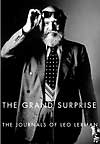
The Grand Surprise
by Leo Lerman (Author), Stephen Pascal (Editor)
Knopf Publishing
How to order
Inside dirt on gay lives is hard to come by. I don't mean the hardcore sexual nitty-gritty, but the emotional and culture nuances that shift shape in public and private lives over years and decades. Diaries and journals are a
prime source: James McCourt's wonderful 2003 Queer Street: Rise and Fall of an American Culture,
1947-1985; or Glenway Wescott's 1990 Continual
Lessons, his journals from 1937 to 1955; or Donald Vining's wonderful
self-published, five-volume A Gay Diary (published through the 1980s). Unfortunately autobiographies-- especially by literary men such as Gore Vidal, Tennessee Williams, or Christopher Isherwood-- while wonderful in their own
way-- tend to be exceedingly self-censored, and worse, compressed, so we don't really get the deluge of everyday detail that brings a moment or a week alive.
So the publication of a major new diary is cause for celebration-- even if, as is likely, it's also been highly edited. Still, more than any recent gay book,
The Grand Surprise gives a look at the day-to-day, almost picaresque,
artistic and sexual journeys of a capital-c Cultured gay man through New York in the middle and end of the 20th century-- and covering years when the city was the West's cultural capital.
In case you're not up on New York's artsy high society of that era, Lerman was a moved, shaker, and opinion-maker. Born in 1914 in the Jewish immigrant community of East Harlem, Lerman was a highly secular Jew. In
that, he followed in the footsteps of the assiduous assimilationism of his parents and grandparents-- though he broke away from their house-painting business. By the late 1940s, Lerman was a fixture on the New York social
scene-- a prominent editor at Mademoiselle and then
Vogue, and editor-in-chief at Vanity
Fair. He knew everyone and then a whole lot more people. Lerman died in 1994 at the age of 80. His journals bring to life for us what it
was like to be an openly gay man obsessed with metropolitan culture-- particularly the intersections of its varieties American and European and high and low.
While Lerman is frank about his love- and his sex-life (he had two major lovers as well as numerous shorter and one-night affairs),
The Grand Surprise fascinates most with its vigilant and ever-accumulating accounts of the
plays, films, dance, opera, singers, and artists he encountered.
The list boggles: Lerman pressed flesh with Marlene Dietrich, Maria Callas, Dame Margot Fontayne, Ruth Gordon, Gore Vidal, Grace Zaring Stone, Truman Capote, Judy Garland, Edouard Roditi, Chester Kallman, Leonard and
Felicia Bernstein, Julie Andrews, Siobhan McKenna, Maggie Smith, Libby Holman, Jennie Tourel, Norman Mailer, Pearl Kazin, Mary Lou Aswell, Lillian Gish, Lili Darvas, S.I. Newhouse, Kitty Hart, Katie and Zero Mostel, Sybil Burton,
Diana and Lionel Trilling-- and these are only the really famous ones.
But Lerman's journals are not simply an exercise in name-dropping. There's some great gossip here: a funny scene of Ruth Gordon gorging herself in a New Haven restaurant; Truman Capote and Leo Lerman referring
to themselves as "Myrt" and "Marge," mother/daughter characters on a radio serial. There's Leo loathing Vidal's
The City and the Pillar and claiming that "it makes all things dirty." We see George Davis, novelist and fiction
editor at Harper's Bazaar, referring to Capote's
Other Voices, Other Rooms as "The faggots'
Huckleberry Finn." And then there's just plain bitchy comments on Libby Holman, Lana Turner, Ike and Tina Turner (he calls their
Carnegie Hall show a "primitive, outdoor water closet, behind-the-barn pornography"). The idea is considered that Lee Strasberg was really responsible for Marilyn Monroe's death by "intellectualizing" her. And Lerman reports
Kenneth Tynan essentially accusing Capote of murdering the men he wrote about in
In Cold Blood.
Along the way, Lerman sketches highlights of cultural events through these years: great performances by Maria Callas (although he's mean about her later work), Lotte Lenya singing Kurt Weill, dancing by prima ballerina
Dame Margot Fontayne, even Joan Crawford at Town Hall. While all very "journal-like"-- it's a chronicle of Lerman's daily life-- these notes and gossip are really the soul of the book. It's a social history of what a certain segment
of gay men did, saw, thought, and felt through these years. While some of this seems ephemeral-- we learn what Princess Marina, Duchess of Kent, wore to the Metropolitan Opera in September 1956-- this is the level of detail
that can sometimes reveal an era.
To be sure, The Grand Surprise sometimes feels claustrophobic. Lerman-- certainly a man of the world-- seems curiously uninterested in what is happening on a larger stage. But in the end this is a brilliant, detailed, and
important window into a gay life over many decades. Lerman records for us a range of insights, emotions, and events to which we have not had previous access.
| Author Profile: Michael Bronski |
|
Michael Bronski is the author of
Culture Clash: The Making of Gay
Sensibility and The Pleasure
Principle: Sex, Backlash, and the
Struggle for Gay Freedom. He writes
frequently on sex, books, movies, and
culture, and lives in Cambridge,
Massachusetts. |
| Email: |
mabronski@aol.com |
You are not logged in.
No comments yet, but
click here to be the first to comment on this
Book Review!
|