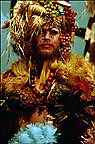
Hibiscus himself
|
 |
And gloriously gay
By
Michael Bronski
The Cockettes
directed by Bill Weber and David Weissman
How to order
Watching The Cockettes-- the incredibly great documentary about the notoriously famous San Francisco drag theater troupe of the late 1960s-- both exhilarates and depresses. The original footage of the
group's performances featured here is marvelous because it reminds just how rich 1960s gay counter-culture was. But along with this comes the inevitable realization of the state of gay culture now. And that, as they would have
said in the 1960s, is a bummer. And, indeed, as directed by Bill Weber and David Weissman
The Cockettes is not just a glimpse at fabulous gay history, but a meditation on how much things have changed since then. Treating
their material-- and their interviewees-- with respect and intelligence, Weber and Weissman help us realize what a special moment that time was.
The Cockettes were a rag-tag, stoned-on-acid, mostly-gay, freakish theater troupe that was started in San Francisco by Hibiscus (the
nom de fag of George Harris, a New York actor who migrated to the queer hippie
scene in San Francisco in the late 1960s). Hibiscus was already noted for his gender-fuck glitter drag persona and performances around the Haight, and after he gathered a few friends together to do a midnight show at the
North Beach's Palace Theater (noted for showing revivals and independent movies) they began calling themselves The Angels of Light, a name that metamorphosed into The Cockettes. Their shows were, at first,
unrehearsed amalgamations of old Broadway and Hollywood musical numbers, elaborate and outrageous drag outfits (even the women in the troupe were essentially drag queens) all strung together with a campy sense of humor,
much nudity, and great globs of irony and fun. With titles like "Tinsel Tarts in a Hot Coma," "Luminous Procuress," and "Pearls over Shanghai," they were brilliant recreations of the best and the worst of American culture as
seen through the eyes of drug-crazed/enlightened queens.
Their anarchistic and improvisational impulses were perfect for their time and place. As The Cockettes grew famous they became a national phenomenon. Fame also brought a new degree of "professionalism"--
they actually began scripting the shows and rehearsing-- as well as the demise of their original roots. Hibiscus left to work on his own projects (which eventually became a reborn Angels of Light) and the company, giddy with
success, were soon on their way to open in New York, where they were eagerly awaited as the sensation
de jour, but alas, were a critical flop. Although their opening night was among the most awaited of the theatrical season--
Mick Jagger, Truman Capote, Sylvia Miles, Andy Warhol, and everyone else was in attendance-- Gore Vidal caught the negative NY mood when he told the press that "not having talent wasn't enough." The free-form,
free-spirited, free-flowing, and completely non-professional-- or rather, anti-professional-- attitude of
The Cockettes didn't make it in the more cut-throat, competitive atmosphere of the Big Apple. They went back to San Francisco,
where they put on a few more shows and then basically disbanded, their bright tinsel star never fading, but just diminished by time.
Out of this craziness Weber and Weissman have fashioned a pungent and funny documentary. Interviewing many of the living Cockettes-- the death toll from AIDS and overdoses was not exceedingly high, but is
significant for what was, in essence, a small group of people-- and interweaving this new footage with archival clips of performances as well as everyday street life in San Francisco-- they have created a memorial not only to
The Cockettes themselves but to their rich milieu.
The interviews are moving, funny, intelligent, and never regretful. When Pamela Trent-Carpenter (who was known as Sweet Pam when she was in the troupe) notes that LSD was so prevalent (and accepted) back then
"we just about brushed our teeth with it," she is both wistful and engagingly forthright. Acid was a large part of The Cockettes culture-- as well as San Francisco culture in general-- and her openness to personal growth, to
exploring new possibilities of being alive-- is not just refreshing but an important marker for where we are now. Hardly anyone interviewed has anything negative to say about the madness of the times-- although some of
The Cockettes, like Goldie Glitters (who didn't want women to be in the troupe) do come across as cranky as they must have been back then. But we're left with the impression that contrition or guilt haunts none of them. Interviews with
non-Cockettes such as Sylvia Miles, John Waters, and Holly Woodlawn are also informative. Waters-- with refreshing honesty-- responds to the charge that
The Cockettes may have stolen some of their costumes or materials for
their sets with "Well, of course they did. We all did. I stole film. We all stole. That was how we created the art we did."
In a gay culture that is predicated on corporate advertising, on television ratings, and on pre-packaged heterosexual celebrities to sell queer magazines,
The Cockettes stand as a monument to imagination, charm,
and survival.
| Author Profile: Michael Bronski |
|
Michael Bronski is the author of
Culture Clash: The Making of Gay
Sensibility and The Pleasure
Principle: Sex, Backlash, and the
Struggle for Gay Freedom. He writes
frequently on sex, books, movies, and
culture, and lives in Cambridge,
Massachusetts. |
| Email: |
mabronski@aol.com |
You are not logged in.
No comments yet, but
click here to be the first to comment on this
Movie Review!
|