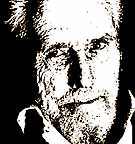
Ezra Pound
|
 |
Puny politics of poetical ex-pats
By
Mitzel
I was thinking about people in extraordinary situations. The
subjects here are Gertrude Stein, Alice Toklas, and Ezra Pound. The
three of them were ex-pats, Stein and Toklas in France and Ez in
Italy. Then the war came.
Stein and Toklas moved from Paris. First to their country house. When
the bombing came close, they moved to another village, a few miles
away where they stayed for the rest of the war, in occupied France.
And what of the
other American lesbians in Paris at that time? Natalie Barney? Sylvia
Beach? Did they ankle Paris for safer climes? Janet Flanner went to
New York and returned in 1944 as a correspondent to cover the
liberation of France. But
I have always wondered about Gertrude Stein and Alice Toklas. Both
were Americans. Both were Jewish. Both were famous lesbians. (Virgil
Thomson, when once asked he if thought Stein had sex with Toklas,
observed:
"She ate her out with a spoon!") Stein was famous as a
modernist writer. Why didn't they get out? The American consul in
Vichy offered to make all the arrangements. In occupied France, and
even in Vichy, a
phony-baloney Republic, both would have been regarded as "enemy
aliens."
One school of thought has it that the Nazis treated those in
France differently than they did those in Poland, Ukraine, Russia and
other territories they occupied. This may be true; I do not know. But
the
agents of the Third Reich pulled a lot of the French out of their
homeland and did away with them. They had a shopping list.
It turns out when the Nazi occupiers wanted a list of names
of everyone in the town wherein Gertrude and Alice then resided, the
Mayor told Stein he had left her name and Alice's off the list
because he
thought they were too old to survive life in a concentration camp.
I have read several biographies about Gertrude Stein. The
best is the late John Malcolm Brinnan's
The Third Rose. Not one of them, as I recall, addresses
exactly what it was that she and Alice went through
in that fearful climate. What, or who, kept them safe? Even Brinnan
is vague: "How serious the plight of the two American ladies was
cannot be certainly known." Stein was an odd bird. Her politics,
to the extent she had
them, were reactionary. She supported Franco and Petain. (Makes you
wonder how right-wing "modernism" was-- think Eliot and
Pound.) This would change under the occupation, and Stein was
ecstatic when the US
troops marched into town (having, just weeks before, had the
grotesque situation of a dozen German soldiers camping out in her
living room for a night-- for Gertrude the ultimate anti-salon). It
is an era now so far away that it
is hard to imagine. Except for this: I think anyone reading this
column will understand Stein's situation. Living in a country once
thought to be hospitable and welcoming, now occupied by forces
unleashed by a horrible
time, when, at any moment, the knock comes on the door. We'll get
back to this later.
Then there is Ezra Pound. I have never made a final judgment
on Pound-- or maybe I have and am in denial. Friends who care about
these things laud his role in promoting new writers and a new
sensibility.
All that's fine. Few care about the arts in AmeriKa, and so Ezra got
to be top banana in avant-garde circles for awhile. But when the
crunch came, there was Pound, living in Italy, not just an
"enemy alien," but one who
embraced the regime. He gave radio broadcasts denouncing the US
President, spewed forth his anti-Semitism, calling FDR "that Jew
Franklin Rosenfeld," and did it all with great verve and
enthusiasm. After the Allied victory,
Pound paid with his piece of flesh, thus the Pisan Cantos. Regarded
by the government as an active traitor, he was slated to be tried.
Judged to be insane, he was committed to St. Elizabeth's Hospital,
where he remained until
1958-- publishing and winning prizes through it all. At the time he
was released, he promptly returned to Italy. There is a famous photo
of Ez, on his return to Italy, giving the fascist salute, the old
piece of shit.
What's the point? Why is Stein an icon in our community?
Can't we find better Sacred Monsters? She strikes me as a selfish,
self-promoting woman, a bad writer and, in the most important
matters, foolish.
Her meditation on the war, a novel called Mrs.
Reynolds, reads as though the Nazi onslaught were just an
inconvenience for a quiet couple-- a pose is a pose is a pose.
Pound's case is a blatant measure of inequity. I know
people who have wound up on lists of targeted groups, men who have
done more time for what I regard as inconsequential acts than did
Pound. Both Stein and Pound left the US in large part because they
thought the country
was crazy. The country is probably crazier now than then, but I would
suggest that, in large measure, the two of them were products of the
craziness not just exiles from it. And I am Marie of Roumania!
You are not logged in.
No comments yet, but
click here to be the first to comment on this
Common Sense!
|