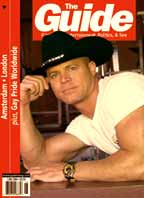
June 2004 Cover
|
 |
20 years on, Fassbinder's still hot
By
Michael Bronski
The BRD Trilogy: The Marriage of Maria Braun / Lola / Veronika Voss
Directed by Rainer Werner Fassbinder
distributed on DVD by
Criterion Films
How to order
Few filmmakers leave behind a body of work that can exist in the present without drawing sustenance from the twin evils of nostalgia and parody. Sure, there are great directors whose
work still stands up after decades-- Fellini, Ford, Hawkes, Murnau, DeSica, Griffith, Sturgis, Bergman-- although each made clunkers and in the case of Fellini and even Hawkes, some of their
most lauded work, although technically wonderful, is starting to fail time's test.
The films of Rainer Werner Fassbinder-- he directed 42 of them for screen and TV between 1965 and his death at 37 in 1982-- are as dense, enjoyable, funny, tragic, and powerful
as you'll find in any artist's output. While he was praised during his short life-- first as radical genius and savior of the German cinema, and then (as he made more popular movies) as
prolific international filmmaker-- most of his films no longer have an audience. Even in festivals and repertory houses, the once-famous Fassbinder barely makes a showing these days.
Is it because his films were too gay? In this age of such dumbed-down fare as "Will and Grace" "Queer Eye For the Straight Guy" and
But, I'm a Cheerleader, being gay is no longer
the detriment in the cultural marketplace that it once was. But alas, today's proliferate queer material proves the dumber's the better. Fassbinder was always "out" and his films display
a flagrant and unerring gay sensibility. But his films aren't watched much these days not because they're "too gay" but rather that they're "too good."
As flawed as many of Fassbinder's movies are (his 1979 terrorist comedy
The Third Generation is a mess, but a terrific mess) and as infuriating as some are
(The Bitter Tears of Petra van Kant is a two-and-a-half-hour soap opera of lesbian breakups that takes place in one room) they're all fascinating and compelling. But the best of Fassbinder's later output is the
BRD Trilogy (the initials stand for "Bundesrepublik Deutschland")-- in which he told the moral and social downfall of post-war Germany through extravagantly melodramatic, and often
subtly campy, films that drew their inspiration from 1940s and 1950s Hollywood "women's movies." The
films-- The Marriage of Maria Braun (1979),
Lola (1981), and Veronika Voss (1981)--
while they were critical and financial hits when they were released-- have suffered two decades of neglect.
Lola was never even released on VHS and the other two movies were transferred
very poorly to videotape. Now, thanks to Criterion films and their noted "Criterion Collection," the
BRD Trilogy is available in pristine condition with ample "extras," including interviews
with performers and enough historical and social context to allow new-to-Fassbinder viewers to enjoy the films in their full glory.
Mining rich cinematic veins
It's difficult to situate these films for a new audience-- the late 1970s and early 1980s was a time of incredible excitement for serious filmgoers. After
The Marriage of Maria Braun was a hit, the excitement surrounding
Lola and Veronika Voss was enormous. Fassbinder was playing with the conventions of the traditional Hollywood melodrama, making gay audiences,
who already had a special place in their hearts for these films, ecstatic. Fassbinder had already declared his love of the films of Douglas Sirk, whose
Imitation of Life and Written on the
Wind were considered junk at the time of their release, but by the 1970s were gaining the reputation of masterpieces. A mixture of suffering women, great outfits, and over-the-top
emotional explosions made the BRD Trilogy great gay cinema.
The Marriage of Maria Braun starts at the very end of World War 2, when Hannah Schygulla, as a newly married woman, accidentally kills a soldier and her new husband takes the
blame. He goes to prison and she becomes famous and wealthy as a businesswoman. This is Joan Crawford territory
here-- Mildred Pierce crossed with Daisy
Kenyon. Fassbinder shot the film is luscious 1950s color, and Schygulla is magnificent. But rather than being your usual "chick flick," by the end it's clear that Fassbinder is condemning the famed German postwar
"economic miracle."
Lola is a remake of Von Sternberg's
The Blue Angle, only this time the main character isn't bad because she's a whore, she's bad because she becomes a proper bourgeois
housewife and matron. Staring Barabra Sukowa and Armin Muller-Stahl,
Lola is a full frontal attack on the postwar German middle-class. Oh, she also sings and wears lovely outfits as well.
Veronika Voss is a redoing of Billy Wilder's famous
Sunset Boulevard-- only this time the ageing actress is a former Nazi movie star who's in the grip of a wicked doctor who has
addicted her to drugs. Staring Rosel Zech, and filmed in glorious black-and-white,
Veronika Voss is perhaps the darkest of the trilogy. Like its inspiration, it's a modernly funny, and very
queer, examination of how history-- especially German history-- is inescapable and how campy melodrama is the best way to expose the deadly idiosyncrasies and fatal flaws that haunt all of us.
Fassbinder's BRD Trilogy is a series of masterworks of gay sensibility and artistic and political acumen that is not to be missed.
| Author Profile: Michael Bronski |
|
Michael Bronski is the author of
Culture Clash: The Making of Gay
Sensibility and The Pleasure
Principle: Sex, Backlash, and the
Struggle for Gay Freedom. He writes
frequently on sex, books, movies, and
culture, and lives in Cambridge,
Massachusetts. |
| Email: |
mabronski@aol.com |
You are not logged in.
No comments yet, but
click here to be the first to comment on this
Movie Review!
|