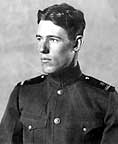
Prescott Townsend as a youth (Collection of Adrian Cathcart, courtesy of The History Project)
|
 |
By
Jim D'Entremont
Prescott Townsend, whose ancestors share Boston's Old Granary Burial Ground with Samuel Adams and Paul Revere, was dropped from the Social Register in 1943, soon after his arrest for performing an "unnatural and lascivious act" with another man. After
18 months in prison, he reentered the local Bohemian demimonde and went on embarrassing his family -- founding the Boston Mattachine Society, pleading for gay rights before the Massachusetts legislature, and leading an unapologetically gay life.
P
rescott used his personal fortune to acquire real estate on Beacon Hill and elsewhere, and to operate, for a time, a theater and gallery complex. Toward the end of his life, his two remaining properties on the Hill were on its North Slope, traditionally the side
where servants of patrician South Slope residents lived. He accommodated a motley collection of tenants, mostly young gay men, in an eight-unit building at 75 Phillips Street; Prescott himself inhabited an old brick townhouse at the end of Lindall Place, a cul-de-sac
that terminated just behind the Philips Street apartments. A subterranean corridor lined with cubicles connected the basements of the two buildings. The tunnel was said to have housed runaway slaves in transit on the Underground Railway prior to the Civil War.
Fusing the repressive and progressive
At the time of Prescott Townsend's birth in 1894, the neighborhood's dominant ethnicities were African-American and Irish. By the time of his death in 1973, continuing a tradition of welcoming whoever occupied the lower rungs of the social ladder, the North Slope
was Boston's gayest enclave. Passing into the hands of Boston's chief defender of "the rights of the homophile," the supposed slave tunnel linking Prescott's buildings seemed emblematic of successive struggles for equality. Prescott himself, a blend of the proper and
the scandalous, seemed to epitomize Boston.
Founded by Puritans seeking the freedom to practice repression, Massachusetts has long been a crossroads of contradictory cultural impulses, clashing styles, and antithetical beliefs. Boston, its capital, is a place whose peculiar mix of propriety and rebelliousness can
be traced back to Colonial times. The city was the epicenter of resistance to the British during the American Revolution, the birthplace of the abolitionist movement, a wellspring of American feminism, a bulwark of support for the black civil rights movement of the
1950s and '60s, and a hotbed of antiwar activity during the Vietnam era. Most recently, Boston has been a pacesetter for the gay rights movement.
In November 2003, the Commonwealth of Massachusetts became the first state to legalize gay marriage when a lawsuit brought by seven same-sex couples, including three from Boston, elicited a favorable ruling from the state's Supreme Judicial Court. The high
court determined that restricting marriage to heterosexual couples was discriminatory, thus unconstitutional. The first same-sex marriage licenses were issued six months later. The very concept of gay marriage seems a distinctively Bostonian fusion of progressive
and regressive agendas.
When Europeans first invaded Massachusetts Bay, the settlers' newly formulated legal systems anathematized homosexual acts, particularly buggery. The Puritans who founded Boston wrote the language of Leviticus into the laws of Massachusetts Bay Colony in
1641, echoing the British penal code in making sodomy a capital offense. Although same-sex "uncleanness" usually drew lighter penalties -- whipping, branding, imprisonment, disenfranchisement -- the death penalty was applied in hard cases, such as that of William
Plaine, who in 1646 earned the sobriquet "monster in human shape" for acts of sodomy committed in England, and for repeatedly luring young men into "masturbations" while calling religious proscriptions into question. Although sodomy ceased to be a capital crime
in Massachusetts in 1805, a vestige of the 17th-century sodomy law remained on the state's books until the U.S. Supreme Court's
Lawrence v. Texas ruling dismantled such measures in 2003.
But even at the height of Victorian propriety, Boston was never as strait-laced as its reputation for prudery and censoriousness would suggest. 19th-century Boston was a community where proto-capitalists, sober and devout, rubbed elbows with abolitionists,
Unitarians, transcendentalists, free-love advocates, and followers of odd utopian social experiments. Before homosexuality became an identity, people who would now be regarded as gay were submerged in "artistic" nonconformist subcultures. Men pursued their own sex
discreetly; women could at least form domestic partnerships as respectable spinsters. Female couples were sufficiently commonplace to inspire the term "Boston marriage."
In late 19th and early 20th-century Boston, the circles of ecclesiastical architect Ralph Adams Cram and art patroness Isabella Stewart Gardner were shaped by gay men. Many prominent Bostonians were at least covertly queer. When Boston artist John Singer
Sargent wasn't painting portraits of the social elite, he was pursuing a personal interest in the nude male form.
A gay city around the Hill
By the late 1930s, a Bostonian gay subculture had clearly emerged. By the 1950s and '60s, the Boston gay scene was roughly laid out in a circle enclosing Beacon Hill, Boston Common, and the adjacent Public Garden. Along the periphery of Beacon Hill, a gay
clientele converged on Sharaf's coffee shop, and men on the prowl filled Sporter's Cafe. But the three major hotspots were Scollay Square, a section of Washington Street, and Park Square.
Scollay Square's network of sidestreets was packed with restaurants, nightclubs, saloons, used bookstores, curio shops, tattoo parlors, and theaters. People flocked to the Crawford House to see the fabled Sally Keith twirl tassels attached to her breasts. The
Howard Athenaeum or "Old Howard" was a major venue on the burlesque circuit. The unbuttoned atmosphere and the campiness of many of the acts attracted gay patrons, who sometimes made connections at shows. There were also several gay or mixed bars in the area,
most notably the Jewel Box.
Half a mile away, the honky-tonk stretch of Washington Street between Essex and Stuart -- the "Combat Zone" -- attracted throngs of servicemen. Playland, Boston's oldest continuously operating gay bar (1938-'98), was located on Essex Street. Just around the
corner, below a tablet marking the location of Colonial patriots' iconic Liberty Tree, stood the Silver Dollar, an ostensibly straight bar popular with gay hustlers, their fans, and available men in uniform.
Two blocks away from the Combat Zone lay Park Square. In 2003, praising the area's growing number of chain restaurants in
Boston magazine, Alexandra Hall called old Park Square "that awkward enclave of nothingness, that void beyond the Park Plaza Hotel." In
Park Square's heyday, however, more sentient observers could see that the area was crammed with businesses that were unique operations, not franchises, and that its streets teemed with gay men and lesbians.
"Park Square was where all the sissies would go," recalls T.J., a former librarian who frequented the area's bars and baths in the 1950s and '60s. "In Boston, during the postwar Truman and Eisenhower era, gays congregated regularly, day and night, within a
six-block radius of Park Square. Carver Street, the birthplace of Edgar Allan Poe, lent a 'nevermore' aspect to the neighborhood."
Symbolic vibes also came from the monument at Park Square's core: a replica of Thomas Ball's Freedmen's Memorial (the original casting is in Washington, D.C.), commemorating Abraham Lincoln's Emancipation Proclamation. The statue was presented to the city
in 1879 by P.T. Barnum associate Moses Kimball. "The combination of the sentiments of the statue and the reputations of its donors resonated with denizens of the Square," notes T.J. "Swirling around the base of this monument to freedom, the Boston gays of that
[pre-Stonewall] era experienced considerable encouragement."
The Trailways bus terminal, together with the nearby Greyhound terminal and Back Bay Station, supplied regular infusions of transients looking for something to do. Behind Trailways was alley-sized Carver Street, site of the Lundin Turkish Baths and a popular gay
bar called Twelve Carver, containing Boston's first leather-and-denim venue, "Herbie's Ramrod Room." At the Stuart Street end of Carver was Hillbilly Ranch, a country-and-western bar catering to a mixed jeans-and-uniforms crowd.
Gay Village and 'The Block'
Steps away from Park Square, in Bay Village, gay patrons poured into Mario's, a restaurant with an upstairs bar; Jacques, a drag venue that still exists; Cavana's, a boisterous women's bar; and, in a former speakeasy space, the more formal Napoleon Club. Not far
away, straddling the block between Providence and Boylston Streets, was a 24-hour Hayes Bickford Cafeteria known to its regulars as "the Gay Hayes."
A short distance from Mario's was the Punch Bowl, Boston's foremost gay bar from World War II to Stonewall. Joseph McGrath, Prescott Townsend's secretary during the '60s, remembers pub crawls that would begin near South Station, continue through Playland
and Twelve Carver, and "always wind up at the Punch Bowl." The two-level operation had a dance floor in the basement. Like other pre-Stonewall nightspots, it was subject to police harassment, but whenever Boston's finest came through the front door, upstairs staff
would flash a signal light warning dancers below to switch to partners of the opposite sex. The Punch Bowl's employees included a waitress known as "Tex," who became a den mother to Boston's gay male community, and Sidney Sushman, who later earned infamy as
drag diva Sylvia Sidney. The bar figures prominently in reminiscences collected by Boston's GLBT History Project.
Not far away, there were cruising areas. A mixture of trade and men cruising for free staked out the Back Bay rectangle known as "The Block." The Public Garden along Beacon Street remained until the late '60s an active pick-up spot familiar to locals as "Queens'
Row." It seems likely that the young Tennessee Williams, in Boston repeatedly for pre-Broadway tryouts, would have found his way to Queens' Row, whose principal monument, Daniel Chester French's angel fountain, could have inspired the similar fountain where
Alma Winemiller is picked up by a traveling salesman at the end of
Summer and Smoke.
A more immediately active cruising scene developed nearby on the banks of the Charles where, by the early 1970s, a semicircle of shrubbery on the outer island of the Esplanade outdrew the Public Garden. The sexual activity took place after dark, but in summer, in
a surrounding section of the Esplanade nicknamed "Faggot Flats," there was relatively discreet cruising among sunbathers during daylight hours. More notoriously, there was the Back Bay Fens.
Banned in Boston
Despite the vitality and fun of the era between World War II and the Stonewall riots, Boston’s gay men and lesbians remained subject to forces that helped prod gay scholar F.O. Matthiesson to hurl himself off a tenth-story ledge of the Manger Hotel in 1950. The
moral watchdogs of Boston's Watch and Ward society, whose priggish condemnations gave rise to the phrase "banned in Boston," were eager to pounce on anything queer. The state sodomy law and its companion piece, an 1887 proscription of "unnatural and lascivious
acts," were frequently enforced. Police went out of their way to raid gay parties, sometimes in response to noise complaints, sometimes out of concern that people present might be breaking the Massachusetts sodomy statute en masse and having entirely too good a time
doing it.
The press, from the Boston Globe to the
Mid-Town Journal, was snidely homophobic. The
Mid-Town Journal, a tabloid published in the South End (now, ironically, an upscale gay neighborhood), greeted Prescott Townsend's 1943 arrest with the headline
"'Twilight' Man, Member of Queer Love Cult, Seduced Young Man." Treating a police raid on a Beacon Hill lesbian gathering as grossout humor, the
Journal entitled the story "Butch Balls Baffle Bulls."
When a bar raid triggered New York's Stonewall riots on June 27, 1969, the uproar was simply the splashiest manifestation of a tide of gay resistance that was rising everywhere. The Homophile Union of Boston, chief among the city's first home-grown gay
rights organizations, was founded six months before Stonewall. By the fall of 1969, Boston lesbians had founded a durable chapter of the Daughters of Bilitis. In 1971, Boston-based gay writers -- including Charley Shively, John Mitzel, and Larry Martin -- created
the liberationist Fag Rag Collective. The left-leaning, nationally distributed
Gay Community News began its 17-year career in 1973 at Boston's Unitarian, gay-friendly Charles Street Meeting House.
A disco ball
By the 1970s, since contact dancing had been all but abandoned, same-sex dancing became a non-issue. Discos proliferated. The Boston incarnation of the Club Baths took over an elegant old H.H. Richardson building at the corner of Washington and LaGrange
Streets in the heart of the Combat Zone; the Regency Baths appeared on the edge of the Financial District. Boston's gay bars became edgier. The Shed, a seedy leather-tinged establishment on Huntington Avenue near the New England Conservatory of Music, was a place
to score drugs or get invited to an orgy. Men's rooms there and at Twelve Carver Street's Ramrod Room became sexual mosh pits. At various times in the '70s, three Boston cinemas screened gay porn.
At the height of anti-gay hysteria fomented in 1977-'78 by Florida's born-again citrus shill Anita Bryant, scandal erupted in Revere, on Boston's North Shore. At the center of the storm was a karate-school proprietor who had been allowing his friends to tryst
with teenaged hustlers at his apartment. With considerable help from the Boston press, Suffolk County DA Garret Byrne turned the "Revere sex ring" investigation into a virulent witch hunt that destroyed lives. (The best account of this debacle can be found in
The Boston Sex Scandal [Glad Day Books, 1980] by John Mitzel,
Guide columnist and owner of Boston's Calamus bookstore.)
The gay community fought back, forming the Boston/Boise Committee and plunging into rallies, fundraising, and educational initiatives. One Boston/Boise event, a symposium held in December 1978 at the Back Bay's Community Church, resulted in the formation
of both the legal resource GLAD (Gay and Lesbian Advocates and Defenders) and NAMBLA (the North American Man/Boy Love Association). At the time, the shoulder-to-shoulder proximity of those two fledgling organizations raised few eyebrows; the demonization
of NAMBLA would come later.
Stormy 1980s
In the '80s, HIV/AIDS gave traditional, all-American erotophobia fresh power and credibility. In Puritan Boston, when the epidemic was new and especially frightening, mysterious fires began eliminating the city's bathhouses and clearing the way for redevelopment
of the buildings they occupied. The fires not only eliminated play spaces where men could connect without risking verbal or physical assault, they shut down sites where sexually active men could be screened for STDs, provided counseling, and shown how to play
more safely.
The AIDS era triggered an uptick in police harassment, even at events promoting safer sex. In 1992, resuming tactics beloved of
the Mid-Town Journal in the 1950s, police descended on a 160-man jerkoff party sponsored by Boston Jacks in a townhouse on
Rutland Square, arresting some of its organizers. "They made us line up, naked or in underwear," recalls one attendee. "It felt like a scene out of Dachau." There were also numerous tea-room entrapments at Back Bay Station, the Boston Public Library, and elsewhere.
Bullies with badges were only somewhat counterbalanced by Boston's large, assertive ACT UP chapter, and a feisty local manifestation of Queer Nation.
An attempt at a bathhouse-style sex club, the Safari Club, opened in the fall of '93 in a warehouse district behind Holy Cross Cathedral. It was raided and closed in October 1999 (see
The Guide, November 1999). The Safari Club raid was the last major police
action against a gay establishment in Boston, probably because there was almost nothing else left to harass or shut down.
By the mid-'90s, the closest real bathhouse to Boston was in Providence, Rhode Island; local gay bars were shutting down. (A 1977 article on Boston's gay bars in the long-defunct publication
Esplanade lists 21 establishments; The
Guide now lists about six full-time gay venues in inner-city Boston.) The popular notion that gay bar culture only encouraged alcoholism ignores the confluence of factors that creates an alcoholic, and seems oblivious to what has been lost. Boston's largest and most popular gay AA meeting, which
convenes weekly in a Back Bay church, does attract some veterans of the '70s and '80s bar scene seeking, in sobriety, some of the sense of community they once derived from the bars. But the fertile, democratic camaraderie of individuals from all walks of life uniting in safe
gay spaces is largely gone.
"The whole social scene has changed," observes Libby Bouvier of the History Project. "People now are much more apart."
The most facile explanation is that AIDS changed everything, but a shift in American culture -- the swing toward the right that took root in the late '70s and blossomed during the Reagan presidency -- may have cut more deeply into the gay community than the
epidemic itself.
"The changes we've been through," says the Fag Rag Collective's Charley Shively, "aren't so much a matter of disease as of demographics. People are different."
Booms and busts
Boston has changed in recent decades, not necessarily for the better. Visitors on the alert for tastelessness and hubris can find it easy to be negative about Boston, a city once dubbed "the Athens of America," but known to some as "the Big Lemon." Boston has some
of the worst public art of any major U.S. city, most of it inflicted on the developing cityscape since World War II. (Particularly vile is the Irish Famine Memorial, a visual blooper that redefines "strictly from hunger.") Copley Square, where H.H. Richardson's
masterpiece, Trinity Church, stands opposite Stanford White's Boston Public Library, has been dominated since the '70s by I.M. Pei's John Hancock tower, a monumental glass-and-steel erection looming over church and library as if to assert the superior potency of capitalism
over spirituality and learning.
Throughout the city, the prosperity of the Reagan-era high-tech boom has segued into real estate speculation and investment legerdemain. Completed in 2006, the 15-year, $14.6 billion Central Artery/Tunnel Project (the "Big Dig") eliminated an unsightly
expressway that had separated the waterfront from the rest of the city since the 1950s, and made possible changes in the city that are still evolving, but mostly in corporate directions. In Boston's seaport district, development abounds, much of it provided by cronies of
longtime Mayor Thomas Menino.
Boston has long been among the most expensive cities in the United States. Gentrification has been rampant for more than a decade, invading buildings and neighborhoods occupied for generations by working-class families, artists, and people employed in the
non-profit sector. Ethnic, class, and social diversity have considerably diminished as the non-rich are being priced out of town.
The ambiance that once gave Boston its shabby-genteel charm still survives in some neighborhoods, however, including pockets of the gay South End that have not been sanitized to death. Boston remains a walkable, user-friendly city, enlivened by a swarming
student population and a world-class music scene. Some reclaimed portions of the waterfront are impressive, especially the Fan Pier sites of the glass-curtained U.S. Courthouse and Diller Scofidio + Renfro's new Institute of Contemporary Art. Tourists coming from around
the U.S. in search of the ersatz Boston depicted in television shows, especially "Cheers," can discover historical sites that are among the oldest and most resonant in the United States.
But gay Boston as it existed in Prescott Townsend's day has vanished. On Beacon Hill, the traditionally downscale townhouses and apartments of the North Slope are now inhabited by well-heeled, mostly straight, predominantly white professionals. Scollay Square
was completely obliterated in the 1960s to make way for the windswept sterility of Government Center. In the former Combat Zone, an open space gapes where Playland fell prey to real-estate lust, and on Washington Street, the Massachusetts Registry of Motor
Vehicles occupies a former peepshow space. The red brick bulk of the State Transportation Building now sprawls over ground once occupied by the Trailways bus terminal, the Hillbilly Ranch, and most of Carver Street.
A Four Seasons hotel fills a stretch once patrolled by hustlers opposite the Public Garden, where the strongest gay presence is now a mated pair of female swans. In the 1980s, the city changed traffic patterns to discourage drivers from circling The Block in their cars.
On the site where the Punch Bowl once drew crowds, there stands an underpopulated furniture store. With most hard-core cruising bars gone, gay Bostonians have turned to the internet, making connections via Manhunt.net, Craig's List, or the "m4m" chatrooms at AOL.
America's cruisiest spot
On the Esplanade, shrubbery that formerly enclosed nocturnal bacchanals has been removed, but outdoor cruising does persist. The Back Bay Fens, the central strand of Frederic Law Olmstead's "Emerald Necklace" park system, is now the largest and liveliest
cruising area in New England. The banks of the Muddy River, a tributary of the Charles that meanders through the Fens, have been engulfed by aquatic reeds imported from Australia for ornamental purposes, now running wild and defeating efforts to eradicate them. Most of
the action occurs in a maze of paths in the reeds between the river and Victory Gardens maintained by area residents.
A posting at
Cruisingforsex.com
calls the Back Bay Fens America's "cruisiest spot," and states, "More sex happens here than anywhere else in the continental U.S." The claim is doubtful, but, weather permitting, the park invites comparison to the Tiergarten in
Berlin. The volume of sex in the Fens, however, is perhaps less attributable to the attraction of the swampy terrain -- which in recent decades has drawn muggers, gay-bashers, and even a hammer-wielding maniac -- than to the lack of anywhere else to go for sex in the city
of Boston.
In 1966, Prescott Townsend appeared in "An Early Clue to the New Direction," a 28-minute underground film by Andrew Meyer, in which he explained his "snowflake theory" of sexual variation. It's dispiriting to guess what Prescott might have thought of the
direction Boston and the U.S. as a whole have taken at the dawn of the 21st century -- a time of sex-offender registries, child-protectionist mania, anti-sex feminism, Homeland Security, massive surveillance, and regulatory micromanagement of human behavior.
"We've become more of an administered culture," says Mitzel. "Regulation brings oppression."
Most of Prescott Townsend's purported Underground Railway tunnel was destroyed when 75 Phillips Street, condemned by the City of Boston while Prescott was alive, was torn down. The Freedmen's Memorial, all that remains of old Park Square, is now upstaged
by One Charles Street, a gleaming high-rise. The monument now seems to signal a vision of emancipation that has been shoved aside but not quite lost. At least not yet.
This article was prepared with assistance from the
History Project, whose book Improper Bostonians: Lesbian and Gay History from the Puritans to Playland (Beacon Press, 1998) contains a more detailed account of gay Boston.
You are not logged in.
No comments yet, but
click here to be the first to comment on this
Magazine Article!
|