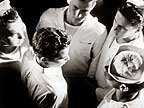
Fireworks ensue
|
 |
By
Michael Bronski
The Films of Kenneth Anger Volume Two
Actors: Bruce Byron (II), Ernie Allo, Steve Crandell, Johnny Dodds, Bill Dorfman
Director: Kenneth Anger
How to order
How to order
For many straight critics, the acknowledgment of a gay presence in American cinema is limited to understanding either some (usually tragic) homosexual theme, the most obvious of camp spectacles, or discovering a
"queer" undertone in an older film. But the reality is that since mid-last century, gay artists have been at the forefront of our culture's most innovative filmmaking. There's been a preponderant representation of gays in (depending
on what decade you are writing about) the avant garde, the underground, or independent cinema. But once these innovations have influenced mainstream filmmaking, the queerness is often forgotten, elided, or erased.
P
erfect case in point is Kenneth Anger, filmmaker extraordinaire. Anger has been making films since 1941 at the age of 14. His first truly groundbreaking work was the 1946
Fireworks, a dream/nightmare of public sex,
queer-bashing, sailors, and men taking explosive things out of their open pants flies.
Fireworks got a lot of attention -- Tennessee Williams called it "the most exciting use of cinema" he had ever seen (and he went to movie
theaters a lot, sometimes even to watch films).
Fireworks became part of the canon of experimental cinema, and its techniques and themes slowly seeped into the mainstream. Anger's 1964 masterpiece
Scorpio Rising achieves the feat of making
Rebel Without a Cause seem even gayer then it actually is. Anger has continued to work up until recently:
Anger Sees Red was made in 2004.
Anger's films are mysterious and difficult. They reverberate with a dense, queer sensibility -- which is something not always true in the films of Andy Warhol, Anger's obvious successor in the queer avant garde. Anger's
work shares some DNA with post-war fiction (all those hallucinatory scenes in Norman Mailer war novels) and even with the paintings of Jasper Johns and Robert Raus-chenberg, in which camp icon- ography is flattened or
distorted in odd ways. But not so distorted that there's any mistaking the queerness of the rich colors, sensual soundtracks, and curious, self-conscious, orientalized touches. Anger's is a disturbing and engulfing artistic achievement.
Fireworks and many of Anger's other films have been hard to find -- until now. With the release of
The Films of Kenneth Anger Volume One and Volume
Two, we have ten of his films -- from the 1946
Fireworks to the 1972 Lucifer Rising -- as pristine, digitally remastered, new prints, along with commentaries from Anger himself and others. The pristine quality no small detail, since many of these films were for years only available in 16 millimeter on
faded prints damaged by endless showings on lousy projectors at college film societies.
Though they vary in length from a few minutes to just over half an hour, I recommend watching these films one at a time so that you are not overwhelmed, or jaded, by the visual richness here -- as well as Anger's
propensity to dabble in obscure imagery, elliptic messages, and occult iconography. Viewed indiv-idually -- as intended -- the films are stunning; viewed consecutively they begin to appear silly.
So what was Anger's influence? Aside from his exploring explicitly gay sexual themes in the years after World War Two (when novels were attempting to grapple with homosexuality, but films certainly were not) Anger had
a visual palate far more sophisticated than his time. His quick editing, cross-cutting, layering of images, and use of discordant soundtracks (often to great ironic or camp effect) was not taken up by other directors until
decades later. Watch films as diverse as Sidney Lumet's
The Pawnbroker (1964), Rich- ard's Lester's
A Funny Thing Happened on My Way to the
Forum (1966), or John Schlesinger's Midnight
Cowboy (1969), and you can see how heavily they draw on Anger's style and scope. Now, watch anything on MTV and you can see Anger's vision writ large -- or routinized.
While it's great to have these films on new DVDs -- and they are beautifully packaged with hefty booklets and lots of extras -- there's also something sad here. This is an artist who might have gone on to making full-length
films. To be sure, Anger perhaps found the short film to be the perfect format for his vision -- but even here he might have gone on to make more ambitious ones. Of course mainstream success for Anger might have meant
squelching his unique voice. But as is, he's suffered obscurity. Anger is almost never acknowledged as the innovator he was, and his enormous contributions to mainstream cinema are lost to most viewers. Younger gay film audiences
are ignorant of his work even as they enjoy the fruits of his labors. If you are seriously interested in film, queer cinema, gay culture, or just like weird shit, get a copy of
The Films of Kenneth Anger -- you won't be disappointed.
| Author Profile: Michael Bronski |
|
Michael Bronski is the author of
Culture Clash: The Making of Gay
Sensibility and The Pleasure
Principle: Sex, Backlash, and the
Struggle for Gay Freedom. He writes
frequently on sex, books, movies, and
culture, and lives in Cambridge,
Massachusetts. |
| Email: |
mabronski@aol.com |
You are not logged in.
No comments yet, but
click here to be the first to comment on this
Movie Review!
|