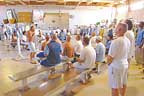
At California State Prison-- the Vacaville facility that
was scene of the US's first same-sex conjugal visit
|
 |
By
Jim D'Entremont
Without fanfare, the first same-sex conjugal visit ever permitted in a US prison took place last December at a Vacaville, California state correctional facility. Vernon Foeller, 40, serving a
20-month sentence for attempted burglary, was allowed to spend two-and-a-half days with the man who has been his registered domestic partner since 2005.
Although the California Domestic Partner Rights and Responsibilities Act of 2003 forbids discrimination against registered domestic partners by any state agency, it took a threat of
legal action for the California Department of Corrections and Rehabilitation to rethink its conjugal visitation policy. Foeller and his partner met every requirement for a conjugal visit, but
were repeatedly turned down by prison officials who refused to regard a gay domestic partner as a legitimate spouse.
F
inally, after a series of letters to the Department of Corrections from ACLU attorney Alex Cleghorn, the couple was allowed an extended private visit. Foeller, who was released in April
and lives in Sacramento, recently told journalists that except for security intrusions at four-hour intervals, the visit went well. Much of the time was spent preparing meals and watching
television. The visit, he told Reuters reporter Adam Tanner, was about "just getting to know each other, not some horn-dog experience."
For the past three decades, California prisons have allowed private visits by eligible inmates' spouses or partners. Politicians with law-and-order constituencies complain that conjugal
visits are conduits for contraband, and coddle criminals at taxpayers' expense. But proponents of such visits find them an effective tool for rehabilitation. Opportunities for couples to
spend quality time together in private don't simply reward good behavior and offer occasions for sex. The American penal system seems rigged to destroy relationships and break down
families; conjugal visits provide an antidote, strengthening bonds that can help sustain an inmate after release and reduce the risk of recidivism.
Only certain categories of inmate are allowed to benefit from the availability of private spousal visits, however. Sex offenders, some of whom could benefit from structured opportunities
for noncoercive sex, appear to be without exception denied access to conjugal visitation sessions. Also ineligible are death row inmates, persons convicted of serious felonies, and anyone
who has failed to meet disciplinary standards at any point during the six months preceding a proposed visit. No program of conjugal visits is available to any class of inmates at any
federal correctional facility, regardless of location.
In California state prisons, conjugal visits may last up to 72 hours. They usually take place on the grounds of the correctional facility in specially maintained apartments or trailers
equipped with bathrooms and kitchenettes. All couples seeking conjugal visits must have married or entered into a domestic partnership prior to one partner's incarceration.
Keeping families thick as thieves
Various forms of spousal visit are also allowed in New York, Connecticut, New Mexico, Washington, and Mississippi. Such arrangements are sometimes officially known as "Extended
Family Visits." The designation is more than a euphemism-- in some states, overnight visits may involve multiple members of an inmate's immediate family, including children.
But not all extended-visit programs are pitched to promote home and hearth. Conjugal visits held under the aegis of the Mississippi Department of Corrections are strictly sexual,
and available only to legally married, HIV-negative, heterosexual inmates and their spouses. According to the Mississippi DOC website, "Inmates are given one hour for a conjugal visit
and provided with the following items: soap, condoms, tissue, sheets, pillowcase, face towel, and a bath towel. The inmate and spouse are searched before and after each visit for
security reasons."
Mississippi, a study-in-scarlet Red State with an official one-man-one-woman definition of marriage, will not be sponsoring same-sex conjugal visits any time soon. (One reason why the
state provides inmates opportunities for quickies under hot-sheet motel conditions is to keep heterosexuality abuzz in a homosocial environment.) But more gay-friendly states-- beginning
with Connecticut and New York-- can be expected to follow California's lead.
In prison systems around the world, visitation policies vary. In Canada, which granted full marriage equality to gay couples in 2005, qualified gay or lesbian inmates are granted conjugal
visits in fully furnished apartments. In Brazil, gay male prisoners have the same conjugal-visitation rights as their heterosexual counterparts, though the visitation rights of all female prisoners
are curtailed. The United Kingdom proscribes conjugal prison visits entirely, but in France an incarcerated lesbian or gay man in
a pacte civile can have prolonged private visits with a
certified partner.
For persons imprisoned by the state of California, conjugal visits are the exception to an official ban on sexual contact of any kind. While homosexual activity is in fact commonplace,
openly gay inmates can be targeted for serious harassment-- as some of the officials reluctant to alter visitation rules for gay couples have been quick to point out. No provision exists for any
legal sexual contact between same-sex couples who are both inmates.
Despite the exception made for Vernon Foeller, California prison authorities have yet to adjust existing regulations on paper. They did, however, announce on June 1 that the rules would
be officially updated to accommodate registered same-sex couples by the end of this year. Guidelines for same-sex conjugal visits will closely parallel rules for straight couples, and follow
state law regarding domestic partners registered within California. It remains to be seen how the California DOC will regard a gay couple registered as domestic partners in another state, or
married in Massachusetts or Canada.
You are not logged in.
No comments yet, but
click here to be the first to comment on this
News Slant!
|