|
 |
What's up in sexology?
By
Bill Andriette
Remember the Sexual Revolution?
In the 60s, sex burst forth in the
West, like spring's
green shoots. The queers rioted at
Stonewall. Sex before and outside of
marriage
became commonplace.
Pornographic imagery bloomed like
lilies in the field. Varieties of
desire previously spoken of only in
hushed voices were now shouted in
the streets. Burning
their bras in public, women
demanded sexual equality.
The Sexual Revolution wasn't
just brought to you by the post-War
demographic bulge or
a random change in the Zeitgeist. It
was
brought about in part by science-- the
doctors who gave
us the birth-control pill and
"magic-bullet" antibiotics
against venereal disease,
the anatomists who rediscovered the
potency of the clitoris, laying to rest
Freud's notion
of the vaginal orgasm. Most
important of all was the
ground-breaking social
science of
Alfred Kinsey, who showed a
yawning gap between what
Americans said about sexual mores
and what they actually did.
That the Sexual Revolution is
now over is old news-- it was done-in
by AIDS, the
political turn to the right in the 80s,
and the
very success and institutionalization
of the movements that in 60s and
70s
were mounting the barricades.
Today, the global media is saturated
with sex scandal--
Bill Clinton's dalliance with a buxom
intern
almost cost him the world's most
powerful job. Celebrities make the
news caught
possessing outlaw pornography.
And
in the US, the Catholic Church has
been brought to its
knees by the once-secret liaisons of
its priests. Tipping their hats to its
power, politicians
and the media attack sex research
that violates current sensibilities.
Caught between
the demands of science and society,
how are sexologists succeeding-- or
failing-- to
deal with the cultural roots and
implications of their work?
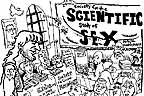
A good place to find out was at
Montreal's Bonaventure Hilton last
November, the site
of the annual conference of the
Society for the Scientific Study of
Sexuality (SSSS)--
known as Quad-S-- America's oldest
sexological organization, and
publisher of the
Journal of Sex Research.
Your correspondent could only
sample among the 100 or so
presentations. He can't
report on "Sexual Assistance
for Disabled
People: How Far Can We Go?"
"Vaginal Spasm,
Pain, and Behavior: Redefining
Vaginismus," or
the cryptic "Does PMDD Belong
in the DSM?"
But he did pick up the following from
the conference buzz...
-- that Viagra-- the 924,149,204th
pill of which was popped last
September 20th--
is changing the face of research by
proving there's big money to be had
in products
that enhance sex-- handy, as state
funding dries
up for everything except preventing,
policing, and punishing it.
-- that it's a bad idea to cut off or
cosmetically "reduce"
children's
genitalia-- which doctors still do
when babies are
born with small (that is, under one
inch) penises
or large (over one inch) clitorises--
surgery conducted only to make
children appear
more "normal"
-- that even in the age of the
internet and ubiquitous gay clubs,
college tearooms
are going strong, despite
harassment from
campus police and cluck-clucking
from lesbigay
student groups. Cruisy campus
toilets, particularly
at rural schools, often serve as
regional gay meeting spots
-- that female circumcision may
be more complex and benign
procedure than
received opinion holds-- often
involving no more than
a snip to the clitoral prepuce,
comparable to what boys routinely
undergo in
American hospitals
-- that the Catholic church in
centuries past tolerated abortion, at
least in so far
as endorsing use of the Herbs of
Venus for what was touted as
healthful "purges" for
women who missed their menses.
From one of those herbs derives the
active ingredient in
the morning-after pill RU-486
-- that women may be as prone
to use violence to get sex and as
likely to diddle
youngsters as men, though they get
caught less frequently and suffer
fewer consequences
-- that some people with sexual
tastes that get them into legal trouble
should be
given treatments that make them
hornier, in order to make them less
sexually discriminating,
and so able to "get off" in
ways less disruptive or taboo.
Margins of the known
universe
As befitting a science confab,
some of the research presented was
"basic"-- advancing
the frontiers of knowledge but without
obvious practical purpose. At one of
the
plenaries, University of Washington
psychiatry professor Julia Heiman
described her inquiries into
the plumbing of female sexual
arousal. While penises famously get
hard, it turns out
that aroused females experience a
more subtle and hidden array of
vascular events, little
known to science. To help lift the veil,
25 women agreed to be immobilized
in an MRI
machine, which can reveal interior
organs in real time. Through
binoculars, they would peer at porn
of their choosing, while enduring the
MRI's raucous clankings. Heiman
described
the experiment, as
well as others, in which scientists
placed up women's vaginas doppler
ultrasound probes,
photo-plethysmographs, and heated
electrodes-- the better to measure
clitoral engorgement
and vaginal blood flow. Alas for
science, Woman remains
mysterious-- the pulsings so
far uncovered bear little relation to
the self-reported peaks and valleys
the of the
subjects' arousal.
But Heiman's was one of the
more technical presentations. Sex
being a vast subject,
Quad-S is an interdisciplinary affair.
Together at the conference were
sociologists,
public-health specialists, educators,
hawkers of sex curricula and therapy
tapes, representatives
of various advocacy groups, and the
odd philosopher or historian.
Bearded,
tweed-clad professors whose
political consciousness seems to
have coalesced in 1968 mingled with
prim therapists from the America's
sex prisons who give off an
antiseptic air of 1984. In
the cramped hotel conference room
set aside for coffee and displays, the
six-foot-plus transvestite
representative of Tri-Ess-- Society for
the Second Self (SSS), a group
for heterosexual cross-dressers (no
relation to Quad-S)-- towered in her
pink dress over
the somber-suited textbook
salesmen from McGraw Hill at the
next table. "It's a little
bit different than from when I was
doing the engineering and
computer-science books,"
the textbook man related with a wink.
Sometimes the conference felt like a
watering hole on
the African savanna, where thirst
brings together giraffes, lions, and
hippos otherwise
rarely seen in each others' company.
An outsider soon realized this
was no ordinary academic confab. At
an interminable
awards luncheon it seemed no
Quad-S recording secretary or
subcommittee chair
remained ungarlanded. When a
professor at Indiana University
received a prize for career service,
he burst into tears. "I will not be
intimidated or silenced," he
declared, his
composure steadying, "and I
hope you won't be either." Just
add "Praise Jesus!" and it
could
have seemed like a convention of
Baptist missionaries working under
peril to save souls in
Red China.
But sex research is indeed under
the gun. In 1991, funding for a
large-scale survey of US
sex practices-- vital for strategizing
against AIDS-- was cut by Congress,
afraid results
would show how common was
queer sex. Playing Vatican to Galileo,
the US Congress in
condemned a 1998 study by Temple
University psychologist Bruce Rind
that suggested that
college students reporting sexual
abuse suffered no statistically
significant harmful effects.
Direct attacks on scholars and
research aside, the study of sex is
low on the
academic pecking order. Nanotech,
breast cancer, and gene sequencing
are sexy research
subjects; sex is not. As Freud
imagined little girls dreaming
wistfully about having penises, so
Quad-S seems to suffer an
institutional envy of, say, physics-- a
science that is hard. Not only
would having the status of physicists
mean enjoying better funding-- for,
say, Kinsey-style
sex surveys, sexology's version of
super-expensive cyclotrons. But it
would also
mint sexologists' scientific
credentials in tarnish-proof gold.
Quad-S's name itself hints at
defensiveness-- there's no Society
for the Scientific Study
of Chemistry, implicitly setting itself
apart from quacks who fool with
Bunsen burners and
gas-chromatography. Science may
be the fig leaf that justifies academic
attention to sex.
But inevitably, those who study sex
are participant-observers. Sexology's
"lab rats" are
fellow humans, and the voice of
research subjects is key-- the inter-
or homo- sexed,
for example, are authorities on their
own being, and doctors got it wrong
until they took
them seriously. What made Kinsey a
great sexologist weren't his creds as
the entomologist
who knew more than anybody else
about gall wasps. It was that he had
a keen
human intelligence about sex, and
how to get people to talk to strangers
about things they
rarely admitted to lovers. As with
good psychology or anthropology
generally, studying
sex requires that researchers be
wholly comfortable in their own
skins, aware of the workings
of their own characters or culture, yet
be simultaneously open to modes of
life radically
alien. Like being a good politician or
novelist, such skills are not reducible
to method.
Perhaps physics isn't either. But for
cultural self-awareness, Quad-S and
academic sexology
generally gets only a middling grade.
The John/Joan case
The most dramatic event at the
conference followed from an
experiment that
failed, underscoring the importance
of correctly teasing out sex's weave
of biology and
culture. David Reimer was seven
months old in 1966 when his penis
was burned off in a
botched circumcision. His parents
were at a loss about what to do when
John Money-- professor
at Johns Hopkins University and a
leading sexologist-- proposed that
the boy be
surgically "reassigned"
as a girl. Money had asserted that
the strong human sense of being
male
or female was wholly culturally
constructed, and only became fixed
around age two.
Reimer's parents went along, and
the infant was castrated, with labia
fashioned from his
scrotum. While the boy's identity
remained secret, over the years the
case was reported as
a resounding success and
confirmation of Money's thesis.
Milton Diamond, then a graduate
student and now Quad-S's president,
had doubts
about Money's theory, noting the role
of prenatal sex hormones in shaping
the brain. He
had published an article questioning
Money's claims about gender
identity. For years
afterward, Diamond tried to track
down the boy who'd been made a
girl.
It turned out that Reimer never
took to his new status, despite his
family's full
cooperation. He would spend his
allowance on toy guns, get into fist
fights, and urinate standing
up, whatever the mess. At school he
faced general ostracism from girls
and boys alike.
When adolescence hit, he began
and then refused to take the
prescribed estrogen pills,
rejecting the budding breasts and
widening hips. Finally, when his
parents told him what
had happened, Reimer chose to live
as a male. He had surgery to
construct a rudimentary
penis. Today he's married, and father
to his wife's children from other
relationships.
Reimer's case has been widely
discussed in recent years, and is the
subject of
John Colapinto's book As Nature
Made Him. At the Montreal
Quad-S meeting, Reimer made
his first public appearance. Perhaps
because of lowered testosterone at
key periods, he cuts
a youthful and handsome figure
(while the hormone helps make the
man, it also
recesses hairlines, clogs arteries,
and ages him). Reimer is angry if
long-resigned about
what happened. To his credit, he's
extended an olive branch to Money,
and has sought to
meet with him. But Money, now
retired, has refused contact with his
former patient and
won't discuss the case. Quad-S
member roundly criticized Money for
both failing to "do no
harm" and then covering up his
mistake. Still, one conference-goer
stood up and said, this
matter notwithstanding, Money
remained an important sexologist, a
comment that won applause.
Diamond summed up the
current state-of-the-art, which he has
helped define: genetic
sex and genitals predispose a
person strongly to the corresponding
sense of sexual identity.
In cases of physical ambiguity or
injury, surgery or reassignment can
wait until the
person makes up his or her own
mind-- or may simply be
unnecessary.
Clerical sex
Another plenary session at the
conference also seemed to jump
from the
newspaper headlines. Jay Feierman,
professor of psychiatry at the
University of New Mexico, asked
why men with other options would
forfeit sex and a shot at reproduction
to take a vow
of celibacy and become Catholic
priests. His answer was that to men
of certain
sexual persuasions, a life spent in
male company isn't a sacrifice at all.
"Through its history, the
church as provide homosexually
oriented men a safe
haven," Feierman said.
"Gay people would hardly have
needed a spiritual motivation to join
a
same-sex community of
equals."
Data on priests' sexuality is
scattershot-- but Feierman was
well-positioned to survey
the landscape, working for years at a
Church-run treatment center for
troubled clergy.
Feierman cited surveys suggesting
that maybe 25 to 75 percent of
American priests
are homoerotically inclined. From his
work ascertaining the sexuality of
priests referred to
him, he found large percentages
attracted to men and adolescent
boys, though very few
to younger ones.
Over the millennia, Feierman
contended, Catholicism became the
transmission line into
the present of the homoerotic
power-plant that was Ancient Greece.
An archetype he
found among homoerotically-inclined
priests were those attracted to
adolescent boys 13 to
16-- after pubic hair, before facial
hair-- the same standard upheld in
ancient Athens.
Socrates and Plato notwithstanding,
Feierman attributed such desire to
"immaturity,"
"arrested development,"
and "fixation." But he
granted that the sexual liaisons--
typically
involving adolescents getting sucked
off or engaging mutual
masturbation-- usually went on with
the youths' complicity. Teenage boys
are sexually charged but often lack
sexual
outlets, Feierman said, and so find
genital manipulation pleasurable.
Sex in the church, on
his account, was an aspect of young
male sexual opportunism-- in which
a donkey, a
cantaloupe, or a cleric's mouth can
all be ports of call in puberty's sexual
storm.
Feierman painted a fairly benign
average picture of these
encounters-- which
corresponds with the typical leniency
these relationships were treated in
the Church over the
centuries-- among participant,
parishioners, and clergy. During
questions and answers following
his speech, America's sexperts
hardly quibbled with Feierman's
benign analysis, but
offered many anecdotes illustrating
what conference-goers considered
the extraordinary
sexual ignorance and hypocrisy
they'd encountered in the Church.
Liberal pieties
After Feierman's lecture, for more
almost two hours a handful of people
joined him to
chat. A young man sat in the group,
but never spoke. Later I sought him
out. He turned out to
be an ex-seminarian, now openly gay
and attending college. He agreed
with parts of
Feierman's picture-- he found the
priests who were to lead him into the
calling immature, prone
to cracking boobs jokes. That is part
of what prompted him to leave the
seminary. But at
the same time he rejected what he
felt was Feierman's reduction of the
clerical vocation
to sexual motivation. Not that sex
didn't have a lot to do with Catholic
spirituality, he said,
or his own reasons for seeking to
join its brotherhood. By rejecting
sexual
attachment, Catholicism sustained
ecstatic traditions of communion--
with God, Jesus, Mary-- or
merely among nuns, monks, or
brothers. That was part of what he
had sought in going to
seminary, but did not find.
It's not a peculiarly Catholic idea
to put homoerotic desire-- with its
chance for freedom
from family obligation-- to cultural
use.
Many premodern societies had a role
for the berdache--
an often sexually variant male
invested with sacred function. There
are parallels in Hindu
and Sufi traditions. The ganglike
promiscuity of homoerotic ties-- as
distinct from
romantic heterosexual ones-- has
sustained group morale in military
contexts throughout
history. More peaceably, Walt
Whitman's poetry suggests the
male's exuberant
wide-ranging sexuality-- the quality of
finding everyone desirable-- can lead
to a rampant rutting in
the bushes, but may also sustain a
sense of bonding with all humanity.
Freud argued that
the general social connectivity on
which civilization depends is at heart
libidinal.
But despite the minute attention
given at the Quad-S conference to
the pulse and push
of sexual response-- there was a
curious obliviousness to these
cultural uses of sexuality.
The sex professionals of Quad-S
aspire to nothing if not a
"rational" view of sex,
within
whose categories is worked out an
entire morality-- with ideals of sexual
health grounded in
freely chosen, sex-educated, justly
policed, committed relationships
among consenting adults.
This commitment to rational sex
is why Feierman-- and no one in his
audience-- posed
an obvious question. If the
relationships now being exposed in
the Church were generally
banal and rooted in verities of history
and biology-- if not exactly Papal
bull-- then how to
judge the sudden shocked outrage?
Is the furor driven only by money, the
$10 billion
dollars Feierman said has been paid
out by the Church in sex settlements
in the US? Or is the
panic a manifestation of something
strange going on in the larger
culture? And is the
destruction of the Church only to be
welcomed as an end to irrationality
and hypocrisy?
Sexual dysfunction
If sexology can't grasp forms of
eroticism that don't meet its
standards of transparency
and reason, then its attempt to
understand sex fails. A pity, because
greater understanding
is desperately needed as the
program of liberalizing, rationalizing,
and categorizing sex,
has run its course, and is ceasing to
serve the integrity of individuals in
whose name it
is invoked.
The West is now deeply troubled
over sex, not from the failure of
liberalizing project, but
its realization. There is greater
freedom and openness in some
ways than ever before--
from Tokyo to Tbilisi, porn on tap
from every screen, sexy scenarios in
every ad,
rights protections for designated
sexual minorities. But beneath that
crust churns a magma
of hatred and repugnance toward
sex, and a readiness to ascribe to it
every imaginable evil.
A continuing series of manufactured
but explosive scandals-- from the
claims of satanic
day-care center sex abuse cases of
the 80s to the claims about
hundreds of thousands
of missing children-- have poured
lava over the political landscape.
With the priest panic,
these seismic events seem
continuous.
Every advance of the last
generation has come to cast a
shadow. There is a massive
legal apparatus in place to protect
people from sexual coercion, but it
means that every man
is vulnerable to a charge--
impossible to disprove-- that he
touched someone 25 years
ago, the line between
"touch" and
"rape" now erased. There
is official recognition of
homosexual and transgenderism,
but other sexual identities-- once they
are ascribed to you by
the state-- can mean that you are
civilly committed-- or, soon, in
Canada and Britain, have
chips implanted in you monitoring
your every move. Gone is the old
regime of censorship
and silence, but click on the wrong
web link, and you can go to prison for
decades. Along
with drugs and terror, sex hysteria
propels the moves toward universal
surveillance.
Around the time of the French
Revolution-- another period in which
both democracy
and terror spread-- the claim that
masturbation was destroying bodies,
minds, and the fabric
of civilization suddenly struck a
chord. These ideas flourished
throughout the West for
more than century. These claims are
renewed today-- only sexual
"self abuse" has
morphed
into the category "sexual
abuse"-- with the
symptomatology claimed by experts
virtually identical. This secularized,
medicalized picture of sex as
degenerating has so far
proven more intractable than the old
religious proscriptions, which the
Church proved so adept
at wriggling around.
John Money, fond of bold claims,
may this time be right when he says
that
"graham crackers and
corn flakes [foods invented to stop
masturbation] have a great deal to
say not only about
our past but also about our future,
and whether our children and
grandchildren will live in
a political democracy or a
dictatorship."
"Degeneracy theory,"
Money goes on, "not only
affects the sexual health of the
individual person, it impinges on the
political health of the body politic as
well."
At a time when the West's liberal
program of sexual reform has
reached its breaking
point, sexology must grasp the
potentialities of sexuality that lie
beyond its current
understanding. At a time when
getting it wrong about sex is helping
push the West into tyranny, getting
it right about sex couldn't be more
vital.
| Author Profile: Bill Andriette |
| Bill Andriette is features editor of
The Guide |
| Email: |
theguide@guidemag.com |
You are not logged in.
No comments yet, but
click here to be the first to comment on this
Magazine Article!
|