By
Bill Andriette
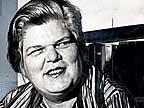
If credit for the "L" in GLBT could be pinned on
anyone's bosom it might be that of Del Martin, co-
founder in 1953 of Daughters of Bilitis, who died in
San Francisco August 27 at age 87.
"Today the LGBT movement lost a real hero," says
Kate Kendell, head of the National Center for
Lesbian Rights. "For all of Del's life, she was an
activist and organizer even before we knew what
those terms meant."
Along with longtime lover Phyllis Lyon, who
survives her, Del Martin was at the San Francisco
apartment on October 19, 1955 when eight women
met to form Daughter of Bilitis. The gathering lay
the foundation for the first national lesbian
organization in the U.S.
DOB, together with the Mattachine Society and One,
Inc., were the "Big Three" U.S. homophile groups in
the 1950s. The trio were centered on the West
Coast and often sparked with each other. But
together they paved the way for gay liberation in
the late 1960s and '70s -- whose militancy soon,
in turn, eclipsed its more cautious forebears.
Like its fellows, DOB's name was steeped in
obscurity -- in this case a book of poetry by Pierre
Louys featuring a Greek contemporary of Sappho.
But if DOB sometimes gave off the whiff of the
closet, it was because of the challenges of the
times.
"We were illegal, immoral, and sick -- I mean, that
was heavy-duty," Martin recalled in a 1995
interview in Paul D. Cain's Leading the
Parade. "So what we needed to do was develop
self-esteem, and self-acceptance being the real
key. And then, once you have accepted yourself,
then you can start coping in a hostile society."
Born in San Francisco in 1921, Martin studied
journalism at UC Berkeley and briefly married,
having a daughter, whose custody she later gave up
to her husband. Moving to Seattle, she met Phyllis
Lyon in 1950 when they both worked at the same
construction-trades journal.
For more than half a century, Martin was a voice for
lesbian visibility. "Nothing was ever accomplished
by hiding in a dark corner," she declared as DOB's
first president. "Why not discard the hermitage for
the heritage that awaits any red-blooded American
woman who dares to claim it?"
In the months after that first meeting, DOB's small
membership would split -- with most of the
working-class women, as Martin characterized it
later, leaving to form a lesbian social club. Deb and
Phil stayed behind, and were key to fashioning DOB
on a political and activist course. Part of that
strategy was founding a magazine, and The
Ladder helped spread DOB's profile across
North America.
"Reading one little article in '59 by Del Martin and
Phyllis Lyon... got to me and changed my life from
being a suicidal kid in Canada, to being out of the
closet immediately, never knowing what it was like
to be in the closet," declared comedian Robin
Tyler."
Martin threw herself into national gay organizing,
and was active in the North American Conference of
Homophile Organizations (NACHO) through the
'60s. But she often wasn't content with the gay
movement as she found it.
"At every one of these conventions I attend, year
after year, I find I must defend the Daughters of
Bilitis as a separate and distinct women's
organization," she declared at one NACHO
gathering. "Lesbians are not satisfied to be auxiliary
members or second-class homosexuals."
Gay men's sexuality seemed to bother her. "There
are many other phases of the American Sexual
Revolution to which Lesbians may address
themselves than to get bogged down in the defense
of promiscuity among male homosexuals and of
public sexual activity in 'tea rooms.'" she wrote in
the June 1967 issue of The Ladder.
Lesbians, she went on, "are much more concerned
with problems of inequality in job and educational
opportunities than in the problems of male hustlers
and prostitutes."
As DOB faded in the 1970s, Martin and Lyon
switched their energies from collaborating with gay
men to working with straight feminists. Together
they wrote the 1972 Lesbian/Woman,
which argued lesbianism was less about sex and
more about women being women-centric. Martin
was elected to the board of the National
Organization of Women (NOW) in 1973 -- a sign of
the group's decreasing unease over homosexuality.
In 1977 she wrote one of the first books about
domestic violence.
"I had the greatest respect and fondness for them,"
says Paul Cain, who profiled the two women. "We
also shared the same heroes -- Eleanor Roosevelt
(whom Phyllis once interviewed) and Harvey Milk."
Adds longtime Chicago gay activist William B Kelley:
"I deeply regret Del's loss but am glad she
remained an activist until the end." Kelley
remembers that Martin once publicly took him to
task for what she claimed was slighting the lesbian
contribution to gay liberation. "Of course, I
intended no such thing," he says, "but I never
argued with her about it."
In 1977, Martin and Lyon declared in the
Advocate that they would not choose to
marry, even if it were possible. But they changed
their mind. In San Francisco on June 16, in her last
public political act, Martin married her partner of
55 years, after a court decision in a case she and
Lyon helped bring about.
| Author Profile: Bill Andriette |
| Bill Andriette is features editor of
The Guide |
| Email: |
theguide@guidemag.com |
You are not logged in.
No comments yet, but
click here to be the first to comment on this
News Slant!
|





 Advertise with us
Subscriptions
Contact us
Site map
Translate
Advertise with us
Subscriptions
Contact us
Site map
Translate