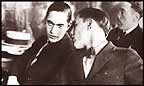
Leopold & Loeb-- saved by stereotype?
|
 |
Jewish culture in a gay light
By
Michael Bronski
Queer Theory and the Jewish Question
Edited by Daniel Boyarin, Daniel
Itzkovitz, & Ann Pellegrini
Columbia University Press
How to order
Thirty years ago the idea of gay and lesbian studies was flamingly bright imagine (we barely could) an actual, formal, study of how gay men and lesbians lived their lives, how their history was shaped, how they fit into the world. But once we got past the rudimentary questions
and the easy thrill of "outing" homosexuals from history, gay studies grew dull. But soon, roaring down the academic tracks from a roughly Frenchward direction, came the screaming locomotive of Queer Theory the ideas of social constructionists such as Michel Foucault, Jacques
Lacan, and other French and Americans who saw like quantum mechanics to Newtonian physics the world in radically more unstable terms. The nature (and accepted social value) of identities such as "homosexual," "heterosexual," "man," and "woman" were it was declared far
more dependent on vagaries of societal norms rather then any innate "quality." As Simone de Beauvoir wrote in
The Second Sex, "women are not born, but made."
But as exciting as all this queer theory was (and is), it too has limits. With a few exceptions in the past decade I'd cite Ann Pelligrini's and Janet Jakobsen's
Love the Sin: Sexual Regulation and the Limits of Religious
Tolerance, Judith Halberstam's Female
Masculinity, and Carolyn Dinshaw's Getting
Medieval the original excitement of queer theory has faded. This is, in part, because any "new" theory becomes familiar, and also because as queer theory got popularized it became overused and predictable.
The publication of Queer Theory and the Jewish
Question is reason to get excited all over again. Partly it's that this collection of 16 essays isn't specifically about "gay" themes. The idea here isn't to "out" queer jews (or Jewish queers) or to make overly exact historical
parallels between homophobia and anti-Semitism, but to "explore the relays" between how queerness and Jewishness are put together. Queer theory has never been consigned only to homosexual topics or subjects (though it's usually ended up there), but this collection feels far
more uninhibited than most recent books in the field. "Jewishness" as vague and wide-open a term as "queer" turns out the perfect counterpart for a queer-theoretical treatment.
Many amazing neat, and not so neat, correspondences get explored here. Paul Franklin's "Jew Boys and Queer Boys" looks at the notorious 1924 Leopold and Loeb case, and shows how the social and psychological standards of the time were conflated to help both
"experts" and the "general population" understand how the two young men could murder a boy. The irony here is that once their disease "Jewish homosexuality" could be named, it also allowed them to plead insanity and avoid the death penalty.
Naomi Seidman's "The Ghost of Queer Loves Past: Ansky's 'Dybbik' and the Sexual Transformation of the Ashkenaz" is a great exploration of
gender-bending and sexual "deviance" in the famous Yiddish play (recently rewritten by Tony Kushner), as well as the idea of
sexual liminality in eastern European Jewish culture.
These themes are taken up in Michael Moon's "Tragedy and Trash: Yiddish Theater and Queer Theater" in which he looks specifically at the works of those great gay stage writers of the 1980s, Charles Ludlam and Ethyl Eichelberger.
Barbra Streisand gets analyzed in Stacy Wolf's "Barbra's 'Funny Girl' Body." The connections between Streisand's camp sensibility, her unrepentant Jewishness, her gay following, and her stark determination in both the character of Fanny Brice in
Funny Girl and in the character of Barbra Streisand are wittily brought together.
Queer Theory and the Jewish
Question juggles theoretical concerns with popular culture and never condescends. But more than that, the book makes reading serious essays about homosexuality fun again. And that's saying a lot.
| Author Profile: Michael Bronski |
|
Michael Bronski is the author of
Culture Clash: The Making of Gay
Sensibility and The Pleasure
Principle: Sex, Backlash, and the
Struggle for Gay Freedom. He writes
frequently on sex, books, movies, and
culture, and lives in Cambridge,
Massachusetts. |
| Email: |
mabronski@aol.com |
You are not logged in.
No comments yet, but
click here to be the first to comment on this
Book Review!
|